




Draw diagrams of typical monocot and dicot leaves to show their venation pattern
Answer
 Verified
541.5k+ views
Hint: The flowering plants have been divided into two major groups called: the Dicots and the Monocots. Dicots have two cotyledons and monocots and one single cotyledon. It is a classification of angiosperms.
Complete answer:
The plant’s on the basis of the number of cotyledons present are divided into monocot and dicot.
Major morphological differences between monocots and dicots-
A number of cotyledons: The number of cotyledons found in the embryo is the actual basis for distinguishing the two classes of angiosperms, and is the source of the names Monocotyledonae i.e one cotyledon and Dicotyledonae i.e two cotyledons. The cotyledons actually are the "seed leaves" produced by the embryo. They serve to provide nutrition. An example of monocot is maize, and dicot is the gram.
Pollen structure: The monocots had pollen with a single furrow or pore through the outer layer (monosulcate), but most dicots are descended from a plant that developed three furrows or pores in its pollen (triporate).
Leaf veins: In monocots, there are usually a number of major leaf veins which run parallel to the length of the leaf whereas, in dicots, there are usually numerous Auxillary veins that reticulate between the major ones.
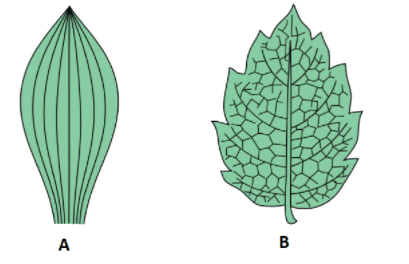
Thus, A- Monocot leaves(Parallel venation) B- Dicot leaves(Reticulate venation)
Note: Monocot plants mostly have fibrous root system. All the plants of the grass family belong to the monocot. Number of flower parts - If you count the number of petals, stamens, or other floral parts, in monocot flowers tend to have a number of parts that is divisible by three, usually three or six. Dicot flowers on the have parts in multiples of four or five (four, five, ten, etc.).
Complete answer:
The plant’s on the basis of the number of cotyledons present are divided into monocot and dicot.
Major morphological differences between monocots and dicots-
A number of cotyledons: The number of cotyledons found in the embryo is the actual basis for distinguishing the two classes of angiosperms, and is the source of the names Monocotyledonae i.e one cotyledon and Dicotyledonae i.e two cotyledons. The cotyledons actually are the "seed leaves" produced by the embryo. They serve to provide nutrition. An example of monocot is maize, and dicot is the gram.
Pollen structure: The monocots had pollen with a single furrow or pore through the outer layer (monosulcate), but most dicots are descended from a plant that developed three furrows or pores in its pollen (triporate).
Leaf veins: In monocots, there are usually a number of major leaf veins which run parallel to the length of the leaf whereas, in dicots, there are usually numerous Auxillary veins that reticulate between the major ones.
Thus, A- Monocot leaves(Parallel venation) B- Dicot leaves(Reticulate venation)
Note: Monocot plants mostly have fibrous root system. All the plants of the grass family belong to the monocot. Number of flower parts - If you count the number of petals, stamens, or other floral parts, in monocot flowers tend to have a number of parts that is divisible by three, usually three or six. Dicot flowers on the have parts in multiples of four or five (four, five, ten, etc.).
Recently Updated Pages
Master Class 10 English: Engaging Questions & Answers for Success

Master Class 10 Social Science: Engaging Questions & Answers for Success
Master Class 10 Computer Science: Engaging Questions & Answers for Success
Class 10 Question and Answer - Your Ultimate Solutions Guide
Master Class 10 General Knowledge: Engaging Questions & Answers for Success
Master Class 10 Maths: Engaging Questions & Answers for Success
Trending doubts
One Metric ton is equal to kg A 10000 B 1000 C 100 class 11 physics CBSE
Difference Between Prokaryotic Cells and Eukaryotic Cells
How many of the following diseases can be studied with class 11 biology CBSE
Two of the body parts which do not appear in MRI are class 11 biology CBSE
Which of the following enzymes is used for carboxylation class 11 biology CBSE
Explain zero factorial class 11 maths CBSE