




Draw block diagram of
A. Communication system
B. Production of AM waves
C. Transmitter
D. Receiver
Answer
 Verified
573k+ views
Hint :A communication system consists of mainly five blocks that include information source, transmitter, channel, receiver and destination. The information for a source is first passed into the information source where it is converted into a message signal. Then it passes into a transmitter where the message signal is amplified and passed to the receiver via channel. The receiver receives the message signal and converts it into its original form.
Complete Step By Step Answer:
The figure below shows the block diagram of a basic communication system.
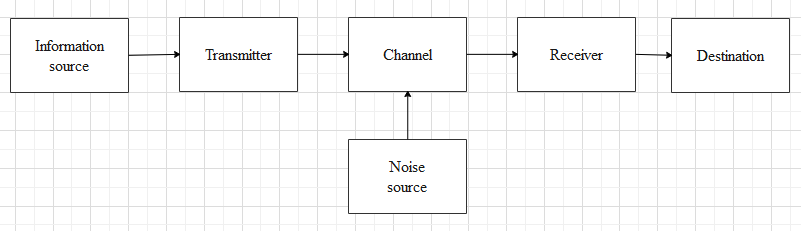
A communication system consists mainly of five blocks that include information source, transmitter, channel, receiver and destination.
In a communication system, the first thing that we need is information generated from a source, which we want to transfer from one end to another. The information source converts the original information into a physical quantity that can be transferred. This physical quantity is called a message signal.
Then the message signal passes into the transmitter. A transmitter collects the message signal and may modify it into a suitable form if needed and then transmits to the receiver via the chosen channel. Channel is a physical medium that connects the transmitter and the receiver. For example cables and wires.
Then the message signal is received by the receiver, which converts the message signal into its original non-electric form. Then this information is passed to the destination where the data is interpreted.
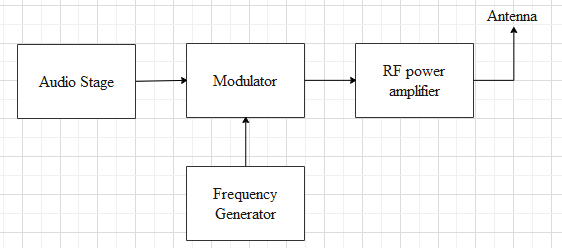
Block diagram of a transmitter and AM waves:
Block diagram of a receiver:

Note :
Sometimes, the input source information can be transferred in its original form. Therefore, the transmitter modifies the message signal by amplifying it. This step is called amplitude modulation.
When the message signal passes through the channel, many unwanted signals (termed as noise) superimpose with the message signal. This is corrected by the receiver.
Complete Step By Step Answer:
The figure below shows the block diagram of a basic communication system.
A communication system consists mainly of five blocks that include information source, transmitter, channel, receiver and destination.
In a communication system, the first thing that we need is information generated from a source, which we want to transfer from one end to another. The information source converts the original information into a physical quantity that can be transferred. This physical quantity is called a message signal.
Then the message signal passes into the transmitter. A transmitter collects the message signal and may modify it into a suitable form if needed and then transmits to the receiver via the chosen channel. Channel is a physical medium that connects the transmitter and the receiver. For example cables and wires.
Then the message signal is received by the receiver, which converts the message signal into its original non-electric form. Then this information is passed to the destination where the data is interpreted.
Block diagram of a transmitter and AM waves:
Block diagram of a receiver:
Note :
Sometimes, the input source information can be transferred in its original form. Therefore, the transmitter modifies the message signal by amplifying it. This step is called amplitude modulation.
When the message signal passes through the channel, many unwanted signals (termed as noise) superimpose with the message signal. This is corrected by the receiver.
Recently Updated Pages
Master Class 12 Business Studies: Engaging Questions & Answers for Success

Master Class 12 Chemistry: Engaging Questions & Answers for Success
Master Class 12 Biology: Engaging Questions & Answers for Success
Class 12 Question and Answer - Your Ultimate Solutions Guide
Master Class 11 Social Science: Engaging Questions & Answers for Success
Master Class 11 Chemistry: Engaging Questions & Answers for Success
Trending doubts
Which are the Top 10 Largest Countries of the World?
Draw a labelled sketch of the human eye class 12 physics CBSE
Name the crygenes that control cotton bollworm and class 12 biology CBSE
Differentiate between homogeneous and heterogeneous class 12 chemistry CBSE
Ribosomal RNA is actively synthesised in A Nucleoplasm class 12 biology CBSE
How many molecules of ATP and NADPH are required information class 12 biology CBSE