




How do you draw an equilateral triangle without a compass?
Answer
 Verified
594.6k+ views
Hint: We recall the definition and shape of equilateral triangle. We draw equilateral triangles without a compass using calibrated scale with measurements and a protractor. We first draw one side $BC$ and we draw angle $\angle CBX={{60}^{\circ }},\angle BCY={{60}^{\circ }}$. We denote the point of intersection of $\overrightarrow{BX},\overrightarrow{CY}$ as A.
Complete step by step answer:
A triangle is a polygon with three sides and three vertices otherwise known 3-gon. If we denote the vertices of any triangle as A, B, C then its sides are denote as $\overline{AB},\overline{BC},\overline{AC}$ and length of the sides are denoted as $AB,BC,AC$. If lengths of all sides of a triangle are equal we call the triangle equilateral. If $\Delta ABC$ is an equilateral triangle then we have;
\[AB=BC=AC\]
We also know that the interior angles of the equilateral triangle is ${{60}^{\circ }}$. So we have
\[\angle ABC=\angle ACB=\angle BAC={{60}^{\circ }}\]
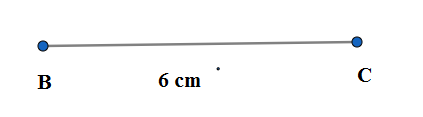
If we want to draw equilateral triangles without a compass we need a calibrated scale and protractor. We draw the one side say $BC=6$ cm with a scale.
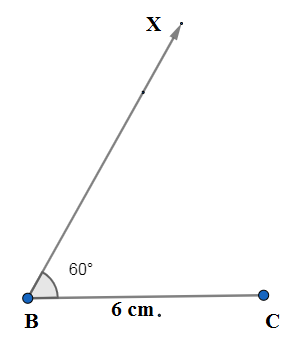
We draw $\angle CBX={{60}^{\circ }}$ with a protractor.
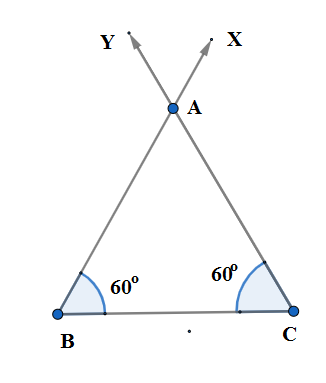
We draw $\angle BCY={{60}^{\circ }}$ with the protractor and denote the point of intersection as $A$.
Note:
We can measure the lengths of the sides $AB=AC=6$cm to verify our construction. We can also construct using the perpendicular bisector of $BC$. We should try to use compasses for accurate construction. If lengths of any two sides are equal we call the triangle isosceles triangle which means one of $AB=BC,BC=AC,AB=AC$ in triangle ABC is true. If the lengths of the triangle are not equal to each other which means $AB\ne BC\ne AC$ then it is called a scalene triangle.
Complete step by step answer:
A triangle is a polygon with three sides and three vertices otherwise known 3-gon. If we denote the vertices of any triangle as A, B, C then its sides are denote as $\overline{AB},\overline{BC},\overline{AC}$ and length of the sides are denoted as $AB,BC,AC$. If lengths of all sides of a triangle are equal we call the triangle equilateral. If $\Delta ABC$ is an equilateral triangle then we have;
\[AB=BC=AC\]
We also know that the interior angles of the equilateral triangle is ${{60}^{\circ }}$. So we have
\[\angle ABC=\angle ACB=\angle BAC={{60}^{\circ }}\]
If we want to draw equilateral triangles without a compass we need a calibrated scale and protractor. We draw the one side say $BC=6$ cm with a scale.
We draw $\angle CBX={{60}^{\circ }}$ with a protractor.
We draw $\angle BCY={{60}^{\circ }}$ with the protractor and denote the point of intersection as $A$.
Note:
We can measure the lengths of the sides $AB=AC=6$cm to verify our construction. We can also construct using the perpendicular bisector of $BC$. We should try to use compasses for accurate construction. If lengths of any two sides are equal we call the triangle isosceles triangle which means one of $AB=BC,BC=AC,AB=AC$ in triangle ABC is true. If the lengths of the triangle are not equal to each other which means $AB\ne BC\ne AC$ then it is called a scalene triangle.
Recently Updated Pages
Master Class 11 English: Engaging Questions & Answers for Success

Master Class 11 Social Science: Engaging Questions & Answers for Success
Master Class 11 Maths: Engaging Questions & Answers for Success
Master Class 11 Biology: Engaging Questions & Answers for Success
Master Class 11 Physics: Engaging Questions & Answers for Success
Master Class 11 Chemistry: Engaging Questions & Answers for Success
Trending doubts
Explain the Treaty of Vienna of 1815 class 10 social science CBSE
What is the full form of CNG A Complete Natural Gas class 10 social science CBSE
In cricket, what is a "Yorker" designed to do?
What is the full form of POSCO class 10 social science CBSE
Define Potential, Developed, Stock and Reserved resources
What were the majoritarian measures taken in Sri Lanka class 10 social science CBSE