




Draw a velocity-time graph for a uniform accelerated motion. What does its slope depict?
Answer
 Verified
623.4k+ views
Hint: Use relation between acceleration, velocity and time to find the nature of the graph. The Velocity-time graph gives acceleration as slope. In non-uniform motion acceleration changes, eventually slope changes. The slope is either increasing or decreasing. While, in uniform motion, the acceleration remains constant, thus slope remains the same.
Complete solution:
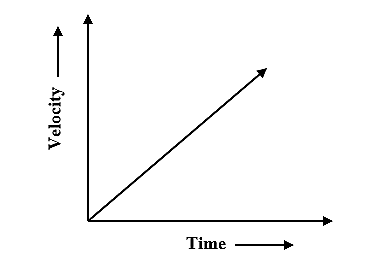
The velocity-time graph for a uniform accelerated motion is shown below.
We know formula for acceleration is given by,
$a=\dfrac {v}{ t }$
where,
a: Acceleration
v: Velocity
t : Time
From the above equation, it can be understood that the slope calculated from the velocity-time graph gives acceleration. Thus, the velocity-time graph of a uniformly accelerated motion is a straight line graph inclining towards the time axis on the X-axis. If the body is moving with a positive constant acceleration then the graph slopes upward. In case, if the body is moving with negative constant acceleration then the graph slopes downward.
Additional Information:
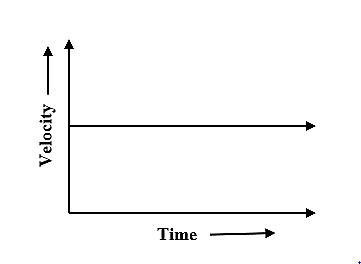
If the acceleration of the body is zero then the slope of the graph will also be zero. Then, the graph will just be a straight horizontal line with zero slope. Such a motion is known as uniform motion with zero acceleration. The graph for zero acceleration is shown below.
Note:
Students must not confuse between the nature of the graph for a uniform accelerated motion and non-uniform accelerated motion. The velocity-time graph for uniform accelerated motion is a straight line. Whereas, for non-uniform accelerated motion it gives a curved line. If we draw a distance versus time graph, it will show the same nature of graph for uniform motion and non-uniform motion as it is in velocity versus time graph.
Complete solution:
The velocity-time graph for a uniform accelerated motion is shown below.
We know formula for acceleration is given by,
$a=\dfrac {v}{ t }$
where,
a: Acceleration
v: Velocity
t : Time
From the above equation, it can be understood that the slope calculated from the velocity-time graph gives acceleration. Thus, the velocity-time graph of a uniformly accelerated motion is a straight line graph inclining towards the time axis on the X-axis. If the body is moving with a positive constant acceleration then the graph slopes upward. In case, if the body is moving with negative constant acceleration then the graph slopes downward.
Additional Information:
If the acceleration of the body is zero then the slope of the graph will also be zero. Then, the graph will just be a straight horizontal line with zero slope. Such a motion is known as uniform motion with zero acceleration. The graph for zero acceleration is shown below.
Note:
Students must not confuse between the nature of the graph for a uniform accelerated motion and non-uniform accelerated motion. The velocity-time graph for uniform accelerated motion is a straight line. Whereas, for non-uniform accelerated motion it gives a curved line. If we draw a distance versus time graph, it will show the same nature of graph for uniform motion and non-uniform motion as it is in velocity versus time graph.
Recently Updated Pages
Onehalf of a convex lens is covered with a black paper class 12 physics CBSE

Differentiate between lanthanoids and actinoids class 12 chemistry CBSE
An object 5 cm in length is held 25 cm away from a class 12 physics CBSE
Name the following halides according to the IUPAC system class 12 chemistry CBSE
An infinite ladder network of resistances is constructed class 12 physics CBSE
How will you bring about the following conversions class 12 chemistry CBSE
Trending doubts
Draw a labelled sketch of the human eye class 12 physics CBSE
Which are the Top 10 Largest Countries of the World?
Draw ray diagrams each showing i myopic eye and ii class 12 physics CBSE
Which is the correct genotypic ratio of mendel dihybrid class 12 biology CBSE
Differentiate between homogeneous and heterogeneous class 12 chemistry CBSE
What is the Full Form of PVC, PET, HDPE, LDPE, PP and PS ?