




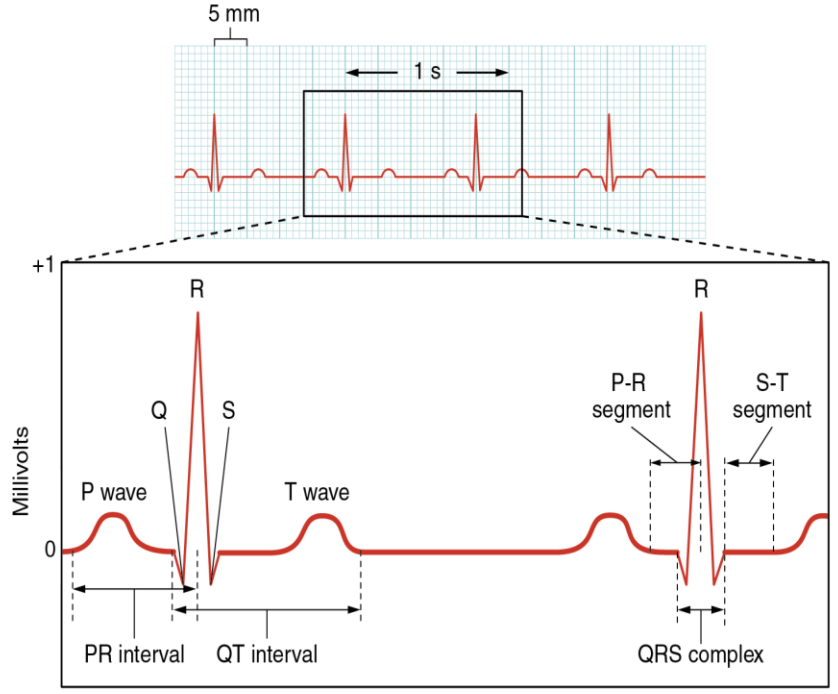
Draw a standard ECG and explain the different segments in it.
Answer
 Verified
592.5k+ views
Hint: ECG stands for Electrocardiogram. Dutch physiologist Willem Einthoven developed the first electrocardiogram in 1903. It is a graphic tracing of the electrical impulses generated by the muscles of the heart during a heartbeat.
Complete answer:
The electrical impulses produced by the heart are recorded by the electrocardiograph. It provides information regarding the condition and performance of the heart.
Segments of the electrocardiogram-
1. The normal ECG graph shows upward and downward deflections that shows the alternate contraction of upper two chambers and the lower two chambers called the auricles and the ventricles.
2. The atrial contraction leads to first upward deflection called the “P” called the atrial complex.
3. The action of ventricles leads to deflections “Q, R, S, T” called the ventricular complexes.
4. Any deviation from the normal pattern in ECG graph indicates heart disorders.
5. The normal PR interval is 120- 200 milliseconds.
6. The normal QT interval is 400-440 milliseconds.
7. The prolonged QT interval leads to lower heart rates.
Uses of Electrocardiogram:
- It is used to diagnose cardiac arrhythmias, myocardial infarctions, pericardial disease, and cardiac enlargement.
- Hypertension, thyroid disease and certain malnutrition can also be diagnosed by ECG.
- It is also used to diagnose a heart blockage.
Note: Electrocardiograms are generated by applying electrodes in different parts of the body including the limbs, chest. These electrodes record the electrical activity of the heart. The ECGs are standardised so that they can be compared from person to person.
Complete answer:
The electrical impulses produced by the heart are recorded by the electrocardiograph. It provides information regarding the condition and performance of the heart.
Segments of the electrocardiogram-
1. The normal ECG graph shows upward and downward deflections that shows the alternate contraction of upper two chambers and the lower two chambers called the auricles and the ventricles.
2. The atrial contraction leads to first upward deflection called the “P” called the atrial complex.
3. The action of ventricles leads to deflections “Q, R, S, T” called the ventricular complexes.
4. Any deviation from the normal pattern in ECG graph indicates heart disorders.
5. The normal PR interval is 120- 200 milliseconds.
6. The normal QT interval is 400-440 milliseconds.
7. The prolonged QT interval leads to lower heart rates.
Uses of Electrocardiogram:
- It is used to diagnose cardiac arrhythmias, myocardial infarctions, pericardial disease, and cardiac enlargement.
- Hypertension, thyroid disease and certain malnutrition can also be diagnosed by ECG.
- It is also used to diagnose a heart blockage.
Note: Electrocardiograms are generated by applying electrodes in different parts of the body including the limbs, chest. These electrodes record the electrical activity of the heart. The ECGs are standardised so that they can be compared from person to person.
Recently Updated Pages
Master Class 12 Economics: Engaging Questions & Answers for Success

Master Class 12 English: Engaging Questions & Answers for Success
Master Class 12 Social Science: Engaging Questions & Answers for Success
Master Class 12 Maths: Engaging Questions & Answers for Success
Master Class 12 Physics: Engaging Questions & Answers for Success
Master Class 10 English: Engaging Questions & Answers for Success
Trending doubts
Explain the Treaty of Vienna of 1815 class 10 social science CBSE
Why is it 530 pm in india when it is 1200 afternoon class 10 social science CBSE
What is the full form of POSCO class 10 social science CBSE
Define Potential, Developed, Stock and Reserved resources
Which Country Has the Largest Border with India?
Choose the feminine form of the given noun Fox AFoxess class 10 english CBSE