




Draw a sketch that shows the standing waves pattern.
Answer
 Verified
616.2k+ views
Hint:Draw the wave pattern of a standing wave. Discuss about the node, antinode and relation between a fixed string length with the wavelength of the vibrating string. Explain about the region where the disturbances are maximum and minimum.
Complete step by step solution:
Standing wave pattern is a vibrational pattern created within a medium when the vibrational frequency of the source causes reflected waves from one end of the medium to interfere with incident waves from the source. Basically standing wave when the wave does not propagate, just sits there vibrating up and down in a fixed place.
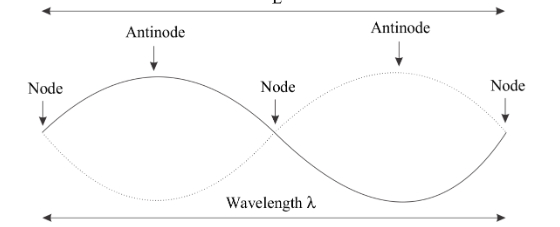
Standing waves remain fixed in a place, but they have regions where the amplitude of the wave is very small, almost zero. These locations are called nodes. These points in the wave pattern appear to be standing still. Nodes are sometimes described as points of no displacement.
There are also regions where the disturbance is maximum, greater than anywhere else in the medium, called antinodes.
Standing wave patterns are always expressed with an alternating pattern of nodes and antinodes.
For a standing wave on a string of length $L$ with two fixed ends is $L = \dfrac{{n\lambda }}{2}$ where $n = 1,2,3 \cdot \cdot \cdot $
Note:Standing waves can be formed under various conditions, but they are easily demonstrated in a finite or bounded medium. Any system of standing waves can produce various natural frequencies. The lowest frequency of a standing wave having least number of nodes and antinodes is called fundamental frequency.
Complete step by step solution:
Standing wave pattern is a vibrational pattern created within a medium when the vibrational frequency of the source causes reflected waves from one end of the medium to interfere with incident waves from the source. Basically standing wave when the wave does not propagate, just sits there vibrating up and down in a fixed place.
Standing waves remain fixed in a place, but they have regions where the amplitude of the wave is very small, almost zero. These locations are called nodes. These points in the wave pattern appear to be standing still. Nodes are sometimes described as points of no displacement.
There are also regions where the disturbance is maximum, greater than anywhere else in the medium, called antinodes.
Standing wave patterns are always expressed with an alternating pattern of nodes and antinodes.
For a standing wave on a string of length $L$ with two fixed ends is $L = \dfrac{{n\lambda }}{2}$ where $n = 1,2,3 \cdot \cdot \cdot $
Note:Standing waves can be formed under various conditions, but they are easily demonstrated in a finite or bounded medium. Any system of standing waves can produce various natural frequencies. The lowest frequency of a standing wave having least number of nodes and antinodes is called fundamental frequency.
Recently Updated Pages
Master Class 12 Economics: Engaging Questions & Answers for Success

Master Class 12 English: Engaging Questions & Answers for Success
Master Class 12 Social Science: Engaging Questions & Answers for Success
Master Class 12 Maths: Engaging Questions & Answers for Success
Master Class 12 Physics: Engaging Questions & Answers for Success
Master Class 9 General Knowledge: Engaging Questions & Answers for Success
Trending doubts
One Metric ton is equal to kg A 10000 B 1000 C 100 class 11 physics CBSE
Difference Between Prokaryotic Cells and Eukaryotic Cells
Two of the body parts which do not appear in MRI are class 11 biology CBSE
1 ton equals to A 100 kg B 1000 kg C 10 kg D 10000 class 11 physics CBSE
Draw a diagram of nephron and explain its structur class 11 biology CBSE
10 examples of friction in our daily life