




Draw a sectional view of the human heart and label the aorta, right ventricle and veins.
Answer
 Verified
651k+ views
Hint: Heart is the pumping organ which is used to circulate the blood to all parts of the body. It is connected by blood vessels.
Complete answer:
Heart is a muscular organ. The size of the heart is of fist. It is located behind and to the left of the breast bone. It is connected with blood vessels. It pumps the blood from the heart to body parts and also receives from the body parts.
Blood vessels are arteries and veins.
Artery: It carries blood from the heart to body parts. There are two types:
Pulmonary artery: Pulmonary artery carries deoxygenated blood from the right ventricles of heart to the lungs.
Aorta: It carries oxygenated blood from the heart to different parts of the body.
Veins carry blood from the body parts to the heart. These are of two types:
Pulmonary veins: It carries oxygenated blood from the lungs to the left atrium of the heart.
Vena cava: It carries deoxygenated blood from the different parts of the body to the heart.
Heart consists of:
Atrium: It receives the blood from the body parts. It consists of two types: Right atrium and left atrium.
Ventricle: It transports the blood from the heart to all parts of the body. It consists of two types: Right ventricle and left ventricle.
Please look in the image for labelling:
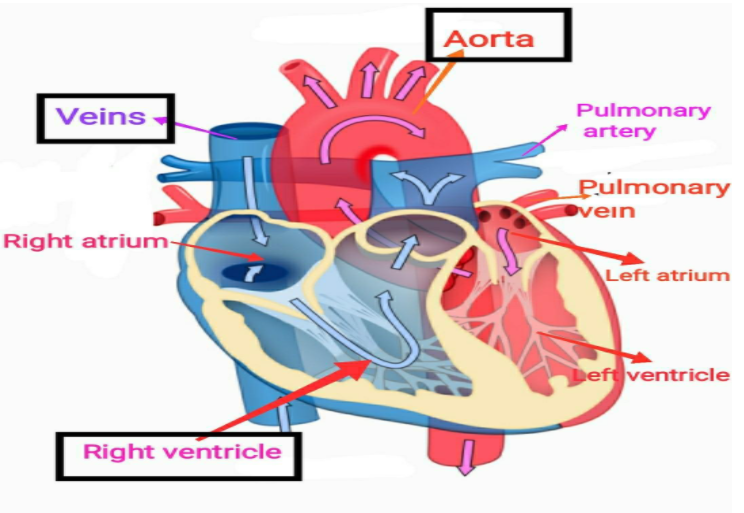
The right ventricle, aorta and vein is encircled in a black box.
Note:
Heart is responsible for pumping the blood to different parts of the body. The blood transports the oxygen to the tissue of the body. It also provides the nutrient to the body. It excretes carbon dioxide from the tissue to the lungs.
Complete answer:
Heart is a muscular organ. The size of the heart is of fist. It is located behind and to the left of the breast bone. It is connected with blood vessels. It pumps the blood from the heart to body parts and also receives from the body parts.
Blood vessels are arteries and veins.
Artery: It carries blood from the heart to body parts. There are two types:
Pulmonary artery: Pulmonary artery carries deoxygenated blood from the right ventricles of heart to the lungs.
Aorta: It carries oxygenated blood from the heart to different parts of the body.
Veins carry blood from the body parts to the heart. These are of two types:
Pulmonary veins: It carries oxygenated blood from the lungs to the left atrium of the heart.
Vena cava: It carries deoxygenated blood from the different parts of the body to the heart.
Heart consists of:
Atrium: It receives the blood from the body parts. It consists of two types: Right atrium and left atrium.
Ventricle: It transports the blood from the heart to all parts of the body. It consists of two types: Right ventricle and left ventricle.
Please look in the image for labelling:
The right ventricle, aorta and vein is encircled in a black box.
Note:
Heart is responsible for pumping the blood to different parts of the body. The blood transports the oxygen to the tissue of the body. It also provides the nutrient to the body. It excretes carbon dioxide from the tissue to the lungs.
Recently Updated Pages
Master Class 11 Social Science: Engaging Questions & Answers for Success

Master Class 11 English: Engaging Questions & Answers for Success
Master Class 11 Accountancy: Engaging Questions & Answers for Success
Master Class 11 Physics: Engaging Questions & Answers for Success
Master Class 11 Computer Science: Engaging Questions & Answers for Success
Master Class 11 Business Studies: Engaging Questions & Answers for Success
Trending doubts
Find the value of the expression given below sin 30circ class 11 maths CBSE
One Metric ton is equal to kg A 10000 B 1000 C 100 class 11 physics CBSE
Draw a diagram of nephron and explain its structur class 11 biology CBSE
10 examples of friction in our daily life
Proton was discovered by A Thomson B Rutherford C Chadwick class 11 chemistry CBSE
The teeth used for biting and cutting food are called class 11 biology CBSE