




Draw a schematic representation of transport and exchange of oxygen and carbon dioxide in the human body.
Answer
 Verified
630k+ views
Hint:The human body requires oxygen for the process of respiration, it uses up oxygen and in turn produces carbon dioxide that needs to be expelled out of the body.
Complete answer:
The oxygen which is present in the air is inhaled by humans after which it reaches the alveoli of the lungs. Alveoli are very small balloon-like structures that are connected to a network of blood capillaries where the exchange of gases takes place. The oxygen after reaching the alveoli diffuses out into the surrounding capillaries from where it is transported to the entire body. Oxygen can be transported either in the dissolved form or in combination with hemoglobin. In contrast carbon dioxide is brought to the capillaries of the lungs from the body. The form in which carbon dioxide can be transported in dissolved form, as carbaminohemoglobin and as bicarbonate. After they reach the capillary they diffuse to the alveoli from where it is expelled out of the body. The diffusion of oxygen into the capillary and diffusion of carbon dioxide from the capillarity to the alveoli occurs simultaneously and thus is called exchange of gases. The schematic representation of the transport and exchange of oxygen and carbon dioxide is given in the following diagram.
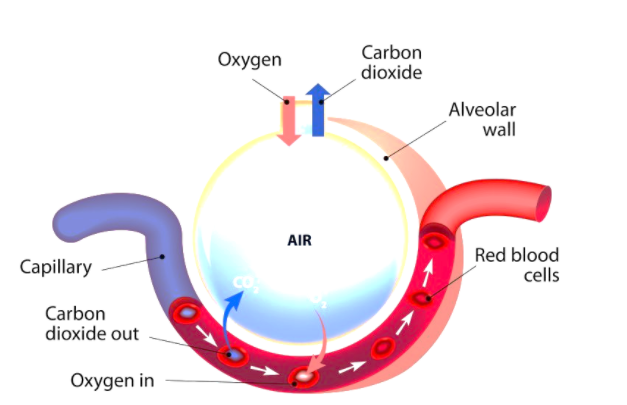
Note:The process of exchange and transport of oxygen and carbon dioxide is of great importance since it helps the oxygen to reach cells where it is needed for various biochemical reactions and also removes carbon dioxide from the body which in higher amounts is toxic.
Complete answer:
The oxygen which is present in the air is inhaled by humans after which it reaches the alveoli of the lungs. Alveoli are very small balloon-like structures that are connected to a network of blood capillaries where the exchange of gases takes place. The oxygen after reaching the alveoli diffuses out into the surrounding capillaries from where it is transported to the entire body. Oxygen can be transported either in the dissolved form or in combination with hemoglobin. In contrast carbon dioxide is brought to the capillaries of the lungs from the body. The form in which carbon dioxide can be transported in dissolved form, as carbaminohemoglobin and as bicarbonate. After they reach the capillary they diffuse to the alveoli from where it is expelled out of the body. The diffusion of oxygen into the capillary and diffusion of carbon dioxide from the capillarity to the alveoli occurs simultaneously and thus is called exchange of gases. The schematic representation of the transport and exchange of oxygen and carbon dioxide is given in the following diagram.
Note:The process of exchange and transport of oxygen and carbon dioxide is of great importance since it helps the oxygen to reach cells where it is needed for various biochemical reactions and also removes carbon dioxide from the body which in higher amounts is toxic.
Recently Updated Pages
Basicity of sulphurous acid and sulphuric acid are

Master Class 11 English: Engaging Questions & Answers for Success
Master Class 11 Physics: Engaging Questions & Answers for Success
Master Class 11 Computer Science: Engaging Questions & Answers for Success
Master Class 11 Chemistry: Engaging Questions & Answers for Success
Master Class 11 Social Science: Engaging Questions & Answers for Success
Trending doubts
Difference Between Prokaryotic Cells and Eukaryotic Cells
One Metric ton is equal to kg A 10000 B 1000 C 100 class 11 physics CBSE
Two of the body parts which do not appear in MRI are class 11 biology CBSE
Draw a diagram of nephron and explain its structur class 11 biology CBSE
10 examples of friction in our daily life
What will happen if the mucus is not secreted by the class 11 biology CBSE