




Draw a real velocity versus time graph for Mars.
Answer
 Verified
569.1k+ views
Hint: According to Kepler’s second law of planetary motion; the areal velocity of the planet remains constant. Recall the expression for Kepler’s second law of planetary motion. Mars or every planet in the solar system orbits at higher speed when it is closest to the sun and it orbits at lower speed when it is farthest from the sun. therefore, the angular momentum remains constant.
Complete answer:
The answer of the question is based on Kepler’s second law of planetary motion.We have according to Kepler’s second law of planetary motion; the areal velocity of the planet remains constant. That is the imaginary line joining the planet to the sun sweeps out equal areas in equal intervals of time. We have the expression for the Kepler’s second law of planetary motion,
\[\dfrac{{dA}}{{dt}} = \dfrac{L}{{2m}}\]
Here, \[\dfrac{{dA}}{{dt}}\] is the rate of change of area, L is the angular momentum and m is the mass of Mars.
We know that the angular momentum is the product of radius of circular motion and the linear or orbital velocity of the planet. Therefore,
\[L = \vec r \times \vec v\]
As we know, Mars or every planet in the solar system orbits at higher speed when it is closest to the sun and it orbits at lower speed when it is farthest from the sun. Therefore, the product \[\vec r \times \vec v\] remains the same. Thus, the angular momentum of the planet around the sun remains constant.
So, we can say that the areal velocity \[\dfrac{{dA}}{{dt}}\] does not change with time t and therefore, the graph between areal velocity and time will be parallel to the time axis as shown in the figure below.
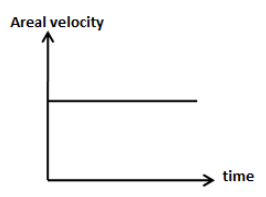
Note:Students don’t need to stretch the answer towards the angular momentum of the planet. The areal velocity remains constant means \[\dfrac{{dA}}{{dt}} = {\text{constant}}\]. Therefore, students can easily interpret that the areal velocity versus time graph shows no change in areal velocity with respect to time t.
Complete answer:
The answer of the question is based on Kepler’s second law of planetary motion.We have according to Kepler’s second law of planetary motion; the areal velocity of the planet remains constant. That is the imaginary line joining the planet to the sun sweeps out equal areas in equal intervals of time. We have the expression for the Kepler’s second law of planetary motion,
\[\dfrac{{dA}}{{dt}} = \dfrac{L}{{2m}}\]
Here, \[\dfrac{{dA}}{{dt}}\] is the rate of change of area, L is the angular momentum and m is the mass of Mars.
We know that the angular momentum is the product of radius of circular motion and the linear or orbital velocity of the planet. Therefore,
\[L = \vec r \times \vec v\]
As we know, Mars or every planet in the solar system orbits at higher speed when it is closest to the sun and it orbits at lower speed when it is farthest from the sun. Therefore, the product \[\vec r \times \vec v\] remains the same. Thus, the angular momentum of the planet around the sun remains constant.
So, we can say that the areal velocity \[\dfrac{{dA}}{{dt}}\] does not change with time t and therefore, the graph between areal velocity and time will be parallel to the time axis as shown in the figure below.
Note:Students don’t need to stretch the answer towards the angular momentum of the planet. The areal velocity remains constant means \[\dfrac{{dA}}{{dt}} = {\text{constant}}\]. Therefore, students can easily interpret that the areal velocity versus time graph shows no change in areal velocity with respect to time t.
Recently Updated Pages
Basicity of sulphurous acid and sulphuric acid are

Master Class 11 Business Studies: Engaging Questions & Answers for Success
Master Class 11 Computer Science: Engaging Questions & Answers for Success
Master Class 11 Economics: Engaging Questions & Answers for Success
Master Class 11 Social Science: Engaging Questions & Answers for Success
Master Class 11 English: Engaging Questions & Answers for Success
Trending doubts
Name the part of the brain responsible for the precision class 11 biology CBSE
The growth of tendril in pea plants is due to AEffect class 11 biology CBSE
One Metric ton is equal to kg A 10000 B 1000 C 100 class 11 physics CBSE
State and prove Bernoullis theorem class 11 physics CBSE
Actinoid contraction is more than lanthanoid contraction class 11 chemistry CBSE
Which out of the following hydrocarbons undergo addition class 11 chemistry CBSE