




Why do we draw a normal between the reflected ray and the incident ray? What does a normal represent?
Answer
 Verified
529.2k+ views
Hint: In this question, first we will understand all the points i.e., incident ray, reflected ray and the normal and after we will conclude “Why do we draw a normal between the reflected ray and the incident ray?”. And at last, we will know about the laws of reflection.
Complete answer:
Let us consider the below image.
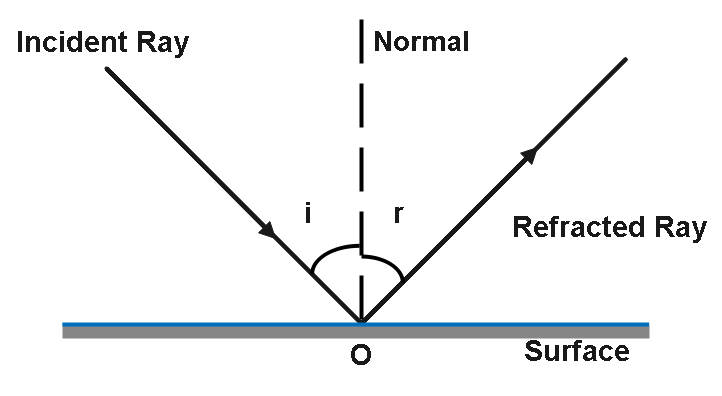
Incident ray: The ray which falls on the surface of a mirror or a smooth surface is known as an incident ray.
Point of incidence: Where the incident ray of lights strikes that surface is known as the point of incidence. In the figure above, the point of incidence is represented by “O”
Normal: We can see on the diagram too that a normal is at \[{90^ \circ }\] which is incident to a surface. And to the surface, the ray is perpendicular or normal. And it is called Normal ray.
Reflected ray: The ray which is sent back by the mirror from the point of incidence is known as a reflected ray.
Angle of incidence: Angle with the incident light with a normal to the surface is known as angle of incidence. In the above figure, the angle of incidence is $i$ .
Angle of reflection: Angle with the reflected light ray with a normal to the surface is known as angle of reflection. In the above figure, the angle of incidence is $r$ .
As we have explained all the term in above now, we will explain Why do we draw a normal between the reflected ray and the incident ray,
We draw a normal ray because it gives us the impression of knowing what happens when the angle of reflection, incidence, and refraction change. We also need the Normal ray because it separates incident and reflected rays into two equal angles, thus we won't be able to measure angles with respect to the surface without it.
Note: Laws of Reflection
Whenever a ray of light reflects from the smooth or a shiny surface, it obeys laws of reflection.
Laws of reflection:
Law 1
The first law of reflection states that the angle of reflection is always equivalent to the angle of incidence. If the incident ray falls on the plane mirror along the normal, i.e., ${90^ \circ }$ , the reflected ray will travel along the same path
Law 2
The incident ray, reflected ray and the normal all lie on the same plane at the same point.
Complete answer:
Let us consider the below image.
Incident ray: The ray which falls on the surface of a mirror or a smooth surface is known as an incident ray.
Point of incidence: Where the incident ray of lights strikes that surface is known as the point of incidence. In the figure above, the point of incidence is represented by “O”
Normal: We can see on the diagram too that a normal is at \[{90^ \circ }\] which is incident to a surface. And to the surface, the ray is perpendicular or normal. And it is called Normal ray.
Reflected ray: The ray which is sent back by the mirror from the point of incidence is known as a reflected ray.
Angle of incidence: Angle with the incident light with a normal to the surface is known as angle of incidence. In the above figure, the angle of incidence is $i$ .
Angle of reflection: Angle with the reflected light ray with a normal to the surface is known as angle of reflection. In the above figure, the angle of incidence is $r$ .
As we have explained all the term in above now, we will explain Why do we draw a normal between the reflected ray and the incident ray,
We draw a normal ray because it gives us the impression of knowing what happens when the angle of reflection, incidence, and refraction change. We also need the Normal ray because it separates incident and reflected rays into two equal angles, thus we won't be able to measure angles with respect to the surface without it.
Note: Laws of Reflection
Whenever a ray of light reflects from the smooth or a shiny surface, it obeys laws of reflection.
Laws of reflection:
Law 1
The first law of reflection states that the angle of reflection is always equivalent to the angle of incidence. If the incident ray falls on the plane mirror along the normal, i.e., ${90^ \circ }$ , the reflected ray will travel along the same path
Law 2
The incident ray, reflected ray and the normal all lie on the same plane at the same point.
Recently Updated Pages
Master Class 11 English: Engaging Questions & Answers for Success

Master Class 11 Social Science: Engaging Questions & Answers for Success
Master Class 11 Maths: Engaging Questions & Answers for Success
Master Class 11 Biology: Engaging Questions & Answers for Success
Master Class 11 Physics: Engaging Questions & Answers for Success
Master Class 11 Chemistry: Engaging Questions & Answers for Success
Trending doubts
One Metric ton is equal to kg A 10000 B 1000 C 100 class 11 physics CBSE
Difference Between Prokaryotic Cells and Eukaryotic Cells
1 ton equals to A 100 kg B 1000 kg C 10 kg D 10000 class 11 physics CBSE
Find the value of the expression given below sin 30circ class 11 maths CBSE
Two of the body parts which do not appear in MRI are class 11 biology CBSE
What are hard magnetic materials class 11 physics CBSE