




Draw a labelled diagram to show the reddish appearance of sun at sunrise and sunset.
Answer
 Verified
614.7k+ views
Hint: In this question, the concept of the refraction of the light depends on the wavelength and different colors have different wavelengths. Use this concept to draw the diagram of the sun during noon and during sunrise and sunset. Then discuss the scattering phenomenon and the role of shorter and longer wavelengths behind the reddish appearance.
Complete step by step answer:
Consider the following diagram of the reddish appearance of sun at sunrise and sunset,
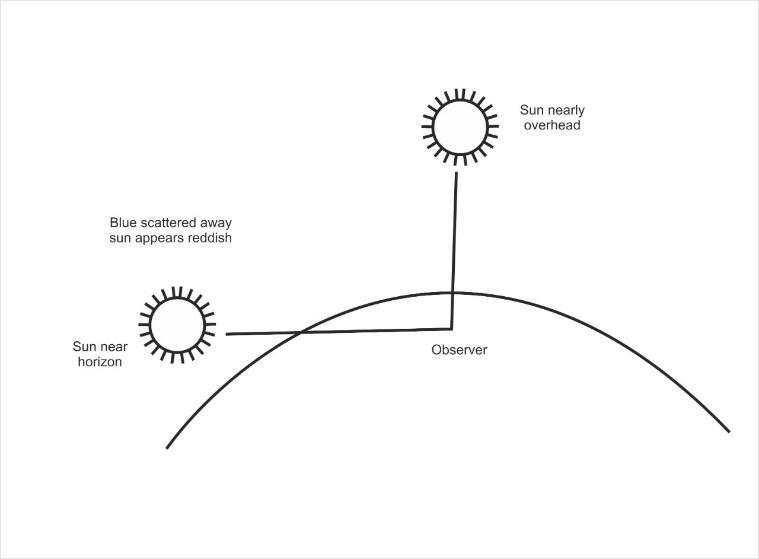
As we know that, the sun generally appears to be white at noon. But at the time of sunrise and sunset it becomes reddish. The main reason behind such appearance is scattering of light. There are various molecules of air and many fine particles are present in the atmosphere. During sunrise and sunset the sun reaches the horizon. So sunlight has to come a longer distance. In longer distance travel the blue light having less wavelength gets scattered in the atmosphere. So, the blue light cannot reach the observers. But as red light has higher wavelength so it gets less scattered in the atmosphere and reaches our eyes. This is the reason that at sunrise and sunset the sky appears to be reddish.
Note: As we know that the blue color light has shorter wavelength, with wavelengths between about 450 and 495 nanometers, so it gets scattered. On the other hand, red color light has longer wavelength, with wavelengths about 620 to 750 nanometers, so it is scattered less as compared to blue color light.
Complete step by step answer:
Consider the following diagram of the reddish appearance of sun at sunrise and sunset,
As we know that, the sun generally appears to be white at noon. But at the time of sunrise and sunset it becomes reddish. The main reason behind such appearance is scattering of light. There are various molecules of air and many fine particles are present in the atmosphere. During sunrise and sunset the sun reaches the horizon. So sunlight has to come a longer distance. In longer distance travel the blue light having less wavelength gets scattered in the atmosphere. So, the blue light cannot reach the observers. But as red light has higher wavelength so it gets less scattered in the atmosphere and reaches our eyes. This is the reason that at sunrise and sunset the sky appears to be reddish.
Note: As we know that the blue color light has shorter wavelength, with wavelengths between about 450 and 495 nanometers, so it gets scattered. On the other hand, red color light has longer wavelength, with wavelengths about 620 to 750 nanometers, so it is scattered less as compared to blue color light.
Recently Updated Pages
Master Class 11 Social Science: Engaging Questions & Answers for Success

Master Class 11 English: Engaging Questions & Answers for Success
Master Class 11 Maths: Engaging Questions & Answers for Success
Master Class 11 Chemistry: Engaging Questions & Answers for Success
Master Class 11 Biology: Engaging Questions & Answers for Success
Class 11 Question and Answer - Your Ultimate Solutions Guide
Trending doubts
Explain the Treaty of Vienna of 1815 class 10 social science CBSE
Why is it 530 pm in india when it is 1200 afternoon class 10 social science CBSE
What is the full form of POSCO class 10 social science CBSE
Define Potential, Developed, Stock and Reserved resources
Which Country Has the Largest Border with India?
Choose the feminine form of the given noun Fox AFoxess class 10 english CBSE