




Draw a labelled diagram to show the components of a reflex arc. Use arrows to indicate the flow of impulse.
Answer
 Verified
617.4k+ views
Hint: An action generated extremely quickly, suddenly, and automatically by the body without thinking against any harmful external stimuli.
Complete answer:
Reflex action is an involuntary action (as there is no conscious control of the brain on it) occurring where there will be an instant response to the external stimuli happens, this action occurs with the help of a neural pathway known as reflex arc, whenever there is an impulse the response happens immediately or suddenly before the impulse reaches the brain.
Components of Reflex action:
-Receptor organ: These receptors are located in important organs mainly sensory types of organs such as eyes, ears, nose, tongues, and integumentary organs. They receive external stimuli from the external environment.
-Sensory neurons: They are afferent neurons that carry stimulus from receptors to the spinal cord.
-Motor neuron: They carry the impulses to effector organs (these organs respond to the stimulus received from motor neurons).
Pathway of reflex action:
Reflex action starts when a stimulus is received by the sensory organs i.e. eyes, ears, etc from the surrounding environment. This stimulus then converts into an electrical impulse which is perceived by the sensory neurons and these neurons carry the signal to the spinal cord via axons. In the spinal cord, these impulses then pass to intermediate neurons. Then stimulus for a motor response passes through motor neurons and reaches the effector organs which perform the necessary function needed.
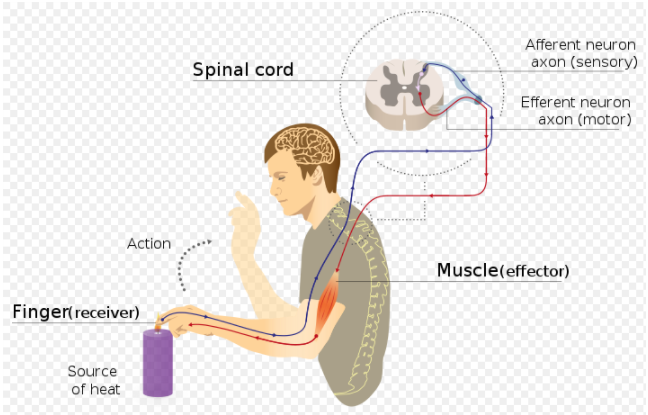
Note: The reflex arc pathway has no involvement of the brain. A reflex arc is classified into; an autonomic (which involves the affecting inner organs) and a somatic reflex arc (it involves affecting muscles).
Complete answer:
Reflex action is an involuntary action (as there is no conscious control of the brain on it) occurring where there will be an instant response to the external stimuli happens, this action occurs with the help of a neural pathway known as reflex arc, whenever there is an impulse the response happens immediately or suddenly before the impulse reaches the brain.
Components of Reflex action:
-Receptor organ: These receptors are located in important organs mainly sensory types of organs such as eyes, ears, nose, tongues, and integumentary organs. They receive external stimuli from the external environment.
-Sensory neurons: They are afferent neurons that carry stimulus from receptors to the spinal cord.
-Motor neuron: They carry the impulses to effector organs (these organs respond to the stimulus received from motor neurons).
Pathway of reflex action:
Reflex action starts when a stimulus is received by the sensory organs i.e. eyes, ears, etc from the surrounding environment. This stimulus then converts into an electrical impulse which is perceived by the sensory neurons and these neurons carry the signal to the spinal cord via axons. In the spinal cord, these impulses then pass to intermediate neurons. Then stimulus for a motor response passes through motor neurons and reaches the effector organs which perform the necessary function needed.
Note: The reflex arc pathway has no involvement of the brain. A reflex arc is classified into; an autonomic (which involves the affecting inner organs) and a somatic reflex arc (it involves affecting muscles).
Recently Updated Pages
Basicity of sulphurous acid and sulphuric acid are

Master Class 11 English: Engaging Questions & Answers for Success
Master Class 11 Physics: Engaging Questions & Answers for Success
Master Class 11 Computer Science: Engaging Questions & Answers for Success
Master Class 11 Chemistry: Engaging Questions & Answers for Success
Master Class 11 Social Science: Engaging Questions & Answers for Success
Trending doubts
Difference Between Prokaryotic Cells and Eukaryotic Cells
Two of the body parts which do not appear in MRI are class 11 biology CBSE
One Metric ton is equal to kg A 10000 B 1000 C 100 class 11 physics CBSE
10 examples of friction in our daily life
Draw a diagram of nephron and explain its structur class 11 biology CBSE
What will happen if the mucus is not secreted by the class 11 biology CBSE