




Draw a frequency polygon for the following data using histogram.
Marks 10-20 20-30 30-40 40-50 50-60 60-70 70-80 80-90 90-100 Number of students 4 6 8 5 7 4 9 5 7
| Marks | 10-20 | 20-30 | 30-40 | 40-50 | 50-60 | 60-70 | 70-80 | 80-90 | 90-100 |
| Number of students | 4 | 6 | 8 | 5 | 7 | 4 | 9 | 5 | 7 |
Answer
 Verified
609.9k+ views
Hint:
We will draw a histogram for the given data. We will represent the frequency (number of students) for each class of marks using a bar. Then we will locate the midpoint of the upper horizontal side of each bar. Then we will join all the mid-points using line segments one after the other and this will give us the required frequency polygon.
Complete step by step solution:
We will make a histogram to represent the data in the table. On the X-axis, we will take all the class intervals (marks of students) and on the Y-axis, we will take the frequency (number of students).
There are no students who have got marks between 0 and 10, so we will make a class interval 0-10 (because the values on the x-axis start from 0.If we want to take values from 10, we will have to draw a kink)and take its frequency as 0.
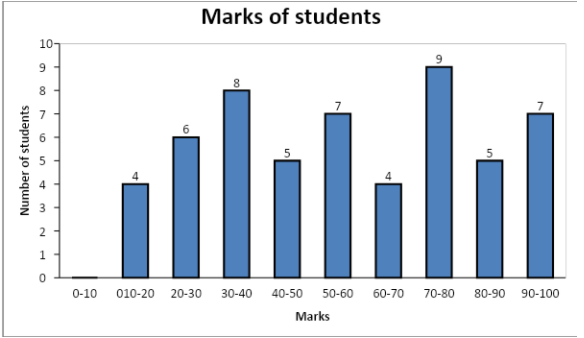
Now we will find the midpoint of the upper horizontal side of each bar of the histogram. The midpoint of a class is given by \[M = \dfrac{{U + L}}{2}\] where M is the midpoint, U is the upper class limit and L lower class limit.
We will represent the data in the above table using a frequency polygon. We will represent the mid-points on the x-axis and the frequency on the y-axis.

Note:
Here, we have drawn a histogram because it becomes much easier to show different data of different ranges through bars. The taller bar represents more value in a particular range. We can also directly draw the polygon without making the histogram. We will directly find the mid-points of the given intervals and plot their corresponding frequencies on the y-axis. We will represent the mid-points on the x-axis.
We will draw a histogram for the given data. We will represent the frequency (number of students) for each class of marks using a bar. Then we will locate the midpoint of the upper horizontal side of each bar. Then we will join all the mid-points using line segments one after the other and this will give us the required frequency polygon.
Complete step by step solution:
We will make a histogram to represent the data in the table. On the X-axis, we will take all the class intervals (marks of students) and on the Y-axis, we will take the frequency (number of students).
There are no students who have got marks between 0 and 10, so we will make a class interval 0-10 (because the values on the x-axis start from 0.If we want to take values from 10, we will have to draw a kink)and take its frequency as 0.
Now we will find the midpoint of the upper horizontal side of each bar of the histogram. The midpoint of a class is given by \[M = \dfrac{{U + L}}{2}\] where M is the midpoint, U is the upper class limit and L lower class limit.
| Marks | Midpoint of the bar | Height of the bar (Frequency) |
| 0-10 | \[\dfrac{{10 + 0}}{2} = 5\] | 0 |
| 10-20 | \[\dfrac{{20 + 10}}{2} = 15\] | 4 |
| 20-30 | \[\dfrac{{30 + 20}}{2} = 25\] | 6 |
| 30-40 | \[\dfrac{{40 + 30}}{2} = 35\] | 8 |
| 40-50 | \[\dfrac{{50 + 40}}{2} = 45\] | 5 |
| 50-60 | \[\dfrac{{60 + 50}}{2} = 55\] | 7 |
| 60-70 | \[\dfrac{{70 + 60}}{2} = 65\] | 4 |
| 70-80 | \[\dfrac{{80 + 70}}{2} = 75\] | 9 |
| 80-90 | \[\dfrac{{90 + 80}}{2} = 85\] | 5 |
| 90-100 | \[\dfrac{{100 + 90}}{2} = 95\] | 7 |
We will represent the data in the above table using a frequency polygon. We will represent the mid-points on the x-axis and the frequency on the y-axis.
Note:
Here, we have drawn a histogram because it becomes much easier to show different data of different ranges through bars. The taller bar represents more value in a particular range. We can also directly draw the polygon without making the histogram. We will directly find the mid-points of the given intervals and plot their corresponding frequencies on the y-axis. We will represent the mid-points on the x-axis.
Recently Updated Pages
Master Class 9 General Knowledge: Engaging Questions & Answers for Success

Master Class 9 Maths: Engaging Questions & Answers for Success
Master Class 9 Science: Engaging Questions & Answers for Success
Master Class 9 English: Engaging Questions & Answers for Success
Master Class 9 Social Science: Engaging Questions & Answers for Success
Class 9 Question and Answer - Your Ultimate Solutions Guide
Trending doubts
Explain the Treaty of Vienna of 1815 class 10 social science CBSE
Who Won 36 Oscar Awards? Record Holder Revealed
What is the median of the first 10 natural numbers class 10 maths CBSE
Why is it 530 pm in india when it is 1200 afternoon class 10 social science CBSE
Make a sketch of the human nerve cell What function class 10 biology CBSE
Define Potential, Developed, Stock and Reserved resources