




Draw a floral diagram and write floral formula of Ixora coccinea.
Answer
 Verified
565.8k+ views
Hint: A floral diagram is a visual illustration of the arrangement of a flower. It depicts the number and organisation of floral organs, as well as their fusion. Symbols for different parts of the flower are used to represent them.
Complete answer:
A floral diagram is a cross-section of a young flower in schematic form. It can also be described as the flower's projection perpendicular to its axis. The number of floral sections, their proportions, relative locations, and fusion are normally seen. Different organs are represented by distinct marks, which may be consistent across organ types or indicate specific morphology. Symbols that do not reflect concrete objects but convey additional details can also be used in the diagram (e.g. symmetry plane orientation). There is no consensus about how floral diagrams can be drawn; it is up to the artist to decide if the diagram is just a rough illustration or includes anatomical descriptions of the flower. Diagrams may be used to illustrate evolutionary relationships or to explain the ontogeny of flowers. They can be simplified to depict a taxon's usual floral structure. Diagrams may also be used to reflect (partial) inflorescences. A decent diagram will hold a significant amount of detail. It can be used to identify flowers or make comparisons between angiosperm taxa. Floral diagrams may also be of didactic value.
The floral diagram of Ixora coccinea is given below:
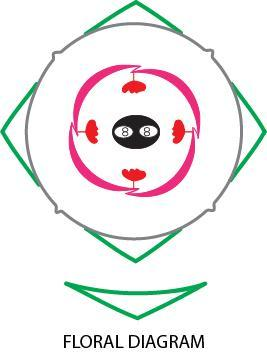
The floral formula is: (c) ꚛ $K_5$ $C_5$ $A_(5)$ $G_ {2}$
Note:
Floral formula is a way of representing a flower's arrangement with numbers, letters, and different symbols, providing important facts about the flower in a compact shape. It can be used to describe specific organisms or it can be used to classify higher taxa, typically with organ number ranges.
Complete answer:
A floral diagram is a cross-section of a young flower in schematic form. It can also be described as the flower's projection perpendicular to its axis. The number of floral sections, their proportions, relative locations, and fusion are normally seen. Different organs are represented by distinct marks, which may be consistent across organ types or indicate specific morphology. Symbols that do not reflect concrete objects but convey additional details can also be used in the diagram (e.g. symmetry plane orientation). There is no consensus about how floral diagrams can be drawn; it is up to the artist to decide if the diagram is just a rough illustration or includes anatomical descriptions of the flower. Diagrams may be used to illustrate evolutionary relationships or to explain the ontogeny of flowers. They can be simplified to depict a taxon's usual floral structure. Diagrams may also be used to reflect (partial) inflorescences. A decent diagram will hold a significant amount of detail. It can be used to identify flowers or make comparisons between angiosperm taxa. Floral diagrams may also be of didactic value.
The floral diagram of Ixora coccinea is given below:
The floral formula is: (c) ꚛ $K_5$ $C_5$ $A_(5)$ $G_ {2}$
Note:
Floral formula is a way of representing a flower's arrangement with numbers, letters, and different symbols, providing important facts about the flower in a compact shape. It can be used to describe specific organisms or it can be used to classify higher taxa, typically with organ number ranges.
Recently Updated Pages
Master Class 5 English: Engaging Questions & Answers for Success

Master Class 5 Maths: Engaging Questions & Answers for Success
Master Class 5 Social Science: Engaging Questions & Answers for Success
Master Class 5 Science: Engaging Questions & Answers for Success
Class 5 Question and Answer - Your Ultimate Solutions Guide
Master Class 9 General Knowledge: Engaging Questions & Answers for Success
Trending doubts
One Metric ton is equal to kg A 10000 B 1000 C 100 class 11 physics CBSE
What is cell theory Who formulated it class 11 biology CBSE
Phyllotaxy is the arrangement of ALeaflets BLeaves class 11 biology CBSE
Difference Between Prokaryotic Cells and Eukaryotic Cells
The symbiotic association of fungi and algae is called class 11 biology CBSE
Cell theory was formulated by A Schleiden and Schwann class 11 biology CBSE