




Draw a diagram to represent the nature, position and relative size of the image formed by a
i) Convex lens for the object placed at 2F
ii) Concave lens for the object placed between F and 2F
Answer
 Verified
642.3k+ views
Hint: In this question, we start with the convex lens which is also a converging lens and when we place the object at 2F the image we get is real, inverted, of the same size, and at 2F on the opposite side of the lens. Similarly, we take a concave lens which is also a diverging lens and when we place the object between F and 2F the image we get is Virtual, non-inverted, of smaller size and at distance less than F on the same side of the lens.
Complete Step-by-Step solution:
Let us take a principle axis and place a lens with the focal point as F
I) A convex lens is also known as a converging lens so it can be used to get a real image and we get an inverted image because we have placed the object at a distance greater than the focal length of the convex lens as shown in figure 1. Here the object is placed at a 2F distance from the center of the lens, so the image is formed at 2F but it is on the other side of the lens and it is of equal size as that of the object.
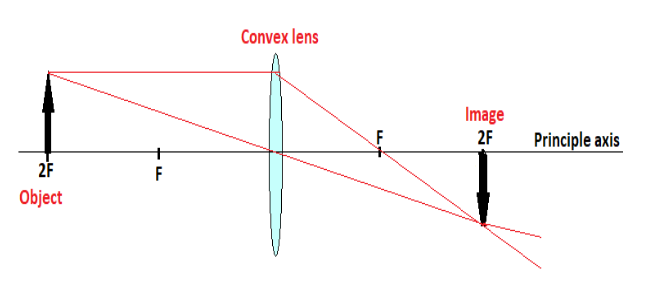
Figure 1
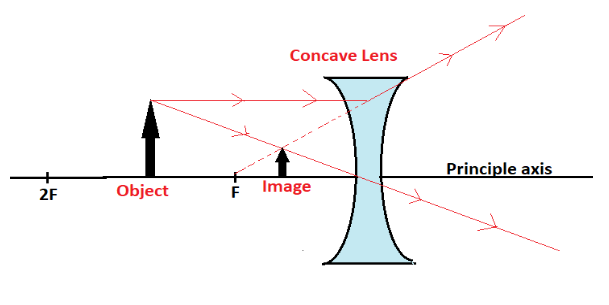
ii) A concave lens is also known as a diverging lens so it can be used to get a virtual image and we get a non-inverted image because we have placed the object at a distance greater than the focal length of the concave lens as shown in figure 2.Here object is placed between F and 2F so, the image is formed at a distance less than F and it is smaller than the original object.
Note: For these types of questions, we need to know the nature of the image formed by a convex lens, concave lens, convex mirror, concave mirror, and plane mirror for different positions of the object. The image may be real or virtual, inverted or non-inverted, and Size it’s may vary depending upon its position and the type of lens or mirror used.
Complete Step-by-Step solution:
Let us take a principle axis and place a lens with the focal point as F
I) A convex lens is also known as a converging lens so it can be used to get a real image and we get an inverted image because we have placed the object at a distance greater than the focal length of the convex lens as shown in figure 1. Here the object is placed at a 2F distance from the center of the lens, so the image is formed at 2F but it is on the other side of the lens and it is of equal size as that of the object.
Figure 1
ii) A concave lens is also known as a diverging lens so it can be used to get a virtual image and we get a non-inverted image because we have placed the object at a distance greater than the focal length of the concave lens as shown in figure 2.Here object is placed between F and 2F so, the image is formed at a distance less than F and it is smaller than the original object.
Figure 2
Note: For these types of questions, we need to know the nature of the image formed by a convex lens, concave lens, convex mirror, concave mirror, and plane mirror for different positions of the object. The image may be real or virtual, inverted or non-inverted, and Size it’s may vary depending upon its position and the type of lens or mirror used.
Recently Updated Pages
Master Class 11 English: Engaging Questions & Answers for Success

Master Class 11 Social Science: Engaging Questions & Answers for Success
Master Class 11 Maths: Engaging Questions & Answers for Success
Master Class 11 Biology: Engaging Questions & Answers for Success
Master Class 11 Physics: Engaging Questions & Answers for Success
Master Class 11 Chemistry: Engaging Questions & Answers for Success
Trending doubts
Explain the Treaty of Vienna of 1815 class 10 social science CBSE
In cricket, what is a "Yorker" designed to do?
What is the full form of POSCO class 10 social science CBSE
Define Potential, Developed, Stock and Reserved resources
Identify the plural form of the word child from the class 10 english CBSE
Draw a circuit diagram showing the cell switch and class 10 physics CBSE