




Draw a diagram that illustrates the life cycle of flowering plants. Why don't flowering plants require a source of outside water for pollination?
Answer
 Verified
602.1k+ views
Hint: Angiosperms are also known as the flowering plants. These are the seed bearing plants. They are the diverse plants which are found abundantly on earth. They belong to the Plantae kingdom. Sporophytic generation is known to dominate their life cycle.
Complete answer:
The sporophytic plants bear flowers consisting of both male as well as female reproductive organs. Production of sperms occurs through male gametophyte within the pollen grain. On the other hand, eggs are produced from the female gametophytes inside the ovaries. Production of both sperms as well as eggs takes place by the process of meiosis. Pollination occurs via wind or insects resulting in double fertilization of the flower. This results in delivery of the sperms to the egg thus forming the zygote inside the ovule present in the ovary. Development of embryos from this zygote takes place inside a seed formed from ovules. It helps in providing nourishment to the developing embryo. Fruit is developed from the ovary which is surrounding the seed. Pollinators are again attracted towards this fruit thus dispersing their seeds. On germination, these seeds develop into a mature sporophytic plant and the cycle is thus repeated.
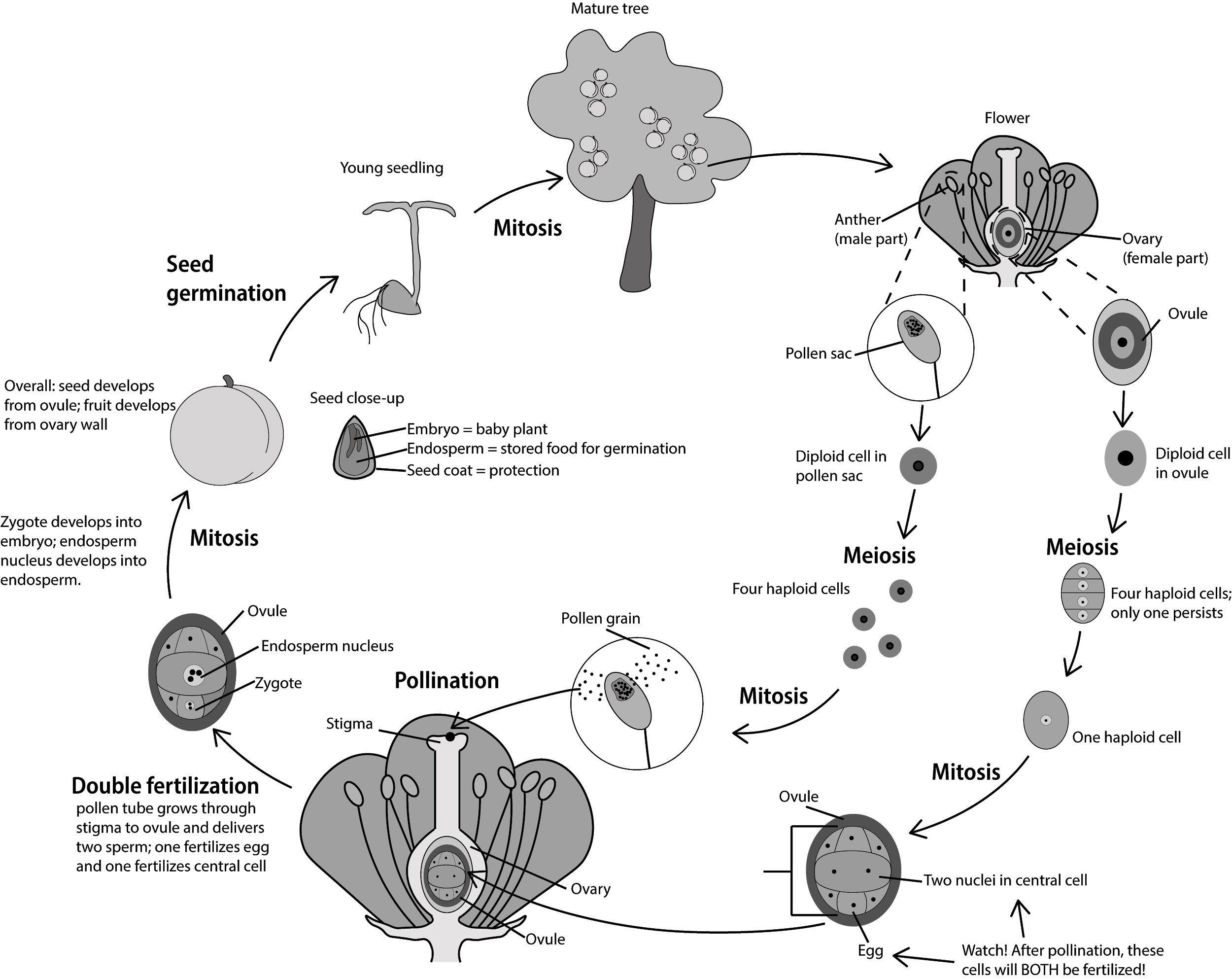
Flowering plants don't require a source of outside water for pollination because angiosperms can normally carry out their pollination by wind or insect pollinators.
Note: All the flowering plants consist of petals, sepals, stamens and carpels. Petals display their vibrant colors in order to attract pollinators. However, light and small flowers are generally pollinated through wind pollination.
Complete answer:
The sporophytic plants bear flowers consisting of both male as well as female reproductive organs. Production of sperms occurs through male gametophyte within the pollen grain. On the other hand, eggs are produced from the female gametophytes inside the ovaries. Production of both sperms as well as eggs takes place by the process of meiosis. Pollination occurs via wind or insects resulting in double fertilization of the flower. This results in delivery of the sperms to the egg thus forming the zygote inside the ovule present in the ovary. Development of embryos from this zygote takes place inside a seed formed from ovules. It helps in providing nourishment to the developing embryo. Fruit is developed from the ovary which is surrounding the seed. Pollinators are again attracted towards this fruit thus dispersing their seeds. On germination, these seeds develop into a mature sporophytic plant and the cycle is thus repeated.
Flowering plants don't require a source of outside water for pollination because angiosperms can normally carry out their pollination by wind or insect pollinators.
Note: All the flowering plants consist of petals, sepals, stamens and carpels. Petals display their vibrant colors in order to attract pollinators. However, light and small flowers are generally pollinated through wind pollination.
Recently Updated Pages
Master Class 11 English: Engaging Questions & Answers for Success

Master Class 11 Social Science: Engaging Questions & Answers for Success
Master Class 11 Maths: Engaging Questions & Answers for Success
Master Class 11 Chemistry: Engaging Questions & Answers for Success
Master Class 11 Biology: Engaging Questions & Answers for Success
Master Class 11 Physics: Engaging Questions & Answers for Success
Trending doubts
One Metric ton is equal to kg A 10000 B 1000 C 100 class 11 physics CBSE
Difference Between Prokaryotic Cells and Eukaryotic Cells
Find the value of the expression given below sin 30circ class 11 maths CBSE
1 ton equals to A 100 kg B 1000 kg C 10 kg D 10000 class 11 physics CBSE
Two of the body parts which do not appear in MRI are class 11 biology CBSE
Draw a diagram of nephron and explain its structur class 11 biology CBSE