




Draw a diagram of the DC motor and label the parts.
Answer
 Verified
624.6k+ views
Hint: The DC motor is a machine that converts electric power to mechanical power. DC motor works based on the principle that when a current-carrying conductor is placed in an external magnetic field, it experiences a force.
Formula used:
The formula for the force, in newtons, exerted on the current-carrying conductor is –
$F = BIL$
where,
B – magnetic field applied on the current-carrying conductor, in tesla
I – current in the conductor, in amperes
L – length of the conductor, in meters.
Complete step by step solution:
The DC motor consists of the following parts –
(i) Armature
(ii) Spindle
(iii) Permanent Magnet
(iv) Split-ring commutators
(v) Brushes
(vi) Electric Source
Here is a diagram of DC motor with all the parts –
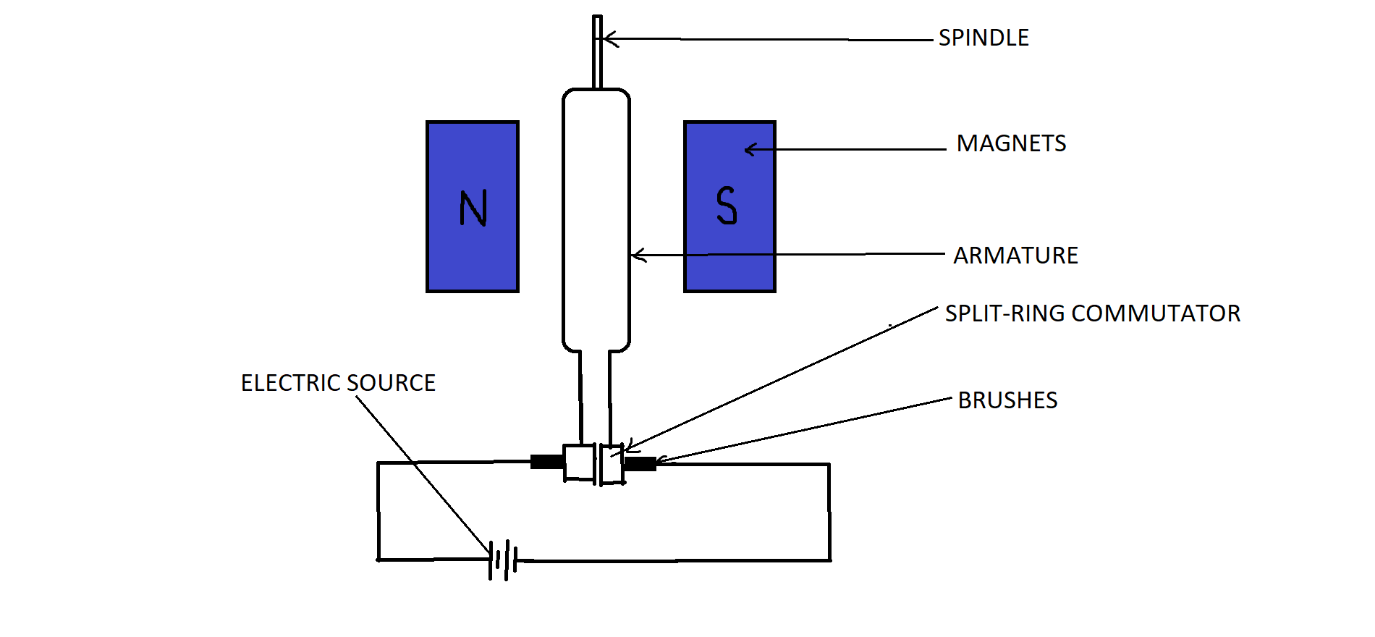
Here is the explanation of the working of these parts:
(i) Armature – The armature is the current-carrying conductor that is connected to the spindle. The force is exerted on the armature causing it to rotate.
(ii) Spindle – The spindle is a rotary member attached to the armature. This part protrudes out of the motor and it is used to connect to the devices.
(iii) Permanent Magnet – These are used for providing the magnetic field. They may be electromagnetic or permanent.
(iv) Split-ring commutators – These are split rings connected to the armature which are used to change the direction of the current so as to ensure the armature completes one complete circle.
(v) Brushes – These are made of carbon and used to provide current to the split rings from the source.
(vi) Electric Source – They provide electric current for the armature through split rings and bushes. The source of current is DC.
Note:
The direction of force induced on the armature is given by Fleming’s Left-Hand rule
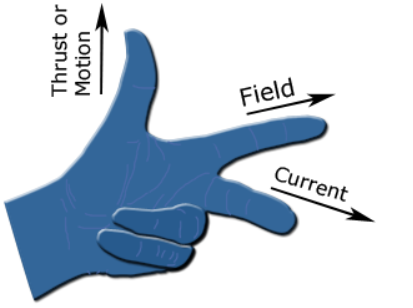
It says that if the left hand is held out as shown in the figure, by orienting the middle finger in the direction of current and the index finger in the direction of the magnetic field, we will be able to observe the direction of force acting on the conductor which is the same as the direction pointed by the thumb.
Formula used:
The formula for the force, in newtons, exerted on the current-carrying conductor is –
$F = BIL$
where,
B – magnetic field applied on the current-carrying conductor, in tesla
I – current in the conductor, in amperes
L – length of the conductor, in meters.
Complete step by step solution:
The DC motor consists of the following parts –
(i) Armature
(ii) Spindle
(iii) Permanent Magnet
(iv) Split-ring commutators
(v) Brushes
(vi) Electric Source
Here is a diagram of DC motor with all the parts –
Here is the explanation of the working of these parts:
(i) Armature – The armature is the current-carrying conductor that is connected to the spindle. The force is exerted on the armature causing it to rotate.
(ii) Spindle – The spindle is a rotary member attached to the armature. This part protrudes out of the motor and it is used to connect to the devices.
(iii) Permanent Magnet – These are used for providing the magnetic field. They may be electromagnetic or permanent.
(iv) Split-ring commutators – These are split rings connected to the armature which are used to change the direction of the current so as to ensure the armature completes one complete circle.
(v) Brushes – These are made of carbon and used to provide current to the split rings from the source.
(vi) Electric Source – They provide electric current for the armature through split rings and bushes. The source of current is DC.
Note:
The direction of force induced on the armature is given by Fleming’s Left-Hand rule
It says that if the left hand is held out as shown in the figure, by orienting the middle finger in the direction of current and the index finger in the direction of the magnetic field, we will be able to observe the direction of force acting on the conductor which is the same as the direction pointed by the thumb.
Recently Updated Pages
Master Class 11 English: Engaging Questions & Answers for Success

Master Class 11 Social Science: Engaging Questions & Answers for Success
Master Class 11 Maths: Engaging Questions & Answers for Success
Master Class 11 Biology: Engaging Questions & Answers for Success
Master Class 11 Physics: Engaging Questions & Answers for Success
Master Class 11 Chemistry: Engaging Questions & Answers for Success
Trending doubts
Explain the Treaty of Vienna of 1815 class 10 social science CBSE
In cricket, what is a "Yorker" designed to do?
What is the full form of POSCO class 10 social science CBSE
Define Potential, Developed, Stock and Reserved resources
Identify the plural form of the word child from the class 10 english CBSE
Draw a circuit diagram showing the cell switch and class 10 physics CBSE