




How to draw a BN molecular orbital diagram?
Answer
 Verified
573.9k+ views
Hint: An orbital diagram explains how the orbitals of the atoms in the molecule are going to split when they are involved in bonding to form a molecule. Molecular orbitals are different from the atomic orbitals.
Complete answer:
- In the question it is given to draw the molecular orbital diagram for BN molecules.
-We should know the atomic number of the atoms involved in the bonding to draw the orbital diagram.
- The atomic number of Boron is 5 means the number of electrons in boron are 5.
- Out of those 5 electrons, three electrons are valence electrons.
- Coming to nitrogen, the atomic number of nitrogen is 7, which means nitrogen contains 7 electrons.
- Out of seven electrons, five electrons are valence electrons in nitrogen.
- Therefore the total number of valence electrons in boron and nitrogen are 8 valence electrons.
- We have to fill the electrons from the lowest energy level from $\sigma 2s$ .
- We know that $\sigma 2s$ orbital can accommodate 2 electrons.
- The next two electrons are going to enter into ${{\sigma }^{*}}2s$ .
- There are two more electrons and they are going to enter into $\sigma 2p$ .
- At last the two electrons from eight valence electrons are going to enter into ${{\pi }_{x}}$ and ${{\pi }_{y}}$ orbitals one in each orbital due to the same energy level of ${{\pi }_{x}}$ and ${{\pi }_{y}}$.
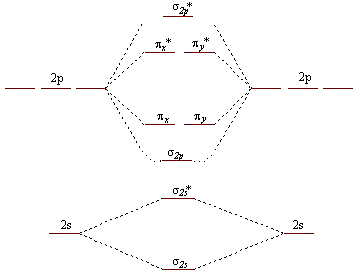
- The BN molecule is paramagnetic in nature due to the presence of unpaired electrons in ${{\pi }_{x}}$ and ${{\pi }_{y}}$ orbitals.
Note:
To draw the energy level diagram of any molecule we should know the number of electrons present in the given molecule and we have to know how many valence electrons are present in the molecule.
Complete answer:
- In the question it is given to draw the molecular orbital diagram for BN molecules.
-We should know the atomic number of the atoms involved in the bonding to draw the orbital diagram.
- The atomic number of Boron is 5 means the number of electrons in boron are 5.
- Out of those 5 electrons, three electrons are valence electrons.
- Coming to nitrogen, the atomic number of nitrogen is 7, which means nitrogen contains 7 electrons.
- Out of seven electrons, five electrons are valence electrons in nitrogen.
- Therefore the total number of valence electrons in boron and nitrogen are 8 valence electrons.
- We have to fill the electrons from the lowest energy level from $\sigma 2s$ .
- We know that $\sigma 2s$ orbital can accommodate 2 electrons.
- The next two electrons are going to enter into ${{\sigma }^{*}}2s$ .
- There are two more electrons and they are going to enter into $\sigma 2p$ .
- At last the two electrons from eight valence electrons are going to enter into ${{\pi }_{x}}$ and ${{\pi }_{y}}$ orbitals one in each orbital due to the same energy level of ${{\pi }_{x}}$ and ${{\pi }_{y}}$.
- The BN molecule is paramagnetic in nature due to the presence of unpaired electrons in ${{\pi }_{x}}$ and ${{\pi }_{y}}$ orbitals.
Note:
To draw the energy level diagram of any molecule we should know the number of electrons present in the given molecule and we have to know how many valence electrons are present in the molecule.
Recently Updated Pages
Master Class 12 Economics: Engaging Questions & Answers for Success

Master Class 12 English: Engaging Questions & Answers for Success
Master Class 12 Social Science: Engaging Questions & Answers for Success
Master Class 12 Maths: Engaging Questions & Answers for Success
Master Class 12 Physics: Engaging Questions & Answers for Success
Master Class 11 Social Science: Engaging Questions & Answers for Success
Trending doubts
One Metric ton is equal to kg A 10000 B 1000 C 100 class 11 physics CBSE
Difference Between Prokaryotic Cells and Eukaryotic Cells
Two of the body parts which do not appear in MRI are class 11 biology CBSE
1 ton equals to A 100 kg B 1000 kg C 10 kg D 10000 class 11 physics CBSE
Draw a diagram of nephron and explain its structur class 11 biology CBSE
10 examples of friction in our daily life