




Why don’t two equipotential surfaces intersect each other?
Answer
 Verified
612.3k+ views
Hint: Equipotential surfaces cannot intersect at any point. Such a situation is impossible and non-existing. If such a situation arises then at a single point there will be the same physical quantities with different directions and magnitudes, which is not possible.
Complete answer:
Equipotential surfaces are those with constant electric potential throughout. The potential is defined as the work done to bring charge from infinity to another charge ‘q’. The electric potential experienced due to a charge q is given by –
\[V=\dfrac{q}{4\pi {{\varepsilon }_{0}}r}\], where ‘r’ is the distance of a point ‘P’ from the charge ‘q’.
When we closely analyse this equation, we can understand that there are an infinite number of ‘P’s in a given space which are at a distance ‘r’ from the charge ‘q’. Obviously, these points when joined together in 2-D gives a circle as shown below -
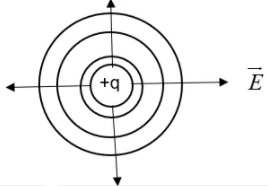
When joined in 3-D, it constitutes a spherical surface. Each circle shows an equipotential surface when taken in 3-D. From the diagram it is clear that the equipotential surfaces never intersect. We can also see that the equipotential surface is perpendicular to the electric field direction. i.e., the potential keeps on decreasing as the distance from the source increases and both are related by a factor of ‘r’.
Now, let us consider the situation when two equipotential surfaces intersect, then will see that the electric field strength and electric potential tends to have more than one value, which is unacceptable. For an electric field from more than two charges the equipotential surface is such that it is the vector sum of all the individual surfaces.
Additional Information:
The electric field and potential are related by
\[\overrightarrow{E}=\dfrac{V}{r}\]
Note:
The electric field is always perpendicular to the equipotential surface. The electric field is also constant along the equipotential surface. The two are related such that a foregoing electric field weakens with distance and the potential drops with this.
Complete answer:
Equipotential surfaces are those with constant electric potential throughout. The potential is defined as the work done to bring charge from infinity to another charge ‘q’. The electric potential experienced due to a charge q is given by –
\[V=\dfrac{q}{4\pi {{\varepsilon }_{0}}r}\], where ‘r’ is the distance of a point ‘P’ from the charge ‘q’.
When we closely analyse this equation, we can understand that there are an infinite number of ‘P’s in a given space which are at a distance ‘r’ from the charge ‘q’. Obviously, these points when joined together in 2-D gives a circle as shown below -
When joined in 3-D, it constitutes a spherical surface. Each circle shows an equipotential surface when taken in 3-D. From the diagram it is clear that the equipotential surfaces never intersect. We can also see that the equipotential surface is perpendicular to the electric field direction. i.e., the potential keeps on decreasing as the distance from the source increases and both are related by a factor of ‘r’.
Now, let us consider the situation when two equipotential surfaces intersect, then will see that the electric field strength and electric potential tends to have more than one value, which is unacceptable. For an electric field from more than two charges the equipotential surface is such that it is the vector sum of all the individual surfaces.
Additional Information:
The electric field and potential are related by
\[\overrightarrow{E}=\dfrac{V}{r}\]
Note:
The electric field is always perpendicular to the equipotential surface. The electric field is also constant along the equipotential surface. The two are related such that a foregoing electric field weakens with distance and the potential drops with this.
Recently Updated Pages
Master Class 12 Economics: Engaging Questions & Answers for Success

Master Class 12 English: Engaging Questions & Answers for Success
Master Class 12 Social Science: Engaging Questions & Answers for Success
Master Class 12 Maths: Engaging Questions & Answers for Success
Master Class 12 Physics: Engaging Questions & Answers for Success
Master Class 9 General Knowledge: Engaging Questions & Answers for Success
Trending doubts
One Metric ton is equal to kg A 10000 B 1000 C 100 class 11 physics CBSE
Difference Between Prokaryotic Cells and Eukaryotic Cells
Find the value of the expression given below sin 30circ class 11 maths CBSE
Two of the body parts which do not appear in MRI are class 11 biology CBSE
1 ton equals to A 100 kg B 1000 kg C 10 kg D 10000 class 11 physics CBSE
Draw a diagram of nephron and explain its structur class 11 biology CBSE