




Does transpiration serve any useful function in the plant? Explain.
Answer
 Verified
634.2k+ views
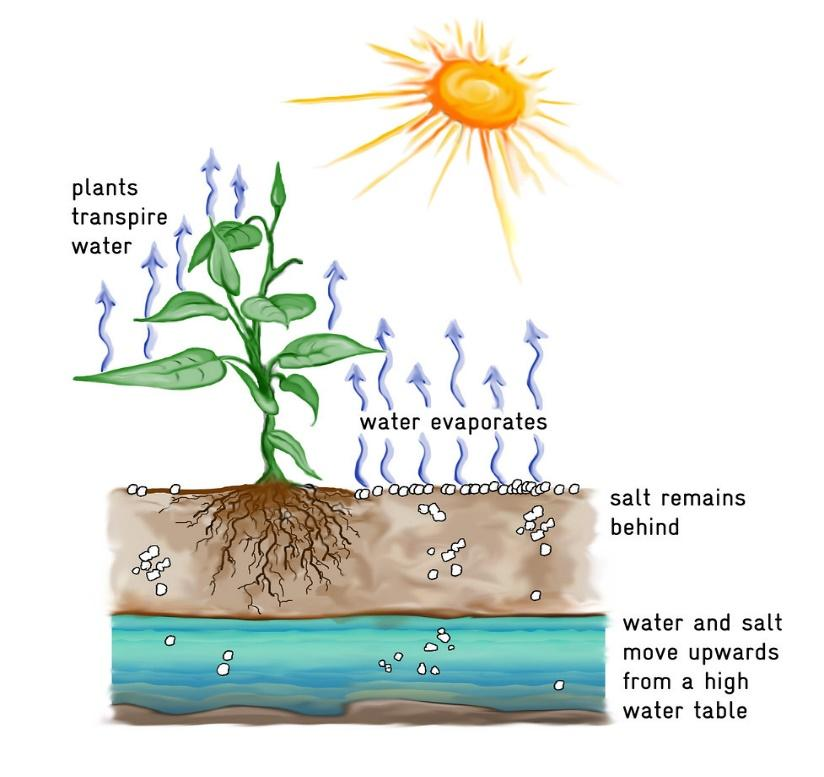
Hint: Transpiration is the process by which water loss occurs in plants through aerial parts such as leaves. Almost ninety- five per cent of the water taken up by the roots of the plant are lost by this mechanism. The process is also known as guttation. The process resembles evaporation and can render a cooling effect on the leaves as well as the whole plan body.
Complete step by step answer: Transpiration serves many useful purposes in plants and is necessary for its developmental processes. The various useful functions of transpiration in plants are:
i. The process of transpiration creates a suction force that aids in the ascent of sap to different parts, which helps in the movement of nutrients, water and other minerals and ions to the different sites of metabolism.
ii. It regulates the absorption of minerals and water by the roots of the plant. The force of pull created by this process creates a pressure difference and causes the absorption of minerals and water from the soil to be absorbed by the roots of the plant.
iii. It helps in the process of translocation of food substances from one plant part to another and can be moved to the appropriate storage places for the excess food substances.
iv. The process can also regulate the opening and closing of the stomatal pores and can play an important role in the regulation of the photosynthesis, by regulating the number of gases exchanged through the pores.
v. It helps in the process of diffusion through the cells and facilitates in the process of intercellular transport of materials, by causing a difference in diffusion pressure due to the transpiration pull.
vi. It helps in the evaporation of the excess absorbed water, without which it can damage plants.
Note: The process of transpiration also possesses certain disadvantages such as a deficiency in water leads to the wilting of plants, which can be fatal in the long run, whereas an excessive rate of transpiration leads to stunted plant growth. Thus transpiration processes can be defined sometimes as a “necessary evil” in plant life.
Complete step by step answer: Transpiration serves many useful purposes in plants and is necessary for its developmental processes. The various useful functions of transpiration in plants are:
i. The process of transpiration creates a suction force that aids in the ascent of sap to different parts, which helps in the movement of nutrients, water and other minerals and ions to the different sites of metabolism.
ii. It regulates the absorption of minerals and water by the roots of the plant. The force of pull created by this process creates a pressure difference and causes the absorption of minerals and water from the soil to be absorbed by the roots of the plant.
iii. It helps in the process of translocation of food substances from one plant part to another and can be moved to the appropriate storage places for the excess food substances.
iv. The process can also regulate the opening and closing of the stomatal pores and can play an important role in the regulation of the photosynthesis, by regulating the number of gases exchanged through the pores.
v. It helps in the process of diffusion through the cells and facilitates in the process of intercellular transport of materials, by causing a difference in diffusion pressure due to the transpiration pull.
vi. It helps in the evaporation of the excess absorbed water, without which it can damage plants.
Note: The process of transpiration also possesses certain disadvantages such as a deficiency in water leads to the wilting of plants, which can be fatal in the long run, whereas an excessive rate of transpiration leads to stunted plant growth. Thus transpiration processes can be defined sometimes as a “necessary evil” in plant life.
Recently Updated Pages
Master Class 11 Social Science: Engaging Questions & Answers for Success

Master Class 11 English: Engaging Questions & Answers for Success
Master Class 11 Accountancy: Engaging Questions & Answers for Success
Master Class 11 Physics: Engaging Questions & Answers for Success
Master Class 11 Computer Science: Engaging Questions & Answers for Success
Master Class 11 Business Studies: Engaging Questions & Answers for Success
Trending doubts
Find the value of the expression given below sin 30circ class 11 maths CBSE
One Metric ton is equal to kg A 10000 B 1000 C 100 class 11 physics CBSE
10 examples of friction in our daily life
Draw a diagram of nephron and explain its structur class 11 biology CBSE
The teeth used for biting and cutting food are called class 11 biology CBSE
Proton was discovered by A Thomson B Rutherford C Chadwick class 11 chemistry CBSE