




What does the slope of the V-I graph of a conductor represent?
A. capacitance
B. power
C. inductance
D. resistance
Answer
 Verified
615.9k+ views
Hint: The slope of a graph can be found out using the derivative method. This means that the change in the variable in y-axis is divided by the change in variable at x-axis. Here the slope will be the change in velocity divided by the change in current. This may help you to solve this question.
Complete answer:
The ohm's law is the basic concept in order to solve this question.
Ohm's Law tells us that the current flowing in a circuit is found to be directly proportional to the potential difference which is applied and inversely proportional to the resistance of the circuit. However we can also say that by changing the voltage across a circuit twice, the current will also increase twice.
$R=\dfrac{V}{I}$
In order to solve this question, let us look at the graph showing the voltage and current.
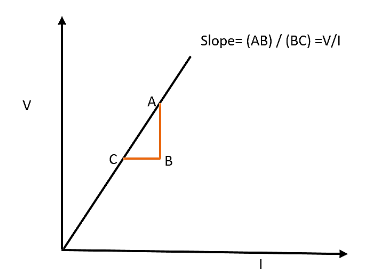
Here the voltage has been represented in the y-axis and current in a conductor is expressed in the x-axis at constant temperature. This graph, the current $I$ against the potential difference $V$, is a straight line with fixed slope of $R$, since the relation is linear and also ohmic. By the way practical resistors sometimes show non-linear behaviour under particular conditions like the exposure to higher temperatures.
From this we can say that the slope of this graph will be the resistance of the circuit.
Note:
The resistance of a conductor is dependent on the area of the cross section of the conductor, the length of the conductor, and also its resistivity. It should be known that the electrical conductivity and resistivity are in inverse relation, which means that the more a material is conductive, then the less resistive it is.
Complete answer:
The ohm's law is the basic concept in order to solve this question.
Ohm's Law tells us that the current flowing in a circuit is found to be directly proportional to the potential difference which is applied and inversely proportional to the resistance of the circuit. However we can also say that by changing the voltage across a circuit twice, the current will also increase twice.
$R=\dfrac{V}{I}$
In order to solve this question, let us look at the graph showing the voltage and current.
Here the voltage has been represented in the y-axis and current in a conductor is expressed in the x-axis at constant temperature. This graph, the current $I$ against the potential difference $V$, is a straight line with fixed slope of $R$, since the relation is linear and also ohmic. By the way practical resistors sometimes show non-linear behaviour under particular conditions like the exposure to higher temperatures.
From this we can say that the slope of this graph will be the resistance of the circuit.
Note:
The resistance of a conductor is dependent on the area of the cross section of the conductor, the length of the conductor, and also its resistivity. It should be known that the electrical conductivity and resistivity are in inverse relation, which means that the more a material is conductive, then the less resistive it is.
Recently Updated Pages
Master Class 10 English: Engaging Questions & Answers for Success

Master Class 10 Social Science: Engaging Questions & Answers for Success
Master Class 10 Computer Science: Engaging Questions & Answers for Success
Class 10 Question and Answer - Your Ultimate Solutions Guide
Master Class 10 General Knowledge: Engaging Questions & Answers for Success
Master Class 10 Maths: Engaging Questions & Answers for Success
Trending doubts
What is the full form of NDA a National Democratic class 10 social science CBSE
Explain the Treaty of Vienna of 1815 class 10 social science CBSE
Who Won 36 Oscar Awards? Record Holder Revealed
Bharatiya Janata Party was founded in the year A 1979 class 10 social science CBSE
What is the median of the first 10 natural numbers class 10 maths CBSE
Why is it 530 pm in india when it is 1200 afternoon class 10 social science CBSE