




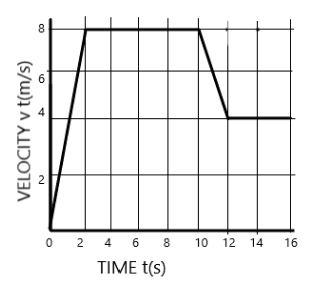
How far does the runner whose time-velocity graph is shown in the figure travel in 16 seconds
Answer
 Verified
630.6k+ views
Hint: Area under the curve of a velocity - time graph (or time – velocity graph) is equal to the displacement covered. Split the velocity time graphs into simple shapes and calculate each of their areas, then add them together.
Formula used: In this solution we will be using the following formulae;
$ {A_t} = \dfrac{1}{2}bh $ where $ {A_t} $ is the area of a triangle, $ b $ is the base of the triangle, and $ h $ is the height of the triangle.
$ {A_r} = lb $ where $ {A_r} $ is the area of a rectangle, $ l $ is the length of the rectangle, and $ b $ is the breath of the rectangle.
Complete Step-by-Step solution
Generally, when a velocity time graph of an object is known, the area under the curve is the displacement of the object. Hence, to find how far the runner went, we shall calculate the area under each curve of the graph shown.
So be simpler, we split it into simple shapes. The first one being the triangle. The area under the triangle ABC is
$ {A_t} = \dfrac{1}{2}2\left( 8 \right) $ since $ {A_t} = \dfrac{1}{2}bh $ where $ {A_t} $ is the area of a triangle, $ b $ is the base of the triangle, and $ h $ is the height of the triangle
$ {A_{ABC}} = 8m $
For the rectangle / square CBDE we have
$ {A_{CBDE}} = \left( {10 - 2} \right)\left( 8 \right) $ since $ {A_r} = lb $ where $ {A_r} $ is the area of a rectangle, $ l $ is the length of the rectangle, and $ b $ is the breath of the rectangle.
Then the triangle, DFG is
$ {A_{DFG}} = \dfrac{1}{2}\left( {12 - 10} \right)\left( {8 - 4} \right) = 4{m^2} $
Rectangle EFGH,
$ {A_{EFGH}} = \left( {12 - 10} \right)\left( 4 \right) = 8{m^2} $
Rectangle GHIJ
$ {A_{GHIJ}} = \left( {16 - 12} \right)\left( 4 \right) = 16{m^2} $
To the total area under the curve is
$ A = 8 + 4 + 8 + 16 = 36m $
Hence, the total displacement covered is 36 m.
Note
Although, it didn’t apply in this case, note that, the velocity time graphs shows gives total displacement, and hence when the velocity is negative, for total displacement, the area under (actually, it would be above the curve now) would be subtracted and not added.
Formula used: In this solution we will be using the following formulae;
$ {A_t} = \dfrac{1}{2}bh $ where $ {A_t} $ is the area of a triangle, $ b $ is the base of the triangle, and $ h $ is the height of the triangle.
$ {A_r} = lb $ where $ {A_r} $ is the area of a rectangle, $ l $ is the length of the rectangle, and $ b $ is the breath of the rectangle.
Complete Step-by-Step solution
Generally, when a velocity time graph of an object is known, the area under the curve is the displacement of the object. Hence, to find how far the runner went, we shall calculate the area under each curve of the graph shown.
So be simpler, we split it into simple shapes. The first one being the triangle. The area under the triangle ABC is
$ {A_t} = \dfrac{1}{2}2\left( 8 \right) $ since $ {A_t} = \dfrac{1}{2}bh $ where $ {A_t} $ is the area of a triangle, $ b $ is the base of the triangle, and $ h $ is the height of the triangle
$ {A_{ABC}} = 8m $
For the rectangle / square CBDE we have
$ {A_{CBDE}} = \left( {10 - 2} \right)\left( 8 \right) $ since $ {A_r} = lb $ where $ {A_r} $ is the area of a rectangle, $ l $ is the length of the rectangle, and $ b $ is the breath of the rectangle.
Then the triangle, DFG is
$ {A_{DFG}} = \dfrac{1}{2}\left( {12 - 10} \right)\left( {8 - 4} \right) = 4{m^2} $
Rectangle EFGH,
$ {A_{EFGH}} = \left( {12 - 10} \right)\left( 4 \right) = 8{m^2} $
Rectangle GHIJ
$ {A_{GHIJ}} = \left( {16 - 12} \right)\left( 4 \right) = 16{m^2} $
To the total area under the curve is
$ A = 8 + 4 + 8 + 16 = 36m $
Hence, the total displacement covered is 36 m.
Note
Although, it didn’t apply in this case, note that, the velocity time graphs shows gives total displacement, and hence when the velocity is negative, for total displacement, the area under (actually, it would be above the curve now) would be subtracted and not added.
Recently Updated Pages
If x a + bt + ct2 where x is in meters and t is in class 11 physics CBSE

A car covers the first half distance between two places class 11 physics CBSE
The resultant of two vectors overrightarrow P and overrightarrow class 11 physics CBSE
Find the value of cos 135 class 11 maths CBSE
A mass M is held in place by an applied force F and class 11 physics CBSE
A solution of glucose in water is labelled as 10 dfracwv class 11 chemistry CBSE
Trending doubts
Find the value of the expression given below sin 30circ class 11 maths CBSE
One Metric ton is equal to kg A 10000 B 1000 C 100 class 11 physics CBSE
Draw a diagram of nephron and explain its structur class 11 biology CBSE
10 examples of friction in our daily life
Proton was discovered by A Thomson B Rutherford C Chadwick class 11 chemistry CBSE
Bond order ofO2 O2+ O2 and O22 is in order A O2 langle class 11 chemistry CBSE