




How does the resistance affect the current in a circuit?
Answer
 Verified
621k+ views
Hint: Current in a circuit flows from one point to the other when there exists a potential difference between the points. Resistance opposes the flow of current. The relationship between potential difference, current and resistance of a circuit is given by the ohm’s law. At constant voltage, we can determine the relation between current and resistance.
Complete answer:
The resistance is the property of a material by virtue of which it resists the flow of current through it. Its SI unit is ohms ($\Omega $). In a circuit the resistance is provided by resistors. Resistors can be connected in series or parallel in a circuit.
According to the ohm's law,
$R=\dfrac{V}{I}$
Here, $R$ is the resistance
$V$ is the potential difference across a circuit
$I$ is the current in the circuit
From the above equation we can see that current is inversely proportional to the resistance in the circuit. Therefore,
$R\propto \dfrac{1}{I}$
This means as the resistance increases, the current decreases and vice versa. The graph between current and resistance is shown in the figure below
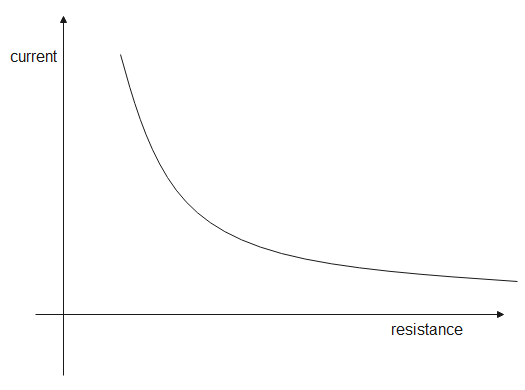
The graph shows the inverse relation between current and resistance. The slope of the graph will be negative.
Therefore, current is inversely proportional to the resistance; current decreases with increase in resistance and vice versa.
Note:
The relationship between current and resistance is true when the potential difference is constant. The resistance depends on the temperature and nature of material. The insulators have the highest resistance, semiconductors have a lower resistance and the conductors have the lowest resistance. With increase in temperature, the resistance of insulators and semiconductors decreases but the resistance of conductors increases.
Complete answer:
The resistance is the property of a material by virtue of which it resists the flow of current through it. Its SI unit is ohms ($\Omega $). In a circuit the resistance is provided by resistors. Resistors can be connected in series or parallel in a circuit.
According to the ohm's law,
$R=\dfrac{V}{I}$
Here, $R$ is the resistance
$V$ is the potential difference across a circuit
$I$ is the current in the circuit
From the above equation we can see that current is inversely proportional to the resistance in the circuit. Therefore,
$R\propto \dfrac{1}{I}$
This means as the resistance increases, the current decreases and vice versa. The graph between current and resistance is shown in the figure below
The graph shows the inverse relation between current and resistance. The slope of the graph will be negative.
Therefore, current is inversely proportional to the resistance; current decreases with increase in resistance and vice versa.
Note:
The relationship between current and resistance is true when the potential difference is constant. The resistance depends on the temperature and nature of material. The insulators have the highest resistance, semiconductors have a lower resistance and the conductors have the lowest resistance. With increase in temperature, the resistance of insulators and semiconductors decreases but the resistance of conductors increases.
Recently Updated Pages
Master Class 11 Social Science: Engaging Questions & Answers for Success

Master Class 11 English: Engaging Questions & Answers for Success
Master Class 11 Accountancy: Engaging Questions & Answers for Success
Master Class 11 Physics: Engaging Questions & Answers for Success
Master Class 11 Computer Science: Engaging Questions & Answers for Success
Master Class 11 Business Studies: Engaging Questions & Answers for Success
Trending doubts
One Metric ton is equal to kg A 10000 B 1000 C 100 class 11 physics CBSE
Find the value of the expression given below sin 30circ class 11 maths CBSE
Draw a diagram of nephron and explain its structur class 11 biology CBSE
10 examples of friction in our daily life
Proton was discovered by A Thomson B Rutherford C Chadwick class 11 chemistry CBSE
The teeth used for biting and cutting food are called class 11 biology CBSE