




What does the following floral formula represent? ${ K }_{ 5 }{ C }_{ 5 }{ A }_{ 5 }{ G }_{ (2) }$
Answer
 Verified
616.8k+ views
Hint: It represents sepals petals and anthers and carpel. When the number of floral parts is numerically represented. It is known as a floral formula. It gives us information about flower symmetry. its presence
Of fusion, level of organs, and the relationship between different floral parts.
Complete step by step answer:
- Flowers are defined by the number of organs, like petals sepals carpels, and stamens
- Floral formula represents the structure of a flower in numeric, letters and symbols forms. That's why floral formulas are considered the simplest way to represent the salient features of a flower.
- Floral formulae represent floral symmetry, position, and insertion of the ovary, the number of parts, connotations, and adnation.
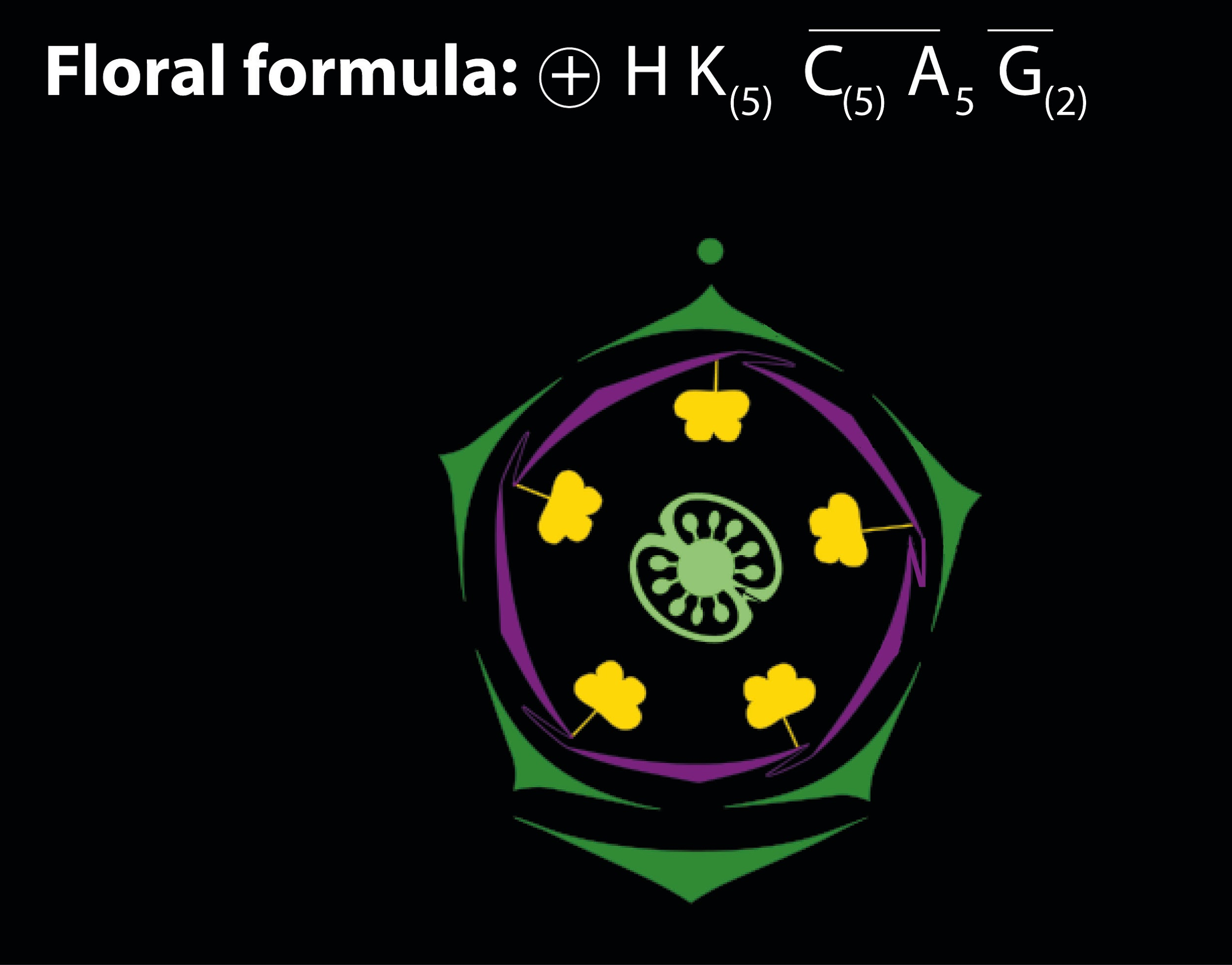
- Floral formula consists of five symbols. These are a number of sepals, numbers of petals, floral symmetry, number of carpels and number of stamens.
- In the following question K represents calyx (sepals), C represents Corolla (petals), A represents androecium (stamens), G represents gynoecium (carpels). It means the flower of the family has 5 free sepals, 5 free petals, 5 anthers, and two carpels that are fused.
Additional information:
- Floral whorls present in concentric circles. Sepals are for the outermost circle, petals are the second one, third is for stamen and the carpel is the innermost.
- For four-lobed structures, stamens are represented as dithecous anthers and for monothecous anthers, it is represented as uniform shape.
- Bracteoles are towards the sides and bract at the base.
- At the top of the floral diagram, the mother axis is represented by a small circle with a dot.
- When there is an organ missing then it is denoted by 0 after its respective symbol.
Note: Always start with a bract and bracteole when beginning to write the floral formula, then moving towards the sexuality or symmetry of the flower and then specify their floral parts.
- The numbers representing each part of the flower must be written after their corresponding symbol.
Of fusion, level of organs, and the relationship between different floral parts.
Complete step by step answer:
- Flowers are defined by the number of organs, like petals sepals carpels, and stamens
- Floral formula represents the structure of a flower in numeric, letters and symbols forms. That's why floral formulas are considered the simplest way to represent the salient features of a flower.
- Floral formulae represent floral symmetry, position, and insertion of the ovary, the number of parts, connotations, and adnation.
- Floral formula consists of five symbols. These are a number of sepals, numbers of petals, floral symmetry, number of carpels and number of stamens.
- In the following question K represents calyx (sepals), C represents Corolla (petals), A represents androecium (stamens), G represents gynoecium (carpels). It means the flower of the family has 5 free sepals, 5 free petals, 5 anthers, and two carpels that are fused.
Additional information:
- Floral whorls present in concentric circles. Sepals are for the outermost circle, petals are the second one, third is for stamen and the carpel is the innermost.
- For four-lobed structures, stamens are represented as dithecous anthers and for monothecous anthers, it is represented as uniform shape.
- Bracteoles are towards the sides and bract at the base.
- At the top of the floral diagram, the mother axis is represented by a small circle with a dot.
- When there is an organ missing then it is denoted by 0 after its respective symbol.
Note: Always start with a bract and bracteole when beginning to write the floral formula, then moving towards the sexuality or symmetry of the flower and then specify their floral parts.
- The numbers representing each part of the flower must be written after their corresponding symbol.
Recently Updated Pages
Master Class 11 English: Engaging Questions & Answers for Success

Master Class 11 Social Science: Engaging Questions & Answers for Success
Master Class 11 Maths: Engaging Questions & Answers for Success
Master Class 11 Biology: Engaging Questions & Answers for Success
Master Class 11 Physics: Engaging Questions & Answers for Success
Master Class 11 Chemistry: Engaging Questions & Answers for Success
Trending doubts
One Metric ton is equal to kg A 10000 B 1000 C 100 class 11 physics CBSE
Difference Between Prokaryotic Cells and Eukaryotic Cells
1 ton equals to A 100 kg B 1000 kg C 10 kg D 10000 class 11 physics CBSE
Find the value of the expression given below sin 30circ class 11 maths CBSE
Two of the body parts which do not appear in MRI are class 11 biology CBSE
Draw a diagram of a plant cell and label at least eight class 11 biology CBSE