




What does Oxytocin do during labor?
Answer
 Verified
513.9k+ views
Hint: Oxytocin is a peptide hormone, which is released during lactation and childbirth. It is a hormone, which is released by the posterior pituitary and is helpful in childbirth. It is a hormone of love as it makes you feel good, triggering nurturing behaviors and feelings. Oxytocin is provided to induce labor, if not started naturally. It can be utilized to strengthen contractions to help childbirth.
Complete answer:
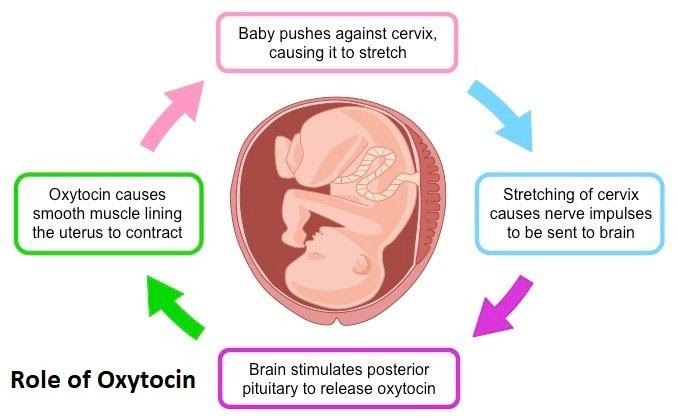
Fig.: Oxytocin in Labor & Birth
Oxytocin is released in huge amounts during labor. It is a therapeutic agent during labor and delivery. It acts as a stimulant, broadly used to induce or augment labor, when adequate oxytocin receptors are present. Besides, it prevents postpartum haemorrhage. Post childbirth, it reduces the excess blood flow.
Receptor cells in the body, which respond to oxytocin increase gradually during pregnancy and enhance a lot during labor. There is a surge of oxytocin at the final stage of labor. If there is vaginal birth, oxytocin will help in pushing. The levels of oxytocin increase at the onset of labor and during labor in comparison with or weeks before the labor. It reaches a peak when the head of the baby is delivered. Oxytocin makes the mother feel selfless and more affectionate. It promotes the progress of labor and warms the chest of the mother for skin-to-skin contact with her baby.
The other functions are as follows: Oxytocin aids uterine muscles to contract and enhances the production of prostaglandins. It also stimulates the release of milk from the mammary gland of the mother.
A low level of oxytocin during labor causes slower contractions, making the labor time longer. It results in excessive bleeding at the site of the placenta after birth. So, health care providers respond by providing interventions.
Note:
The production of oxytocin is promoted by:
1. Staying calm, confident, and comfortable.
2. Avoidance of disturbances like unwelcome people, procedures, and noise.
3. Staying upright and using gravity, so the baby is pressed against the cervix.
4. Stimulation of clitoris and nipples before birth.
5. Avoidance of epidural analgesia.
Complete answer:
Fig.: Oxytocin in Labor & Birth
Oxytocin is released in huge amounts during labor. It is a therapeutic agent during labor and delivery. It acts as a stimulant, broadly used to induce or augment labor, when adequate oxytocin receptors are present. Besides, it prevents postpartum haemorrhage. Post childbirth, it reduces the excess blood flow.
Receptor cells in the body, which respond to oxytocin increase gradually during pregnancy and enhance a lot during labor. There is a surge of oxytocin at the final stage of labor. If there is vaginal birth, oxytocin will help in pushing. The levels of oxytocin increase at the onset of labor and during labor in comparison with or weeks before the labor. It reaches a peak when the head of the baby is delivered. Oxytocin makes the mother feel selfless and more affectionate. It promotes the progress of labor and warms the chest of the mother for skin-to-skin contact with her baby.
The other functions are as follows: Oxytocin aids uterine muscles to contract and enhances the production of prostaglandins. It also stimulates the release of milk from the mammary gland of the mother.
A low level of oxytocin during labor causes slower contractions, making the labor time longer. It results in excessive bleeding at the site of the placenta after birth. So, health care providers respond by providing interventions.
Note:
The production of oxytocin is promoted by:
1. Staying calm, confident, and comfortable.
2. Avoidance of disturbances like unwelcome people, procedures, and noise.
3. Staying upright and using gravity, so the baby is pressed against the cervix.
4. Stimulation of clitoris and nipples before birth.
5. Avoidance of epidural analgesia.
Recently Updated Pages
Master Class 11 English: Engaging Questions & Answers for Success

Master Class 11 Social Science: Engaging Questions & Answers for Success
Master Class 11 Maths: Engaging Questions & Answers for Success
Master Class 11 Chemistry: Engaging Questions & Answers for Success
Master Class 11 Biology: Engaging Questions & Answers for Success
Master Class 11 Physics: Engaging Questions & Answers for Success
Trending doubts
One Metric ton is equal to kg A 10000 B 1000 C 100 class 11 physics CBSE
Difference Between Prokaryotic Cells and Eukaryotic Cells
Find the value of the expression given below sin 30circ class 11 maths CBSE
1 ton equals to A 100 kg B 1000 kg C 10 kg D 10000 class 11 physics CBSE
Two of the body parts which do not appear in MRI are class 11 biology CBSE
Draw a diagram of nephron and explain its structur class 11 biology CBSE