




How does one use the right hand rule to determine the direction of the force applied to a current carrying wire?
$(a)$ Point the fingers of the right hand in the same direction as the magnetic lines of force
$(b)$ Point the thumb at right angles to the lines of force
$(c)$ Point the fingers of the right hand along the wire in the direction of the current
$(d)$ Point the thumb in the direction of the magnetic lines of force
$(e)$ Point the fingers of the right hand against the direction of the magnetic lines of force
Answer
 Verified
625.2k+ views
Hint: In this question use the concept that the direction of force is indicated by the thumb, the direction of magnetic field is indicated by the is indicated by the middle finger and the middle finger indicates the direction of current.
Complete Step-by-Step solution:
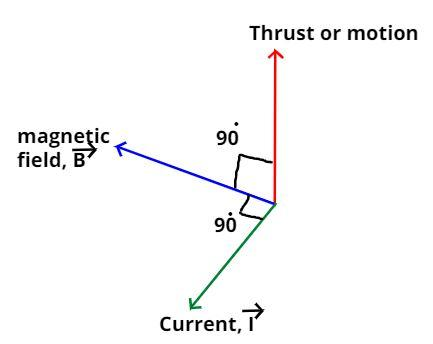
Fleming’s right hand rule –
As a conductor connected to a circuit moves in a magnetic field, Fleming's right-hand rule (for generators) indicates the direction of induced current. The thumb is pointed in the direction of the conductor's motion with respect to the magnetic field.
It follows the FBI rule, where F = force, B = magnetic field, I = current.
Thumb indicates the direction of force or thrust, index finger indicates the direction of magnetic field and middle finger indicates the direction of current.
All these are right angles as shown in the figure.
So point the fingers in the direction of magnetic lines of force.
So this is the required answer.
Hence option (D) is the correct answer.
Note – The right-hand rule can also be used to remember the direction of the axes in a standard x, y, z coordinate system: the thumb points in the positive x direction, the first finger in the positive y direction, and the middle finger in the positive z direction.
Complete Step-by-Step solution:
Fleming’s right hand rule –
As a conductor connected to a circuit moves in a magnetic field, Fleming's right-hand rule (for generators) indicates the direction of induced current. The thumb is pointed in the direction of the conductor's motion with respect to the magnetic field.
It follows the FBI rule, where F = force, B = magnetic field, I = current.
Thumb indicates the direction of force or thrust, index finger indicates the direction of magnetic field and middle finger indicates the direction of current.
All these are right angles as shown in the figure.
So point the fingers in the direction of magnetic lines of force.
So this is the required answer.
Hence option (D) is the correct answer.
Note – The right-hand rule can also be used to remember the direction of the axes in a standard x, y, z coordinate system: the thumb points in the positive x direction, the first finger in the positive y direction, and the middle finger in the positive z direction.
Recently Updated Pages
Master Class 10 Social Science: Engaging Questions & Answers for Success

Master Class 10 Science: Engaging Questions & Answers for Success
Master Class 10 Maths: Engaging Questions & Answers for Success
Master Class 10 General Knowledge: Engaging Questions & Answers for Success
Master Class 10 Computer Science: Engaging Questions & Answers for Success
Class 10 Question and Answer - Your Ultimate Solutions Guide
Trending doubts
What is the full form of PNG A Petrol Natural Gas B class 10 chemistry CBSE
In cricket, how many legal balls are there in a standard over?
Why is there a time difference of about 5 hours between class 10 social science CBSE
Distinguish between the reserved forests and protected class 10 biology CBSE
Metals which do not react with dilute acids beginarray20l class 10 chemistry CBSE
If a trait A exists in 10 of a population of an asexually class 10 biology CBSE