




When does Meiosis occur in Ferns?
Answer
 Verified
512.4k+ views
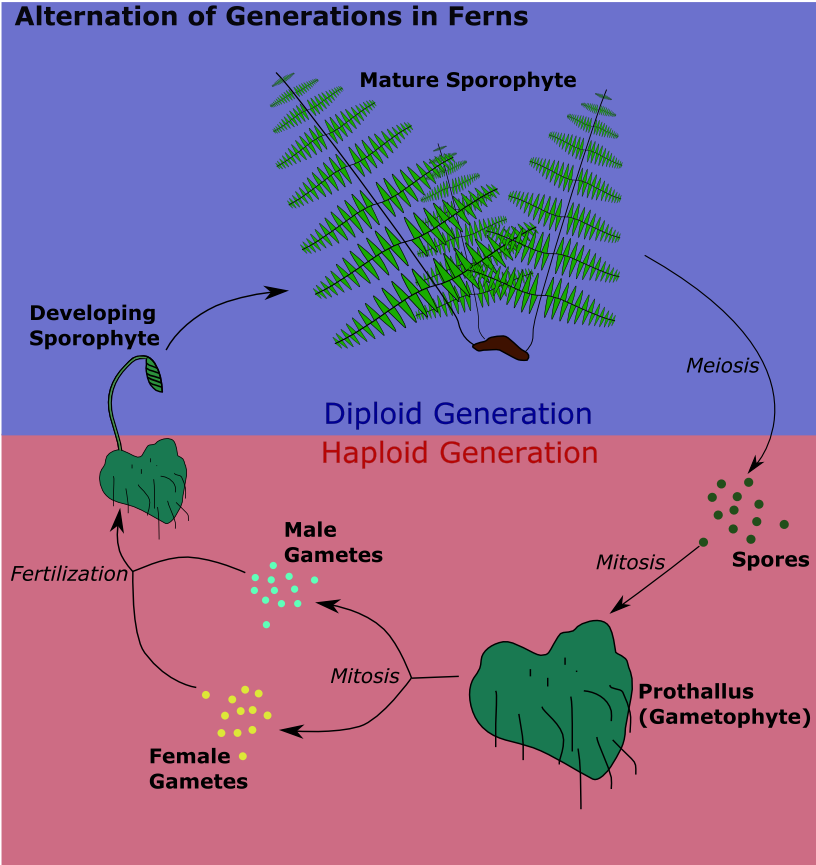
Hint: Meiosis in ferns occurs at spore formation. Where the plant body is sporophyte differentiated into leaves, stems and roots. Ferns undergo meiosis to form haploid spores. The life cycle of ferns is sporophyte and gametophyte, which releases gametes. It is a diploid plant.
Complete answer-
> Ferns are leafy and flowerless plants which are lightweight and feathery in feature and undergo spore formation from the fronds' release. They belong to the gymnosperms category and kingdom plantae. Their vascular system is transporting water.
> Meiosis is the reduction of cellular division from the number of chromosomes from the parent cell by half. This process only occurs during sexual reproduction.
> During prophase $1$ of meiotic cell division, crossings happen between chromatids of homologous chromosomes resulting in the exchange of genetic material. The point of contact is understood to be chiasmata. The chiasmata structure is X-shaped and generally happens at the point of crossing over.
> Usually, recombination or parental cohesion result in the formation of chiasmata.
> The point of contact between them is understood to be chiasmata, where transfer of genetic materials occurs.
> Exchange of non-homologous chromosomes- can be also defined as “Translocation”. This is an unusual condition where a chromosome breaks and attaches to another part of the chromosome.
We discussed the chiasmata formation, which is a result of the point of contact between two homologous chromosomes.
> The chiasmata point is visible after the synaptonemal complex disassembles. Function of chiasmata- is for adherence to the spindle fibers of the homologous chromosomes.
Note:
In ferns, gametes, prothallus and stages of spore formation take place. The life stages in ferns are when the sporophyte is released and the structure that produces spores turns into sporangia. They have both asexual and sexual mode for reproduction. Spores are produced in both modes.
Complete answer-
> Ferns are leafy and flowerless plants which are lightweight and feathery in feature and undergo spore formation from the fronds' release. They belong to the gymnosperms category and kingdom plantae. Their vascular system is transporting water.
> Meiosis is the reduction of cellular division from the number of chromosomes from the parent cell by half. This process only occurs during sexual reproduction.
> During prophase $1$ of meiotic cell division, crossings happen between chromatids of homologous chromosomes resulting in the exchange of genetic material. The point of contact is understood to be chiasmata. The chiasmata structure is X-shaped and generally happens at the point of crossing over.
> Usually, recombination or parental cohesion result in the formation of chiasmata.
> The point of contact between them is understood to be chiasmata, where transfer of genetic materials occurs.
> Exchange of non-homologous chromosomes- can be also defined as “Translocation”. This is an unusual condition where a chromosome breaks and attaches to another part of the chromosome.
We discussed the chiasmata formation, which is a result of the point of contact between two homologous chromosomes.
> The chiasmata point is visible after the synaptonemal complex disassembles. Function of chiasmata- is for adherence to the spindle fibers of the homologous chromosomes.
Note:
In ferns, gametes, prothallus and stages of spore formation take place. The life stages in ferns are when the sporophyte is released and the structure that produces spores turns into sporangia. They have both asexual and sexual mode for reproduction. Spores are produced in both modes.
Recently Updated Pages
Master Class 12 Economics: Engaging Questions & Answers for Success

Master Class 12 English: Engaging Questions & Answers for Success
Master Class 12 Social Science: Engaging Questions & Answers for Success
Master Class 12 Maths: Engaging Questions & Answers for Success
Master Class 12 Physics: Engaging Questions & Answers for Success
Master Class 9 General Knowledge: Engaging Questions & Answers for Success
Trending doubts
One Metric ton is equal to kg A 10000 B 1000 C 100 class 11 physics CBSE
Difference Between Prokaryotic Cells and Eukaryotic Cells
Two of the body parts which do not appear in MRI are class 11 biology CBSE
1 ton equals to A 100 kg B 1000 kg C 10 kg D 10000 class 11 physics CBSE
Draw a diagram of nephron and explain its structur class 11 biology CBSE
10 examples of friction in our daily life