




How does digested food enter the blood?
Answer
 Verified
569.7k+ views
Hint: Digestion involves the blending of food, its movement through the alimentary canal , and therefore the chemical breakdown of the massive molecules of food into smaller molecules. Digestion begins within the mouth, once we chew and swallow, and is completed within the intestine .
Complete answer:
The digested food and nutrients are absorbed through the wall of small intestines.Nutrients then are filtered out by the liver removing any harmful substance then these nutrients are carried within the blood.
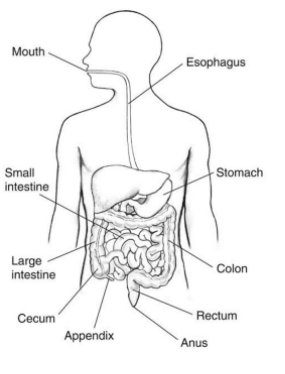
The small intestine absorbs most digested food molecules, also as water and minerals, and passes them on to other parts of the body for storage or further chemical process . Specialized cells help absorbed materials cross the intestinal lining into the bloodstream.
After the digestion of food, the tiny intestine absorbs most digested food molecules, also as water and minerals, and passes them on to other parts of the body for storage or further chemical process . Specialized cells help absorbed materials cross the intestinal lining into the bloodstream.
The bloodstream carries simple sugars, amino acids, glycerol, and a few vitamins and salts to the liver. The systema lymphatica , a network of vessels that carry white blood cells and a fluid called lymph throughout the body, absorbs fatty acids and vitamins.
Note: The mouth is the beginning of the digestive tract. Digestion starts here as soon as we take the primary bite of a meal. Chewing breaks the food into pieces that are more easily digested,while saliva mixes with food to start the method of breaking it down into a form our body can absorb and use.
Complete answer:
The digested food and nutrients are absorbed through the wall of small intestines.Nutrients then are filtered out by the liver removing any harmful substance then these nutrients are carried within the blood.
The small intestine absorbs most digested food molecules, also as water and minerals, and passes them on to other parts of the body for storage or further chemical process . Specialized cells help absorbed materials cross the intestinal lining into the bloodstream.
After the digestion of food, the tiny intestine absorbs most digested food molecules, also as water and minerals, and passes them on to other parts of the body for storage or further chemical process . Specialized cells help absorbed materials cross the intestinal lining into the bloodstream.
The bloodstream carries simple sugars, amino acids, glycerol, and a few vitamins and salts to the liver. The systema lymphatica , a network of vessels that carry white blood cells and a fluid called lymph throughout the body, absorbs fatty acids and vitamins.
Note: The mouth is the beginning of the digestive tract. Digestion starts here as soon as we take the primary bite of a meal. Chewing breaks the food into pieces that are more easily digested,while saliva mixes with food to start the method of breaking it down into a form our body can absorb and use.
Recently Updated Pages
Master Class 12 Economics: Engaging Questions & Answers for Success

Master Class 12 English: Engaging Questions & Answers for Success
Master Class 12 Social Science: Engaging Questions & Answers for Success
Master Class 12 Maths: Engaging Questions & Answers for Success
Master Class 12 Physics: Engaging Questions & Answers for Success
Master Class 11 Social Science: Engaging Questions & Answers for Success
Trending doubts
One Metric ton is equal to kg A 10000 B 1000 C 100 class 11 physics CBSE
Difference Between Prokaryotic Cells and Eukaryotic Cells
Two of the body parts which do not appear in MRI are class 11 biology CBSE
1 ton equals to A 100 kg B 1000 kg C 10 kg D 10000 class 11 physics CBSE
Draw a diagram of nephron and explain its structur class 11 biology CBSE
10 examples of friction in our daily life