




: How does benzene differ from other cyclic hydrocarbons?
Answer
 Verified
569.4k+ views
Hint: Aromatic compounds and the compounds that possess an alternate double and single bond system, where delocalization of electrons can occur.
Complete step-by-step answer:The compound with the formula\[{{C}_{6}}{{H}_{6}}\], contains an alignment with alternate single and double bond inside as ring structure. This compound is known as benzene. Benzene has an aromatic nature, this is proven by the fact that, when we burn it or does a flame test, it burns with a smoky flame; this is the property of aromatic compounds. While, aliphatic compounds burns with flame that is does not produce smoke. Also due to its high carbon content, it has sooty deposits while burning.
Benzene has a cyclic and a planar structure with a six-member carbon ring. The structure of benzene allows delocalization of electrons. The structure is as follows:
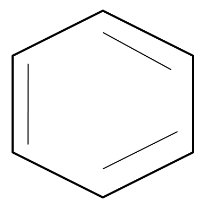
As benzene allows complete delocalization of electrons (pi-electrons), it has conjugation that allows it to participate in electrophilic substitution reactions. This property is possessed by benzene and not by other cyclic hydrocarbons due to absence of aromaticity.
The electrophilic substitution reactions of benzene occur as when an electrophile attacks the benzene, hydrogen gets removed, in the intermediate step, the benzene cation formed by removal of hydrogen is highly reactive, that allows electrophilic substitution on the place of removal of hydrogen. Nitration, sulphonation, Friedal-crafts reactions, are some of the examples of electrophilic substitution reactions of benzene.
Hence, benzene differs in aromaticity and electrophilic substitution reactions from other cyclic hydrocarbons.
Note: Benzene has all the carbons as $s{{p}^{2}}$ hybridized. All the bond lengths are equal in benzene due to resonance, this makes it highly stable and easily available for electrophilic substitution reaction.
Complete step-by-step answer:The compound with the formula\[{{C}_{6}}{{H}_{6}}\], contains an alignment with alternate single and double bond inside as ring structure. This compound is known as benzene. Benzene has an aromatic nature, this is proven by the fact that, when we burn it or does a flame test, it burns with a smoky flame; this is the property of aromatic compounds. While, aliphatic compounds burns with flame that is does not produce smoke. Also due to its high carbon content, it has sooty deposits while burning.
Benzene has a cyclic and a planar structure with a six-member carbon ring. The structure of benzene allows delocalization of electrons. The structure is as follows:
As benzene allows complete delocalization of electrons (pi-electrons), it has conjugation that allows it to participate in electrophilic substitution reactions. This property is possessed by benzene and not by other cyclic hydrocarbons due to absence of aromaticity.
The electrophilic substitution reactions of benzene occur as when an electrophile attacks the benzene, hydrogen gets removed, in the intermediate step, the benzene cation formed by removal of hydrogen is highly reactive, that allows electrophilic substitution on the place of removal of hydrogen. Nitration, sulphonation, Friedal-crafts reactions, are some of the examples of electrophilic substitution reactions of benzene.
Hence, benzene differs in aromaticity and electrophilic substitution reactions from other cyclic hydrocarbons.
Note: Benzene has all the carbons as $s{{p}^{2}}$ hybridized. All the bond lengths are equal in benzene due to resonance, this makes it highly stable and easily available for electrophilic substitution reaction.
Recently Updated Pages
Master Class 12 Economics: Engaging Questions & Answers for Success

Master Class 12 English: Engaging Questions & Answers for Success
Master Class 12 Social Science: Engaging Questions & Answers for Success
Master Class 12 Maths: Engaging Questions & Answers for Success
Master Class 12 Physics: Engaging Questions & Answers for Success
Master Class 11 Social Science: Engaging Questions & Answers for Success
Trending doubts
Find the value of the expression given below sin 30circ class 11 maths CBSE
Draw a diagram of a plant cell and label at least eight class 11 biology CBSE
Name the Largest and the Smallest Cell in the Human Body ?
Draw a diagram showing the external features of fish class 11 biology CBSE
What organs are located on the left side of your body class 11 biology CBSE
Difference between physical and chemical change class 11 chemistry CBSE