




How does anisole react with bromine in ethanoic acid? Write the chemical equation for the reaction.
Answer
 Verified
647.4k+ views
Hint: You should know that; anisole is an electron withdrawing group. It undergoes electrophilic substitution. The halogenation will take place only at the ortho and para positions for anisole and the meta position is not included during this reaction.
Complete step by step solution:
Anisole is an organic compound, which is also known by methoxybenzene. It has a chemical formula ${{C}_{6}}{{H}_{5}}OC{{H}_{3}}$.
The methoxy group present in anisole acts as an electron donating group and it will donate its electron density of the oxygen atom to the benzene ring and thus, the electron density on the benzene ring will increase. Further, this will undergo electrophilic aromatic substitution, resulting in halogenation.
We should know that the methoxy group present in anisole is an ortho, para directing, thus it makes anisole ortho-para directing in nature. So, while reacting, the attacking group will attach to the ortho or para position with respect to the methoxy group in the ring.
Now, coming to ethanoic acid. As we know it is called acetic acid, which acts as a polar solvent for dissolving anisole.
So, we can write the chemical reaction of bromination of anisole as follows:
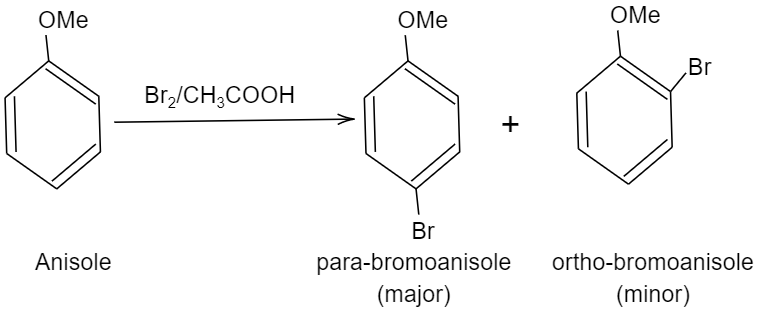
We can see, two products are formed i.e. para-bromoanisole (also written as $1-bromo-2-methoxybenzene$) and the other product is ortho-bromoanisole or $1-bromo-4-methoxybenzene$.
Note: Among these two products formed, para-bromoanisole is the major product and its yield will be around $90%$, ortho product formed is considered as the minor product due to the presence of steric hindrance in the ortho position (bulky methoxy group is present in the ortho group of the benzene ring).
Complete step by step solution:
Anisole is an organic compound, which is also known by methoxybenzene. It has a chemical formula ${{C}_{6}}{{H}_{5}}OC{{H}_{3}}$.
The methoxy group present in anisole acts as an electron donating group and it will donate its electron density of the oxygen atom to the benzene ring and thus, the electron density on the benzene ring will increase. Further, this will undergo electrophilic aromatic substitution, resulting in halogenation.
We should know that the methoxy group present in anisole is an ortho, para directing, thus it makes anisole ortho-para directing in nature. So, while reacting, the attacking group will attach to the ortho or para position with respect to the methoxy group in the ring.
Now, coming to ethanoic acid. As we know it is called acetic acid, which acts as a polar solvent for dissolving anisole.
So, we can write the chemical reaction of bromination of anisole as follows:
We can see, two products are formed i.e. para-bromoanisole (also written as $1-bromo-2-methoxybenzene$) and the other product is ortho-bromoanisole or $1-bromo-4-methoxybenzene$.
Note: Among these two products formed, para-bromoanisole is the major product and its yield will be around $90%$, ortho product formed is considered as the minor product due to the presence of steric hindrance in the ortho position (bulky methoxy group is present in the ortho group of the benzene ring).
Recently Updated Pages
Which of the following graphs shows the variation of class 12 physics CBSE

Draw a labelled diagram of the human male reproductive class 12 biology CBSE
Describe the experiment to compare the emf of two cells class 12 physics CBSE
What is standard hydrogen electrode
What is conventional current and electric current class 12 physics CBSE
2Bromopentane is treated with an alcoholic KOH solution class 12 chemistry CBSE
Trending doubts
Draw a labelled sketch of the human eye class 12 physics CBSE
Which are the Top 10 Largest Countries of the World?
Differentiate between homogeneous and heterogeneous class 12 chemistry CBSE
Draw ray diagrams each showing i myopic eye and ii class 12 physics CBSE
Which is the correct genotypic ratio of mendel dihybrid class 12 biology CBSE
What is the Full Form of PVC, PET, HDPE, LDPE, PP and PS ?