




What does action-reaction force mean?
Answer
 Verified
512.7k+ views
Hint: The forces which act on a body are the action forces and the force which in return acts on the source which applied the force is called the reaction force. Here the action-reaction force is given a special law by Newton. The third law of Newton is based on this nature of the force which has equal as well as opposite action.
Complete answer:
Newton’s law suggests that every force acts in pairs, either it is the force of attraction between sun and the earth, or it may be the force acting between the standing boy and the ground. In both cases equal and opposite forces act on both the bodies.
Let us understand by a simple diagram,
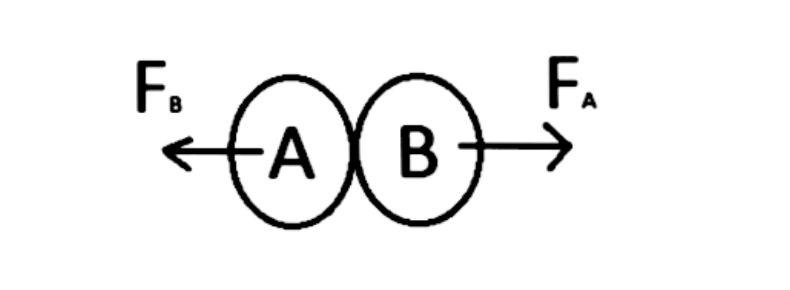
Here, the force on body B is applied by body A which is ${F_A}$, and the force on body A is in turn applied by body B which is ${F_B}$ . These two forces which act are equal and have opposite directions.
According to Newton’s third law of motion, ’Every action has an equal and opposite reaction’. Imagine while a book is kept on the table, while it is kept on the table it does not move since a force equal to its weight is applied to it to keep it in an equilibrium state.
Note:
We know by Newton’s third law every action has an equal and opposite action therefore whenever we come across a force like frictional force, gravitational force, tension force, normal force, magnetic force etc. we always experience a kind of reversed push applied by the target objects. Newton performed several examples to get to this result.
Complete answer:
Newton’s law suggests that every force acts in pairs, either it is the force of attraction between sun and the earth, or it may be the force acting between the standing boy and the ground. In both cases equal and opposite forces act on both the bodies.
Let us understand by a simple diagram,
Here, the force on body B is applied by body A which is ${F_A}$, and the force on body A is in turn applied by body B which is ${F_B}$ . These two forces which act are equal and have opposite directions.
According to Newton’s third law of motion, ’Every action has an equal and opposite reaction’. Imagine while a book is kept on the table, while it is kept on the table it does not move since a force equal to its weight is applied to it to keep it in an equilibrium state.
Note:
We know by Newton’s third law every action has an equal and opposite action therefore whenever we come across a force like frictional force, gravitational force, tension force, normal force, magnetic force etc. we always experience a kind of reversed push applied by the target objects. Newton performed several examples to get to this result.
Recently Updated Pages
Master Class 11 English: Engaging Questions & Answers for Success

Master Class 11 Social Science: Engaging Questions & Answers for Success
Master Class 11 Maths: Engaging Questions & Answers for Success
Master Class 11 Biology: Engaging Questions & Answers for Success
Master Class 11 Physics: Engaging Questions & Answers for Success
Master Class 11 Chemistry: Engaging Questions & Answers for Success
Trending doubts
One Metric ton is equal to kg A 10000 B 1000 C 100 class 11 physics CBSE
Difference Between Prokaryotic Cells and Eukaryotic Cells
Find the value of the expression given below sin 30circ class 11 maths CBSE
1 ton equals to A 100 kg B 1000 kg C 10 kg D 10000 class 11 physics CBSE
Two of the body parts which do not appear in MRI are class 11 biology CBSE
What are hard magnetic materials class 11 physics CBSE