




What does a cross product of $0$ mean?
Answer
 Verified
539.1k+ views
Hint: We will first understand the meaning of cross product and how it is used. We will use the definition that the cross product of two vectors is given by the formula
$\overrightarrow A \times \overrightarrow B = \left| {\overrightarrow A } \right|\left| {\overrightarrow B } \right|\sin \theta $ , where $\theta $ is the angle between the two vectors.
Complete step by step solution:
As we know, the cross product is the binary operation on two vectors in three-dimensional space. It shows us two vectors that are parallel to each other.
We know that the cross product meaning relies on the concept of vectors i.e. it is related with the product of vectors such as
$\overrightarrow A \times \overrightarrow B $ .
Cross Product Formula:
If $\theta $ is the angle between the given vectors, then the formula is denoted by
$\overrightarrow A \times \overrightarrow B = \left| {\overrightarrow A } \right|\left| {\overrightarrow B } \right|\sin \theta \,\,\hat n$ , where $\left| {\overrightarrow A } \right| = $ length of vector A
$\left| {\overrightarrow B } \right| = $ length of vector B
$\theta = $Angle between A and B
And, $n = $ unit vector perpendicular to the plane,
This can be written as the cross product of two vectors is magnitude-wise equal to the product of their magnitude with their sides of that angle between them .
So if we have
$\sin \theta = 0$, then according to formula the result will be
$\left| {\overrightarrow A } \right|\left| {\overrightarrow B } \right| \times 0 = 0$ .
So if the cross product of two vectors is zero then the two vectors are parallel to each other or the angle between them is $0$.
Hence If the two vectors are in the same direction, then the angle between them $\theta $ is
$0$.
So the resultant vector will be the zero vector.
Note:
We can understand the cross product formula with the example.
Let us draw a parallelogram.
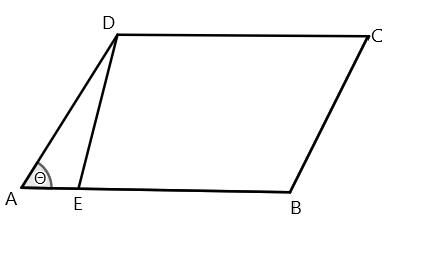
We know the area of the parallelogram is base $ \times $ height. Here Base is $AB$ and height $ = DE$ .
We know that the cross product of two dimensional figures gives us a vector which is equal to the area enclosed by the parallelogram between two vectors or sides.
Here we have $\left| {\overrightarrow A } \right| = AB$ and $\left| {\overrightarrow B } \right| = DE$
So by applying the formula here we can say that the area is
$AB \times DE \times \sin \theta $
$\overrightarrow A \times \overrightarrow B = \left| {\overrightarrow A } \right|\left| {\overrightarrow B } \right|\sin \theta $ , where $\theta $ is the angle between the two vectors.
Complete step by step solution:
As we know, the cross product is the binary operation on two vectors in three-dimensional space. It shows us two vectors that are parallel to each other.
We know that the cross product meaning relies on the concept of vectors i.e. it is related with the product of vectors such as
$\overrightarrow A \times \overrightarrow B $ .
Cross Product Formula:
If $\theta $ is the angle between the given vectors, then the formula is denoted by
$\overrightarrow A \times \overrightarrow B = \left| {\overrightarrow A } \right|\left| {\overrightarrow B } \right|\sin \theta \,\,\hat n$ , where $\left| {\overrightarrow A } \right| = $ length of vector A
$\left| {\overrightarrow B } \right| = $ length of vector B
$\theta = $Angle between A and B
And, $n = $ unit vector perpendicular to the plane,
This can be written as the cross product of two vectors is magnitude-wise equal to the product of their magnitude with their sides of that angle between them .
So if we have
$\sin \theta = 0$, then according to formula the result will be
$\left| {\overrightarrow A } \right|\left| {\overrightarrow B } \right| \times 0 = 0$ .
So if the cross product of two vectors is zero then the two vectors are parallel to each other or the angle between them is $0$.
Hence If the two vectors are in the same direction, then the angle between them $\theta $ is
$0$.
So the resultant vector will be the zero vector.
Note:
We can understand the cross product formula with the example.
Let us draw a parallelogram.
We know the area of the parallelogram is base $ \times $ height. Here Base is $AB$ and height $ = DE$ .
We know that the cross product of two dimensional figures gives us a vector which is equal to the area enclosed by the parallelogram between two vectors or sides.
Here we have $\left| {\overrightarrow A } \right| = AB$ and $\left| {\overrightarrow B } \right| = DE$
So by applying the formula here we can say that the area is
$AB \times DE \times \sin \theta $
Recently Updated Pages
Master Class 12 Business Studies: Engaging Questions & Answers for Success

Master Class 12 Biology: Engaging Questions & Answers for Success
Master Class 12 Chemistry: Engaging Questions & Answers for Success
Class 12 Question and Answer - Your Ultimate Solutions Guide
Master Class 11 Social Science: Engaging Questions & Answers for Success
Master Class 11 English: Engaging Questions & Answers for Success
Trending doubts
Which are the Top 10 Largest Countries of the World?
Draw a labelled sketch of the human eye class 12 physics CBSE
Differentiate between homogeneous and heterogeneous class 12 chemistry CBSE
Why is the cell called the structural and functional class 12 biology CBSE
Draw ray diagrams each showing i myopic eye and ii class 12 physics CBSE
Which is the correct genotypic ratio of mendel dihybrid class 12 biology CBSE