




Do prokaryotes have ribosomes?
Answer
 Verified
570.6k+ views
Hint: Prokaryotes are the unicellular organisms that are small in size and lack membrane-bound organelles. Bacteria and blue-green algae come under this category. The reproduction in prokaryotes depends upon the type of organism and can be of both sexual and asexual type.
Complete answer:
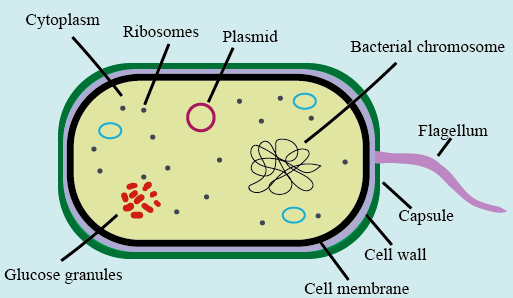
Prokaryotes are unicellular organisms in nature. Its cell range in size from $0.2\mu m$ – $2\mu m$ in diameter. They lack a well-organized nucleus. The permeability of the Nuclear membrane is not present. The nucleolus is absent. Various cell organelles are absent in prokaryotes that include the Golgi apparatus, endoplasmic reticulum, and mitochondria are absent while ribosomes are present in protists and are much smaller when compared to the ribosomes of the eukaryotes. They are very minute and are submicroscopic in size. Flagella with only a single fiber are present that helps in their locomotion. Due to the smaller size of prokaryotes, the dispersion of the particles occurs rapidly.
In 1983 A.D. The ribosomes were first isolated by Claude. In the broad beans root cells, the ribosomes were reported for the first time. They are the cell organelle that are known as the smallest electron microscopic cell organelle. The site for protein synthesis is the ribosomes and these ribosomes are of two types based on the sedimentation coefficient, 70s ribosomes, and 80s ribosomes.
Ribosomes are made up of ribonucleoprotein and are tiny particles that help in the production of protein. They differ based on the prokaryotic and eukaryotic cells. The ribosomes of the prokaryotic cells are made up of 54 kinds of proteins and rRNAs of 3 types. The 3 types of rRNAs are namely, 5S,16S, and 23S rRNAs. While the ribosomes of eukaryotic cells are of two types, the 70S, and 80S they are located freely and attached. The 80S eukaryotic cyto ribosome has two unequal subunits. Their larger subunit is formed of 40 kinds of proteins and 28S, 5S, and 5. 8S rRNAs. The Smaller subunit is formed of 30- 40 proteins and 18S rRNAs.
Note:
'S' values are not additive. 'S' represents the Svedberg unit- the unit of measurement of sedimentation coefficient in ultracentrifugation. Ribosomes are present in all prokaryotic and eukaryotic cells except in mature mammalian erythrocytes. Without any organelles or complex chromosomes to breed, most prokaryotic cells can divide every 24 hours, or maybe faster with an adequate supply of food.
Complete answer:
Prokaryotes are unicellular organisms in nature. Its cell range in size from $0.2\mu m$ – $2\mu m$ in diameter. They lack a well-organized nucleus. The permeability of the Nuclear membrane is not present. The nucleolus is absent. Various cell organelles are absent in prokaryotes that include the Golgi apparatus, endoplasmic reticulum, and mitochondria are absent while ribosomes are present in protists and are much smaller when compared to the ribosomes of the eukaryotes. They are very minute and are submicroscopic in size. Flagella with only a single fiber are present that helps in their locomotion. Due to the smaller size of prokaryotes, the dispersion of the particles occurs rapidly.
In 1983 A.D. The ribosomes were first isolated by Claude. In the broad beans root cells, the ribosomes were reported for the first time. They are the cell organelle that are known as the smallest electron microscopic cell organelle. The site for protein synthesis is the ribosomes and these ribosomes are of two types based on the sedimentation coefficient, 70s ribosomes, and 80s ribosomes.
Ribosomes are made up of ribonucleoprotein and are tiny particles that help in the production of protein. They differ based on the prokaryotic and eukaryotic cells. The ribosomes of the prokaryotic cells are made up of 54 kinds of proteins and rRNAs of 3 types. The 3 types of rRNAs are namely, 5S,16S, and 23S rRNAs. While the ribosomes of eukaryotic cells are of two types, the 70S, and 80S they are located freely and attached. The 80S eukaryotic cyto ribosome has two unequal subunits. Their larger subunit is formed of 40 kinds of proteins and 28S, 5S, and 5. 8S rRNAs. The Smaller subunit is formed of 30- 40 proteins and 18S rRNAs.
Note:
'S' values are not additive. 'S' represents the Svedberg unit- the unit of measurement of sedimentation coefficient in ultracentrifugation. Ribosomes are present in all prokaryotic and eukaryotic cells except in mature mammalian erythrocytes. Without any organelles or complex chromosomes to breed, most prokaryotic cells can divide every 24 hours, or maybe faster with an adequate supply of food.
Recently Updated Pages
Master Class 11 Social Science: Engaging Questions & Answers for Success

Master Class 11 English: Engaging Questions & Answers for Success
Master Class 11 Maths: Engaging Questions & Answers for Success
Master Class 11 Chemistry: Engaging Questions & Answers for Success
Master Class 11 Biology: Engaging Questions & Answers for Success
Class 11 Question and Answer - Your Ultimate Solutions Guide
Trending doubts
One Metric ton is equal to kg A 10000 B 1000 C 100 class 11 physics CBSE
Difference Between Prokaryotic Cells and Eukaryotic Cells
Find the value of the expression given below sin 30circ class 11 maths CBSE
1 ton equals to A 100 kg B 1000 kg C 10 kg D 10000 class 11 physics CBSE
Two of the body parts which do not appear in MRI are class 11 biology CBSE
Draw a diagram of nephron and explain its structur class 11 biology CBSE