




Do chloroplasts have DNA?
Answer
 Verified
570.6k+ views
Hint: Chloroplast is the cell organelles of the plant cell and is absent in animal cells. They are responsible for the process of photosynthesis and results in the formation of ATP molecules. They can also produce their own proteins as they have their own genetic material.
Complete answer:
The chloroplast is double membrane-bound organelles which are separated by fluid-filled intermembrane space. Their genetic material consists of DNA, RNA, along with ribosome, and certain enzymes. The chloroplast has a flat-like structure called thylakoid where the photosynthetic pigment, chlorophyll is present. Thes thylakoids are arranged in a stack-like manner one above the other forming a grana which is connected with the help of stroma lamellae. The chlorophyll pigments are of two types chlorophyll a and b. The chloroplasts varied in shape and structure depending upon the type of organisms in which it is found.
The extranuclear gene transmission is known as the cytoplasmic inheritance. It occurs in most eukaryotes, commonly occurring in cytoplasmic organelles such as chloroplast as they have their own DNA. Chloroplasts produce food for plants during the process of photosynthesis and this food is stored in the form of sugars.
The genes located in chloroplasts carry out proper cellular functions and the genomes replicate independently of the nuclear DNA which is typically arranged in chromosomes that only replicate once preceding cellular division.
Chloroplast has its DNA, also known as the plastome when referring to genomes of other plastids. They are present inside the cells of plants and algae. Plastids produce their proteins due to the presence of their DNA and ribosomes. They were first introduced in 1837 by Hugo von Mohl and were termed chloroplast in 1884 by Eduard Strasburger.
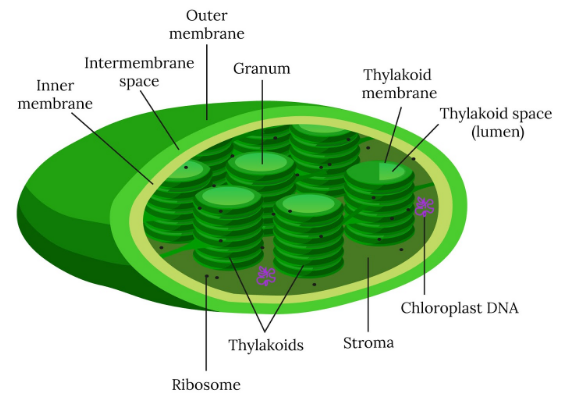
Note:
Both chloroplast and mitochondria are the cell organelles that are very similar to each other. Both have double-membrane structure with their own genetic material that includes DNA and RNA. Both result in the formation of the ATP during the process of respiration and photosynthesis.
Complete answer:
The chloroplast is double membrane-bound organelles which are separated by fluid-filled intermembrane space. Their genetic material consists of DNA, RNA, along with ribosome, and certain enzymes. The chloroplast has a flat-like structure called thylakoid where the photosynthetic pigment, chlorophyll is present. Thes thylakoids are arranged in a stack-like manner one above the other forming a grana which is connected with the help of stroma lamellae. The chlorophyll pigments are of two types chlorophyll a and b. The chloroplasts varied in shape and structure depending upon the type of organisms in which it is found.
The extranuclear gene transmission is known as the cytoplasmic inheritance. It occurs in most eukaryotes, commonly occurring in cytoplasmic organelles such as chloroplast as they have their own DNA. Chloroplasts produce food for plants during the process of photosynthesis and this food is stored in the form of sugars.
The genes located in chloroplasts carry out proper cellular functions and the genomes replicate independently of the nuclear DNA which is typically arranged in chromosomes that only replicate once preceding cellular division.
Chloroplast has its DNA, also known as the plastome when referring to genomes of other plastids. They are present inside the cells of plants and algae. Plastids produce their proteins due to the presence of their DNA and ribosomes. They were first introduced in 1837 by Hugo von Mohl and were termed chloroplast in 1884 by Eduard Strasburger.
Note:
Both chloroplast and mitochondria are the cell organelles that are very similar to each other. Both have double-membrane structure with their own genetic material that includes DNA and RNA. Both result in the formation of the ATP during the process of respiration and photosynthesis.
Recently Updated Pages
Master Class 11 Social Science: Engaging Questions & Answers for Success

Master Class 11 English: Engaging Questions & Answers for Success
Master Class 11 Maths: Engaging Questions & Answers for Success
Master Class 11 Chemistry: Engaging Questions & Answers for Success
Master Class 11 Biology: Engaging Questions & Answers for Success
Class 11 Question and Answer - Your Ultimate Solutions Guide
Trending doubts
One Metric ton is equal to kg A 10000 B 1000 C 100 class 11 physics CBSE
Difference Between Prokaryotic Cells and Eukaryotic Cells
Find the value of the expression given below sin 30circ class 11 maths CBSE
1 ton equals to A 100 kg B 1000 kg C 10 kg D 10000 class 11 physics CBSE
Two of the body parts which do not appear in MRI are class 11 biology CBSE
Draw a diagram of nephron and explain its structur class 11 biology CBSE