




DNA is present in or which one of the following has its own DNA?
(a) Nucleus only
(b) Mitochondria only
(c) Chloroplast only
(d) All of the above
Answer
 Verified
625.2k+ views
Hint: Some cell organelles are endosymbionts as they are supposed to have developed from an endosymbiotic mutualistic relationship. These organelles function as semi-autonomous organelles and replicate on their own whenever required.
Complete step-by-step answer:
In eukaryotic cells, besides the nucleus, the DNA is present in two other cell organelles, chloroplast, and mitochondria.
Additional Information:
Presence of the DNA in them is explained by a theory known as endosymbiotic theory. According to the theory, these two organelles were once anaerobic bacteria like prokaryotic microbes in an earlier time and got engulfed by endocytosis by the photosynthetic bacteria and aerobic bacteria where they formed a mutually beneficial relationship and evolved as chloroplast and mitochondria respectively and the parent cell developed as plant cell and animal cell respectively.
Thus, these two organelles have their own DNA which is similar to the prokaryotic DNA as it is single circular DNA unlike the double-stranded linear DNA of eukaryotes. Due to the presence of their own DNA, they function as semi-autonomous organelles and divide by binary fission whenever required. These two organelles have been shown in the figure below -
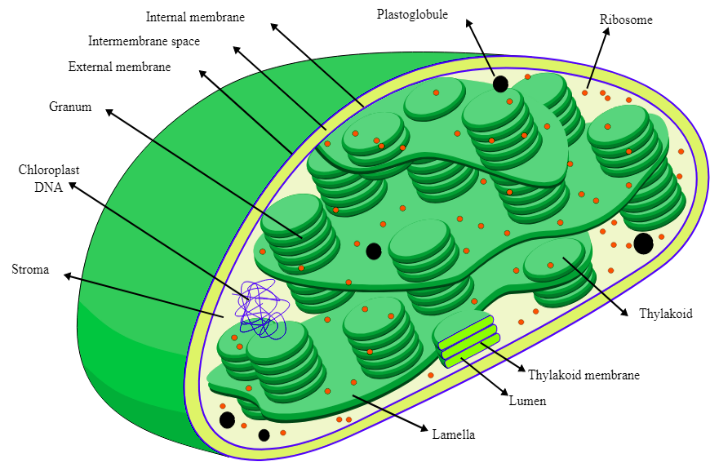
Fig.- Chloroplast
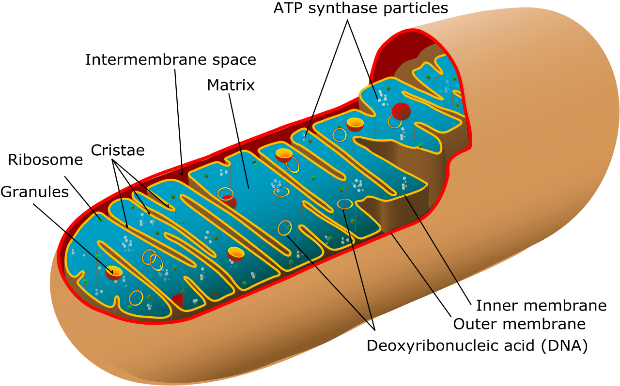
Fig.- Mitochondria
So, the correct answer is ‘All of the above’.
Note:
1. Mitochondria is a cylindrical or sausage-shaped double membranous organelle found in all the eukaryotic cells. The inner and outer membranes differ in the structure as the outer one is smooth but the inner one has enfoldings that are called cristae. The inner membrane surrounds a matrix where single circular DNA, a few RNAs, 70s ribosomes, and other components required for protein synthesis are present.
2. Chloroplasts are also double membrane-bound and are located in the cytoplasm of eukaryotic plant cells only. They absorb sunlight and using light and environmental carbon dioxide, they make food i.e. sugar for the plant cells.
Complete step-by-step answer:
In eukaryotic cells, besides the nucleus, the DNA is present in two other cell organelles, chloroplast, and mitochondria.
Additional Information:
Presence of the DNA in them is explained by a theory known as endosymbiotic theory. According to the theory, these two organelles were once anaerobic bacteria like prokaryotic microbes in an earlier time and got engulfed by endocytosis by the photosynthetic bacteria and aerobic bacteria where they formed a mutually beneficial relationship and evolved as chloroplast and mitochondria respectively and the parent cell developed as plant cell and animal cell respectively.
Thus, these two organelles have their own DNA which is similar to the prokaryotic DNA as it is single circular DNA unlike the double-stranded linear DNA of eukaryotes. Due to the presence of their own DNA, they function as semi-autonomous organelles and divide by binary fission whenever required. These two organelles have been shown in the figure below -
Fig.- Chloroplast
Fig.- Mitochondria
So, the correct answer is ‘All of the above’.
Note:
1. Mitochondria is a cylindrical or sausage-shaped double membranous organelle found in all the eukaryotic cells. The inner and outer membranes differ in the structure as the outer one is smooth but the inner one has enfoldings that are called cristae. The inner membrane surrounds a matrix where single circular DNA, a few RNAs, 70s ribosomes, and other components required for protein synthesis are present.
2. Chloroplasts are also double membrane-bound and are located in the cytoplasm of eukaryotic plant cells only. They absorb sunlight and using light and environmental carbon dioxide, they make food i.e. sugar for the plant cells.
Recently Updated Pages
Master Class 12 Business Studies: Engaging Questions & Answers for Success

Master Class 12 Biology: Engaging Questions & Answers for Success
Master Class 12 Chemistry: Engaging Questions & Answers for Success
Class 12 Question and Answer - Your Ultimate Solutions Guide
Master Class 11 Social Science: Engaging Questions & Answers for Success
Master Class 11 English: Engaging Questions & Answers for Success
Trending doubts
Explain the Treaty of Vienna of 1815 class 10 social science CBSE
Which Indian city is known as the "City of Victory"?
Which instrument is used to measure the Blood Pressure?
Who Won 36 Oscar Awards? Record Holder Revealed
What is the median of the first 10 natural numbers class 10 maths CBSE
Why is it 530 pm in india when it is 1200 afternoon class 10 social science CBSE