




Distinguish between distance and displacement.
Answer
 Verified
665.4k+ views
Hint: Usually in order to define the position of any point or an object we require a reference system. We have chosen a reference system which contains 3 axes representing three dimensions. We call them the x, y, z axes. We take a reference point as its origin and we measure length from origin. Based on how we measure that length we have two entities i.e distance and displacement.
Complete step by step answer:
DISTANCE:
It is the total length travelled by a particle in a certain time interval. The path in which it travels matters too. It is a scalar quantity i.e it has only magnitude. Since it has only magnitude it is Always positive. Its value will be greater than or equal to the displacement. Its unit is meter
DISPLACEMENT.
It is the shortest distance or shortest length the particle had travelled in a given time interval. Path of travel doesn’t matter over here. It is a vector quantity so it has both direction and magnitude. It can be positive or negative or even can be zero. It can never be greater than distance it is always lesser than or equal to distance. Its unit is meter.
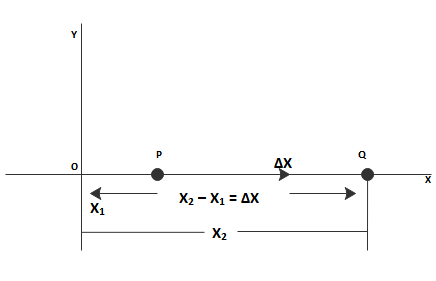
In the above image let us assume the particle started from P and travelled till Q in a straight line. Here PQ will be both distance and displacement. Hence distance and displacement are equal in this case.
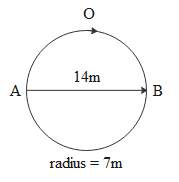
In the above circle if a particle had travelled from A to B along AOB then distance is half of the perimeter of the circle i.e 22m while displacement is its diameter i.e 14m and if it reaches point A again then distance is its perimeter 44m while displacement is zero.
Note:
If a body is travelling in the straight lane path without reversing its direction, we call distance and displacement are equal. In the first figure distance is equal to displacement because the particle had travelled in straight line motion. In kinematics most of the formulas we use involves displacement rather than distance.
Complete step by step answer:
DISTANCE:
It is the total length travelled by a particle in a certain time interval. The path in which it travels matters too. It is a scalar quantity i.e it has only magnitude. Since it has only magnitude it is Always positive. Its value will be greater than or equal to the displacement. Its unit is meter
DISPLACEMENT.
It is the shortest distance or shortest length the particle had travelled in a given time interval. Path of travel doesn’t matter over here. It is a vector quantity so it has both direction and magnitude. It can be positive or negative or even can be zero. It can never be greater than distance it is always lesser than or equal to distance. Its unit is meter.
In the above image let us assume the particle started from P and travelled till Q in a straight line. Here PQ will be both distance and displacement. Hence distance and displacement are equal in this case.
In the above circle if a particle had travelled from A to B along AOB then distance is half of the perimeter of the circle i.e 22m while displacement is its diameter i.e 14m and if it reaches point A again then distance is its perimeter 44m while displacement is zero.
Note:
If a body is travelling in the straight lane path without reversing its direction, we call distance and displacement are equal. In the first figure distance is equal to displacement because the particle had travelled in straight line motion. In kinematics most of the formulas we use involves displacement rather than distance.
Recently Updated Pages
Which will be the least stable resonating structure class 11 chemistry CBSE

How many 5 digit telephone numbers can be construc-class-11-maths-CBSE
How do you find the angle of the resultant vector class 11 physics CBSE
Draw labelled diagram of the following i Gram seed class 11 biology CBSE
1 Quintal is equal to a 110 kg b 10 kg c 100kg d 1000 class 11 physics CBSE
What is the need and importance of classification class 11 biology CBSE
Trending doubts
Find the value of the expression given below sin 30circ class 11 maths CBSE
One Metric ton is equal to kg A 10000 B 1000 C 100 class 11 physics CBSE
10 examples of friction in our daily life
Draw a diagram of a plant cell and label at least eight class 11 biology CBSE
Difference between physical and chemical change class 11 chemistry CBSE
Proton was discovered by A Thomson B Rutherford C Chadwick class 11 chemistry CBSE