




Dissection of Rat is done from this side:
(a) Dorsal
(b) Ventral
(c) Anterior
(d) Lateral
Answer
 Verified
618.6k+ views
Hint: The dissecting incision is taken from the snout to the genitals of the rat from the underside of its body placing it on the dissection board where the underside faces the dissector.
Complete step by step answer:
Rattus rattus, is commonly known as black rat. The dissection of Black rat is aimed at understanding the basic mammalian anatomy and to understand it's structures and functions. The main purpose is exploring the alimentary canal and understanding the digestive system. The body is divided into six anatomical regions: cranial region, cervical region, pectoral, thoracic, abdominal and pelvic. The rat is placed such that the back touches the board and the ventral surface is directed upwards and an incision is made in such a manner to properly explore the inner structures.
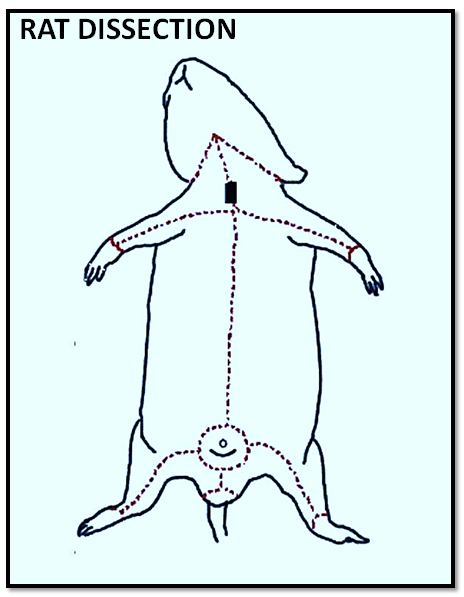
So, the correct answer is ‘(b) Ventral’.
Additional information:
- The taxonomy of black rat is as follows: Kingdom Animalia, Phylum Chordata, Subphylum Vertebrata, Class Mammalia, Order Rodentia, Family Muridae, GenusRattus, Species rattus.
- As rats belong to Subphylum Vertebrata, it has a structure similar to all the vertebrates, this similarity suggests a common origin which would be helpful in tracing ancestry.
- The muscles like biceps brachii, triceps brachii, latissimus dorsi, biceps femoris, tibialis, gluteus, gastrocnemius, etc are similar to those seen in humans.
- Trachea, larynx, lymph glands, salivary glands can also be observed by proper dissection
So, the correct answer is ‘ventral’
Note:
- Dorsal refers to the side which represents the back which is covered with black hair.
- Ventral refers to the underside of the rat's body which is fleshy and lacks hair.
- Anterior refers to the snout area and the posterior refers to the area containing the tail.
Complete step by step answer:
Rattus rattus, is commonly known as black rat. The dissection of Black rat is aimed at understanding the basic mammalian anatomy and to understand it's structures and functions. The main purpose is exploring the alimentary canal and understanding the digestive system. The body is divided into six anatomical regions: cranial region, cervical region, pectoral, thoracic, abdominal and pelvic. The rat is placed such that the back touches the board and the ventral surface is directed upwards and an incision is made in such a manner to properly explore the inner structures.
So, the correct answer is ‘(b) Ventral’.
Additional information:
- The taxonomy of black rat is as follows: Kingdom Animalia, Phylum Chordata, Subphylum Vertebrata, Class Mammalia, Order Rodentia, Family Muridae, GenusRattus, Species rattus.
- As rats belong to Subphylum Vertebrata, it has a structure similar to all the vertebrates, this similarity suggests a common origin which would be helpful in tracing ancestry.
- The muscles like biceps brachii, triceps brachii, latissimus dorsi, biceps femoris, tibialis, gluteus, gastrocnemius, etc are similar to those seen in humans.
- Trachea, larynx, lymph glands, salivary glands can also be observed by proper dissection
So, the correct answer is ‘ventral’
Note:
- Dorsal refers to the side which represents the back which is covered with black hair.
- Ventral refers to the underside of the rat's body which is fleshy and lacks hair.
- Anterior refers to the snout area and the posterior refers to the area containing the tail.
Recently Updated Pages
Master Class 12 Economics: Engaging Questions & Answers for Success

Master Class 12 English: Engaging Questions & Answers for Success
Master Class 12 Social Science: Engaging Questions & Answers for Success
Master Class 12 Maths: Engaging Questions & Answers for Success
Master Class 12 Physics: Engaging Questions & Answers for Success
Master Class 11 Social Science: Engaging Questions & Answers for Success
Trending doubts
One Metric ton is equal to kg A 10000 B 1000 C 100 class 11 physics CBSE
Difference Between Prokaryotic Cells and Eukaryotic Cells
Two of the body parts which do not appear in MRI are class 11 biology CBSE
1 ton equals to A 100 kg B 1000 kg C 10 kg D 10000 class 11 physics CBSE
Draw a diagram of nephron and explain its structur class 11 biology CBSE
10 examples of friction in our daily life