




Discuss the modes of vibrations in a closed path.
Answer
 Verified
603k+ views
Hint: The mode of vibration in a closed path is in the form of reflection from the closed end. As free ends are free to vibrate, they will have maximum amplitude. As a result of this an antinode is formed at the open end. This can also be described as the simplest mode of vibration and hence it is called the fundamental mode.
Complete answer:
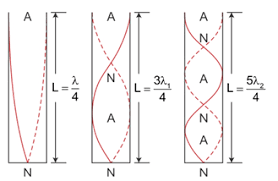
There are a number of natural frequencies set for a musical instrument, which vibrates at the time when a disturbance is introduced to it. The set of natural frequencies are the harmonics of an instrument. There will be a standing wave associated with each of the harmonics.
Each of the modes is associated with a modal frequency and one mode shape. According to the number of half waves, each mode is numbered. The mode of vibration in a closed path is in the form of reflection from the closed end. As free ends are free to vibrate, they will have maximum amplitude. As a result of this an antinode is formed at the open end. This can also be described as the simplest mode of vibration and hence it is called the fundamental mode. Closed pipe shows odd harmonics.
Note:
In a closed path the amplitude will be always minimum. And the amplitude of vibration will be maximum only at the open ends. Thus maximum amplitude forms an antinode, whereas minimum amplitude results in a node. If two ends of a flute is closed, then it acts as a closed organ pipe.
Complete answer:
There are a number of natural frequencies set for a musical instrument, which vibrates at the time when a disturbance is introduced to it. The set of natural frequencies are the harmonics of an instrument. There will be a standing wave associated with each of the harmonics.
Each of the modes is associated with a modal frequency and one mode shape. According to the number of half waves, each mode is numbered. The mode of vibration in a closed path is in the form of reflection from the closed end. As free ends are free to vibrate, they will have maximum amplitude. As a result of this an antinode is formed at the open end. This can also be described as the simplest mode of vibration and hence it is called the fundamental mode. Closed pipe shows odd harmonics.
Note:
In a closed path the amplitude will be always minimum. And the amplitude of vibration will be maximum only at the open ends. Thus maximum amplitude forms an antinode, whereas minimum amplitude results in a node. If two ends of a flute is closed, then it acts as a closed organ pipe.
Recently Updated Pages
Master Class 12 Economics: Engaging Questions & Answers for Success

Master Class 12 English: Engaging Questions & Answers for Success
Master Class 12 Social Science: Engaging Questions & Answers for Success
Master Class 12 Maths: Engaging Questions & Answers for Success
Master Class 12 Physics: Engaging Questions & Answers for Success
Master Class 9 General Knowledge: Engaging Questions & Answers for Success
Trending doubts
1 ton equals to A 100 kg B 1000 kg C 10 kg D 10000 class 11 physics CBSE
How do I convert ms to kmh Give an example class 11 physics CBSE
Mention the important general characters of Urocho class 11 biology CBSE
Define pneumatic bones class 11 biology CBSE
10 examples of diffusion in everyday life
The relation between molarity M and molality m is given class 11 chemistry CBSE