




Discuss motion of a car along a banked road with figure and show that ${{R}_{g}}{{(\dfrac{{{\mu }_{s}}+\tan \theta }{1-\mu \tan \theta })}^{1/2}}$
Answer
 Verified
606.3k+ views
Hint:Banking of roads is the state in which the edges of the curved roads are raised above the inner edge to ensure centripetal force for automobiles, so that the safety is ensured when they take a turn. The angle at which the inclination is maintained is called the bank angle.
Complete step by step answer:
When roads are banked and when a car moves along the road, the centripetal force is provided by the horizontal component of the normal reaction. In normal cases, that is when a car travels through an unbanked, horizontally curved road, the frictional force between the wheels and the surface of the road acts as the centripetal force. But sometimes it is insufficient when the nature of the road changes, especially when it is oily or wet. The roads can’t be made rough either, as it causes wear and tear to the tyres.
The major advantage of banking is that it avoids skidding of the vehicle.
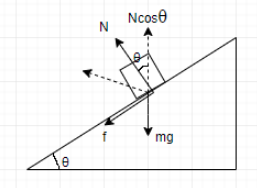
Here, N is the normal force and f is the frictional force.
From the diagram,
$N\cos \theta =mg+f\sin \theta $ - - - - - - - - - - - - - - - - - - - - -(1)
And, $f\cos \theta +N\sin \theta =\dfrac{m{{v}^{2}}}{r}$ - - - - - - - - - - - - - -(2)
Also, $f=\mu N$ - - - - - - - - - - - - - - - - - - - - - - - - -(3)
$
N\cos \theta =\mu N\sin \theta +mg \\
\Rightarrow N(\cos \theta -\mu \sin \theta )=mg \\
$
$\Rightarrow N=\dfrac{mg}{\cos \theta -\mu \sin \theta }$ - - - - - - - - - - - - - - - (4)
Substitute (3) and (4) in (2)
\[
\dfrac{\mu mg\cos \theta }{\cos \theta -\mu \sin \theta }+\dfrac{mg\sin \theta }{\cos \theta -\mu \sin \theta }=\dfrac{m{{v}^{2}}}{r} \\
\Rightarrow \mu mgr\cos \theta +mgr\sin \theta =m{{v}^{2}}\cos \theta -\mu m{{v}^{2}}\sin \theta \\
\Rightarrow \mu mgr+mgr\tan \theta =m{{v}^{2}}-\mu m{{v}^{2}}\tan \theta \\
\Rightarrow mgr(\mu +\tan \theta )=m{{v}^{2}}(1-\mu \tan \theta ) \\
\Rightarrow {{v}^{2}}=\dfrac{rg(\mu +\tan \theta )}{(1-\mu \tan \theta )} \\
\therefore v=\sqrt{\dfrac{rg(\mu +\tan \theta )}{(1-\mu \tan \theta )}} \\
\]
Hence, it is proved.
Note:In questions like this, it is always essential to approach the given conditions using a free body diagram as it makes the process easier. This diagram depicts the relative magnitude and direction of all forces acting on the body.
Complete step by step answer:
When roads are banked and when a car moves along the road, the centripetal force is provided by the horizontal component of the normal reaction. In normal cases, that is when a car travels through an unbanked, horizontally curved road, the frictional force between the wheels and the surface of the road acts as the centripetal force. But sometimes it is insufficient when the nature of the road changes, especially when it is oily or wet. The roads can’t be made rough either, as it causes wear and tear to the tyres.
The major advantage of banking is that it avoids skidding of the vehicle.
Here, N is the normal force and f is the frictional force.
From the diagram,
$N\cos \theta =mg+f\sin \theta $ - - - - - - - - - - - - - - - - - - - - -(1)
And, $f\cos \theta +N\sin \theta =\dfrac{m{{v}^{2}}}{r}$ - - - - - - - - - - - - - -(2)
Also, $f=\mu N$ - - - - - - - - - - - - - - - - - - - - - - - - -(3)
$
N\cos \theta =\mu N\sin \theta +mg \\
\Rightarrow N(\cos \theta -\mu \sin \theta )=mg \\
$
$\Rightarrow N=\dfrac{mg}{\cos \theta -\mu \sin \theta }$ - - - - - - - - - - - - - - - (4)
Substitute (3) and (4) in (2)
\[
\dfrac{\mu mg\cos \theta }{\cos \theta -\mu \sin \theta }+\dfrac{mg\sin \theta }{\cos \theta -\mu \sin \theta }=\dfrac{m{{v}^{2}}}{r} \\
\Rightarrow \mu mgr\cos \theta +mgr\sin \theta =m{{v}^{2}}\cos \theta -\mu m{{v}^{2}}\sin \theta \\
\Rightarrow \mu mgr+mgr\tan \theta =m{{v}^{2}}-\mu m{{v}^{2}}\tan \theta \\
\Rightarrow mgr(\mu +\tan \theta )=m{{v}^{2}}(1-\mu \tan \theta ) \\
\Rightarrow {{v}^{2}}=\dfrac{rg(\mu +\tan \theta )}{(1-\mu \tan \theta )} \\
\therefore v=\sqrt{\dfrac{rg(\mu +\tan \theta )}{(1-\mu \tan \theta )}} \\
\]
Hence, it is proved.
Note:In questions like this, it is always essential to approach the given conditions using a free body diagram as it makes the process easier. This diagram depicts the relative magnitude and direction of all forces acting on the body.
Recently Updated Pages
Master Class 11 Social Science: Engaging Questions & Answers for Success

Master Class 11 English: Engaging Questions & Answers for Success
Master Class 11 Maths: Engaging Questions & Answers for Success
Master Class 11 Chemistry: Engaging Questions & Answers for Success
Master Class 11 Biology: Engaging Questions & Answers for Success
Master Class 11 Physics: Engaging Questions & Answers for Success
Trending doubts
One Metric ton is equal to kg A 10000 B 1000 C 100 class 11 physics CBSE
Difference Between Prokaryotic Cells and Eukaryotic Cells
There are 720 permutations of the digits 1 2 3 4 5 class 11 maths CBSE
Draw a diagram of a plant cell and label at least eight class 11 biology CBSE
Two of the body parts which do not appear in MRI are class 11 biology CBSE
Which gas is abundant in air class 11 chemistry CBSE