




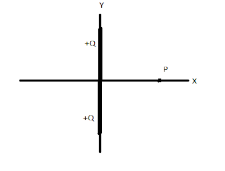
What is the direction of the net electric field at point P?
(A) $\mathop {\text{i}}\limits^ \to $
(B) $\mathop j\limits^ \to $
(C) $ - \mathop {\text{i}}\limits^ \to $
(D) $\mathop { - j}\limits^ \to $
Answer
 Verified
608.7k+ views
Hint
The direction of the electric field is determined by the nature of the charge. In the question two positive charges are given, so we need to consider the symmetry of direction of both charges to find the direction of the electric field.
Complete step by step answer
Electric field is defined as electric force per unit charge.
$\Rightarrow E = \dfrac{F}{q}$
$E$ is the electric field.
$F$ is the electric force.
$q$ is the charge.
Its unit is Newton per coulomb.
Electric force is the force exerted on the point charge.
The direction of electric field produced by positive charges is radially outward from the charge, i.e. away from the point charge.
The direction of electric field produced by negative charges is radially toward the charge, i.e. towards the point charge.
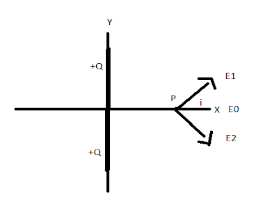
In the given diagram we can see the two point charges $+ Q$ on y axis. One positive point charge is on the upper side of the y axis and another positive charge is on the lower side of the y axis. The direction of charge $q$ on the upper axis is along the direction $E_1$ and the direction of charge $q$ on the lower axis is along the direction $E_2$ as shown in the diagram. The total electric field at the point p is along the direction of $E_0$ which is symmetric about the x-axis. The direction of $E_0$ is along the positive x axis, i.e. it is along $\mathop {\text{i}}\limits^ \to .$
Hence the answer is option (A) $\mathop {\text{i}}\limits^ \to $.
Note
Carefully note the nature of the charge, because the direction of the electric field depends on the nature of the charge. We can find the direction of the electric field at a point by drawing a tangent to the electric line of force which is imaginary lines drawn in which a point charge tends to move or be placed.
The direction of the electric field is determined by the nature of the charge. In the question two positive charges are given, so we need to consider the symmetry of direction of both charges to find the direction of the electric field.
Complete step by step answer
Electric field is defined as electric force per unit charge.
$\Rightarrow E = \dfrac{F}{q}$
$E$ is the electric field.
$F$ is the electric force.
$q$ is the charge.
Its unit is Newton per coulomb.
Electric force is the force exerted on the point charge.
The direction of electric field produced by positive charges is radially outward from the charge, i.e. away from the point charge.
The direction of electric field produced by negative charges is radially toward the charge, i.e. towards the point charge.
In the given diagram we can see the two point charges $+ Q$ on y axis. One positive point charge is on the upper side of the y axis and another positive charge is on the lower side of the y axis. The direction of charge $q$ on the upper axis is along the direction $E_1$ and the direction of charge $q$ on the lower axis is along the direction $E_2$ as shown in the diagram. The total electric field at the point p is along the direction of $E_0$ which is symmetric about the x-axis. The direction of $E_0$ is along the positive x axis, i.e. it is along $\mathop {\text{i}}\limits^ \to .$
Hence the answer is option (A) $\mathop {\text{i}}\limits^ \to $.
Note
Carefully note the nature of the charge, because the direction of the electric field depends on the nature of the charge. We can find the direction of the electric field at a point by drawing a tangent to the electric line of force which is imaginary lines drawn in which a point charge tends to move or be placed.
Recently Updated Pages
Master Class 12 Business Studies: Engaging Questions & Answers for Success

Master Class 12 Chemistry: Engaging Questions & Answers for Success
Master Class 12 Biology: Engaging Questions & Answers for Success
Class 12 Question and Answer - Your Ultimate Solutions Guide
Master Class 11 Social Science: Engaging Questions & Answers for Success
Master Class 11 Chemistry: Engaging Questions & Answers for Success
Trending doubts
Which are the Top 10 Largest Countries of the World?
Draw a labelled sketch of the human eye class 12 physics CBSE
Name the crygenes that control cotton bollworm and class 12 biology CBSE
Differentiate between homogeneous and heterogeneous class 12 chemistry CBSE
Ribosomal RNA is actively synthesised in A Nucleoplasm class 12 biology CBSE
How many molecules of ATP and NADPH are required information class 12 biology CBSE