




How many different IUPAC names can be assigned to hydroxy substituted benzene dicarbonitrile?
Answer
 Verified
557.1k+ views
Hint: IUPAC nomenclature is the method of naming organic compounds by following standard rules given by the international union of pure and applied chemistry. The primary goal of the system is assigning each structure a unique and unambiguous name with which it can easily be identified.
Complete answer:
The compound given in the question is hydroxy substituted benzene dicarbonitrile, but the positions of each functional group is not mentioned clearly. So, according to the different positions of functional groups, we can assign different IUPAC names to the given compound.
The different structures of hydroxy substituted benzene dicarbonitrile along with their IUPAC name can be drawn as follows:
Structure-1:
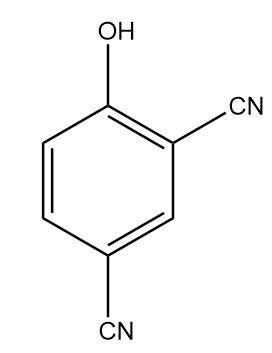
The IUPAC name of the given structure is 2,4-dicyanophenol.
Structure-2:
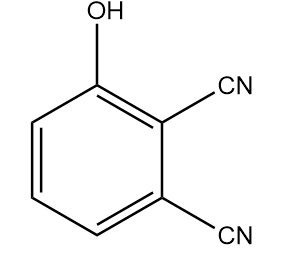
The IUPAC name of the given structure is 2,3-dicyanophenol.
Structure-3:
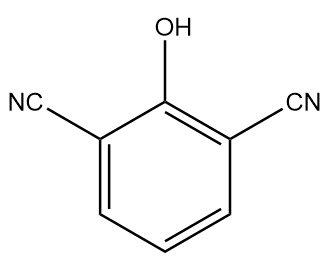
The IUPAC name of the given structure is 2,6-dicyanophenol.
Structure-4:
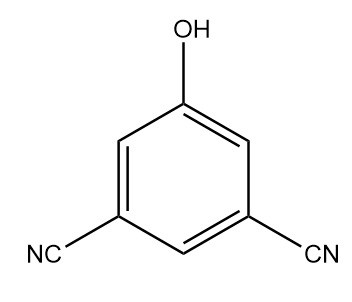
The IUPAC name of the given structure is 3,5-dicyanophenol.
Structure-5:
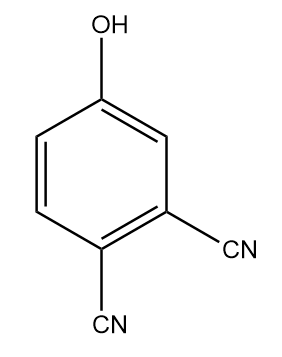
The IUPAC name of the given structure is 3,4-dicyanophenol.
Hence, five different IUPAC names can be assigned to hydroxy substituted benzene dicarbonitrile.
Note:
The following points must be in mind before naming an aromatic compound:
When different groups are attached to an aromatic compound, then the numbering starts with the substituent of the base compound i.e., it is allocated first position (hydroxyl group in the given case).
The numbering of the carbon atoms in the ring should be done in such a manner that the value allocated to the functional groups is minimum.
Complete answer:
The compound given in the question is hydroxy substituted benzene dicarbonitrile, but the positions of each functional group is not mentioned clearly. So, according to the different positions of functional groups, we can assign different IUPAC names to the given compound.
The different structures of hydroxy substituted benzene dicarbonitrile along with their IUPAC name can be drawn as follows:
Structure-1:
The IUPAC name of the given structure is 2,4-dicyanophenol.
Structure-2:
The IUPAC name of the given structure is 2,3-dicyanophenol.
Structure-3:
The IUPAC name of the given structure is 2,6-dicyanophenol.
Structure-4:
The IUPAC name of the given structure is 3,5-dicyanophenol.
Structure-5:
The IUPAC name of the given structure is 3,4-dicyanophenol.
Hence, five different IUPAC names can be assigned to hydroxy substituted benzene dicarbonitrile.
Note:
The following points must be in mind before naming an aromatic compound:
When different groups are attached to an aromatic compound, then the numbering starts with the substituent of the base compound i.e., it is allocated first position (hydroxyl group in the given case).
The numbering of the carbon atoms in the ring should be done in such a manner that the value allocated to the functional groups is minimum.
Recently Updated Pages
Master Class 11 English: Engaging Questions & Answers for Success

Master Class 11 Social Science: Engaging Questions & Answers for Success
Master Class 11 Maths: Engaging Questions & Answers for Success
Master Class 11 Biology: Engaging Questions & Answers for Success
Master Class 11 Physics: Engaging Questions & Answers for Success
Master Class 11 Chemistry: Engaging Questions & Answers for Success
Trending doubts
One Metric ton is equal to kg A 10000 B 1000 C 100 class 11 physics CBSE
What is cell theory Who formulated it class 11 biology CBSE
Phyllotaxy is the arrangement of ALeaflets BLeaves class 11 biology CBSE
Difference Between Prokaryotic Cells and Eukaryotic Cells
The symbiotic association of fungi and algae is called class 11 biology CBSE
Cell theory was formulated by A Schleiden and Schwann class 11 biology CBSE