




What is the difference between unicellular and multicellular organisms in organization of their cells?
Answer
 Verified
623.4k+ views
Hint: Unicellular organisms have a single cell that performs all the work required. These organisms are far simpler. Multicellular organisms have many cells and they are more complex in nature.
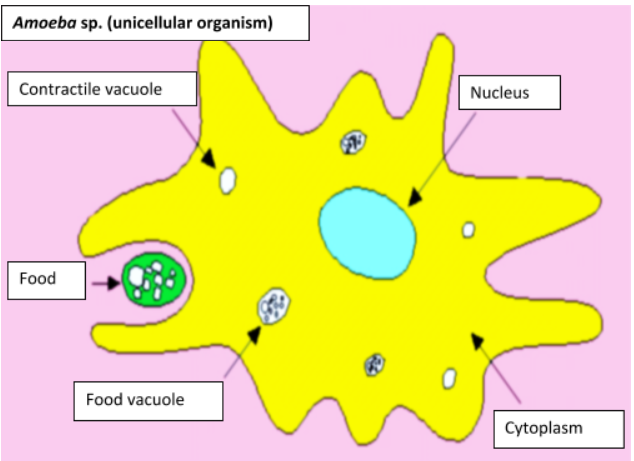
Complete answer: The body is composed of a single cell in unicellular species that can undergo cell division to regenerate. To perform different functions, the cell has numerous organelles. Being a single cell, it is exposed to all sides of the environment. There is no labour separation. Due to a small surface to volume ratio, the cell body cannot achieve a large size, and injury to the cell can cause hazards.
In multicellular species, multiple cells make up the body. Such cells are designed to perform various functions. Cells are grouped into tissues and are a community of cells within an organism that has a similar role. To perform a particular purpose, different tissues come together to form an organ. The more complex species have organ systems. They are, for example, mammals, trees, etc.
Note: A group of organs that work together to perform complex, linked tasks, concentrating each organ on a part of a mission, is called an organ system. Thus, in multicellular species, the division of labour is shown. For example, in the human digestive system, food is chewed in the mouth, crushed in the stomach, broken down by enzymes in pancreatic and gastric juices into macromolecules and consumed by the small intestines.
Complete answer: The body is composed of a single cell in unicellular species that can undergo cell division to regenerate. To perform different functions, the cell has numerous organelles. Being a single cell, it is exposed to all sides of the environment. There is no labour separation. Due to a small surface to volume ratio, the cell body cannot achieve a large size, and injury to the cell can cause hazards.
In multicellular species, multiple cells make up the body. Such cells are designed to perform various functions. Cells are grouped into tissues and are a community of cells within an organism that has a similar role. To perform a particular purpose, different tissues come together to form an organ. The more complex species have organ systems. They are, for example, mammals, trees, etc.
Note: A group of organs that work together to perform complex, linked tasks, concentrating each organ on a part of a mission, is called an organ system. Thus, in multicellular species, the division of labour is shown. For example, in the human digestive system, food is chewed in the mouth, crushed in the stomach, broken down by enzymes in pancreatic and gastric juices into macromolecules and consumed by the small intestines.
Recently Updated Pages
Lysosomes are known as suicidal bags of cell why class 11 biology CBSE

Father s age is three times the sum of the ages of-class-11-maths-CBSE
Give a comparative account of the classes of kingdom class 11 biology CBSE
The ceiling of a long hall is 25m high What is the class 11 physics CBSE
Name the Largest and the Smallest Cell in the Human Body ?
Draw a welllabelled diagram of a plant cell class 11 biology CBSE
Trending doubts
Find the value of the expression given below sin 30circ class 11 maths CBSE
One Metric ton is equal to kg A 10000 B 1000 C 100 class 11 physics CBSE
10 examples of friction in our daily life
Draw a diagram of nephron and explain its structur class 11 biology CBSE
Proton was discovered by A Thomson B Rutherford C Chadwick class 11 chemistry CBSE
Frogs heart when taken out of the body continues to class 11 biology CBSE