




What is the difference between attractive and repulsive force?
Answer
 Verified
540.3k+ views
Hint: The difference between the two forces can be understood from the way they are defined. The attractive and repulsive forces are defined for any two bodies that are under the influence of each other. Hence based on the line of action of force on one due to another we will be able to define whether the force is attractive or repulsive and accordingly differentiate between attractive and repulsive forces.
Formula used:
$N={{N}_{\circ }}{{e}^{-\lambda t}}$
Complete step-by-step solution:
Let us consider two A and B bodies separated by some distance ‘r’ in space along one dimension. Further let us assume the force on A due to B is ${{F}_{AB}}$ and that the force on B due to A be ${{F}_{BA}}$. Further let us say the force between the two is mutual. Let the vector $\overrightarrow{{{r}_{BA}}}$ be direction from A to B
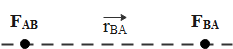
If the ${{F}_{BA}}=-\overrightarrow{{{r}_{BA}}}$ and simultaneously ${{F}_{AB}}=\overrightarrow{{{r}_{BA}}}$ , then we can imply that the force on both the bodies are directed towards each other. Hence both the bodies will be moving towards each other i.e. they attract each other.
Similarly, if ${{F}_{BA}}=\overrightarrow{{{r}_{BA}}}$ and simultaneously ${{F}_{AB}}=-\overrightarrow{{{r}_{BA}}}$ , then we can imply that the force on both the bodies are directed away from each other. Hence both the bodies will be moving away from each other i.e. they repel each other.
Hence we can conclude that two bodies under the action of mutual force between the two, the attractive force brings the bodies towards each other while the repulsive force moves them away from each other.
Note:It is to be noted that the gravitational force is always attractive in nature. Whereas the electrostatic force is either attractive or repulsive. There exists a force of attraction for like charges and force of repulsion for unlike charges.
Formula used:
$N={{N}_{\circ }}{{e}^{-\lambda t}}$
Complete step-by-step solution:
Let us consider two A and B bodies separated by some distance ‘r’ in space along one dimension. Further let us assume the force on A due to B is ${{F}_{AB}}$ and that the force on B due to A be ${{F}_{BA}}$. Further let us say the force between the two is mutual. Let the vector $\overrightarrow{{{r}_{BA}}}$ be direction from A to B
If the ${{F}_{BA}}=-\overrightarrow{{{r}_{BA}}}$ and simultaneously ${{F}_{AB}}=\overrightarrow{{{r}_{BA}}}$ , then we can imply that the force on both the bodies are directed towards each other. Hence both the bodies will be moving towards each other i.e. they attract each other.
Similarly, if ${{F}_{BA}}=\overrightarrow{{{r}_{BA}}}$ and simultaneously ${{F}_{AB}}=-\overrightarrow{{{r}_{BA}}}$ , then we can imply that the force on both the bodies are directed away from each other. Hence both the bodies will be moving away from each other i.e. they repel each other.
Hence we can conclude that two bodies under the action of mutual force between the two, the attractive force brings the bodies towards each other while the repulsive force moves them away from each other.
Note:It is to be noted that the gravitational force is always attractive in nature. Whereas the electrostatic force is either attractive or repulsive. There exists a force of attraction for like charges and force of repulsion for unlike charges.
Recently Updated Pages
Master Class 12 Business Studies: Engaging Questions & Answers for Success

Master Class 12 Biology: Engaging Questions & Answers for Success
Master Class 12 Chemistry: Engaging Questions & Answers for Success
Class 12 Question and Answer - Your Ultimate Solutions Guide
Master Class 11 English: Engaging Questions & Answers for Success
Master Class 11 Social Science: Engaging Questions & Answers for Success
Trending doubts
Which are the Top 10 Largest Countries of the World?
Draw a labelled sketch of the human eye class 12 physics CBSE
Differentiate between homogeneous and heterogeneous class 12 chemistry CBSE
Why is the cell called the structural and functional class 12 biology CBSE
Draw ray diagrams each showing i myopic eye and ii class 12 physics CBSE
Which is the correct genotypic ratio of mendel dihybrid class 12 biology CBSE