




What is the difference between a producer, secondary consumer, primary consumer and tertiary consumer?
Answer
 Verified
569.7k+ views
Hint: Producers and primary, secondary and tertiary consumers are the organisms that belong to the first, second, third and fourth trophic levels of the food chain respectively.
Each trophic level has a prey-predator relation with its preceding and succeeding level.
Complete answer:
A food chain is a pictorial demonstration of the flow of energy and matter in the form of food. Each trophic level is categorised on the basis of the organism’s feeding habits and with transition from one level to another, a significant amount of energy is lost as heat. The levels start from the lowest-producers and move upwards to the tertiary consumers.
-Producers: This category of organisms include all autotrophic green plants that produce their own food by the process of photosynthesis, using the pigment chlorophyll. These organisms take energy from the sun to produce food which is stored as biomass. The first trophic level has the maximum stored biomass.
-Primary Consumers: The animals and plants that eat organisms belonging to the first trophic level are called primary consumers. They are also called herbivores as they feed on plants, for example: rabbits and cattle.
-Secondary Consumers: Animals that feed on herbivores belong to this group. They are also called primary carnivores, for example: snakes.
-Tertiary Consumers: These animals prey on primary carnivores and are thus also called secondary carnivores, for example: eagles, fox, etc.
Note:
Organisms do not belong to one single trophic level as their feeding habits differ. While one prey of a predator belongs to primary consumers, another prey of the same predator might belong to secondary consumers, altering the predator’s trophic level.
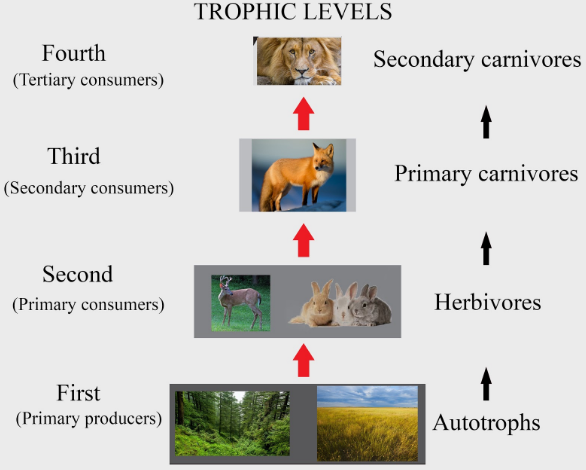
Each trophic level has a prey-predator relation with its preceding and succeeding level.
Complete answer:
A food chain is a pictorial demonstration of the flow of energy and matter in the form of food. Each trophic level is categorised on the basis of the organism’s feeding habits and with transition from one level to another, a significant amount of energy is lost as heat. The levels start from the lowest-producers and move upwards to the tertiary consumers.
-Producers: This category of organisms include all autotrophic green plants that produce their own food by the process of photosynthesis, using the pigment chlorophyll. These organisms take energy from the sun to produce food which is stored as biomass. The first trophic level has the maximum stored biomass.
-Primary Consumers: The animals and plants that eat organisms belonging to the first trophic level are called primary consumers. They are also called herbivores as they feed on plants, for example: rabbits and cattle.
-Secondary Consumers: Animals that feed on herbivores belong to this group. They are also called primary carnivores, for example: snakes.
-Tertiary Consumers: These animals prey on primary carnivores and are thus also called secondary carnivores, for example: eagles, fox, etc.
Note:
Organisms do not belong to one single trophic level as their feeding habits differ. While one prey of a predator belongs to primary consumers, another prey of the same predator might belong to secondary consumers, altering the predator’s trophic level.
Recently Updated Pages
Master Class 11 English: Engaging Questions & Answers for Success

Master Class 11 Social Science: Engaging Questions & Answers for Success
Master Class 11 Maths: Engaging Questions & Answers for Success
Master Class 11 Biology: Engaging Questions & Answers for Success
Master Class 11 Physics: Engaging Questions & Answers for Success
Master Class 11 Chemistry: Engaging Questions & Answers for Success
Trending doubts
Explain the Treaty of Vienna of 1815 class 10 social science CBSE
What is the full form of CNG A Complete Natural Gas class 10 social science CBSE
In cricket, what is a "Yorker" designed to do?
What is the full form of POSCO class 10 social science CBSE
Define Potential, Developed, Stock and Reserved resources
What were the majoritarian measures taken in Sri Lanka class 10 social science CBSE