




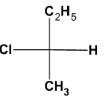
How many dichlorinated products, including stereoisomers, can be isolated when (S)-2- chlorobutane reacts with ${\text{C}}{{\text{l}}_2}/{\text{h}}\nu $?
A.1
B.2
C.3
D.5
Answer
 Verified
604.2k+ views
Hint: To answer this question, you must be familiar with the types of isomerism shown by organic compounds. Organic compounds show broadly two types of isomerism, namely structural or constitutional isomerism or stereoisomerism.
Complete step-by-step answer:Structural isomers are those isomers which have the same molecular formula but different linkage of atoms inside the molecule, i.e., they differ in their structures. Stereoisomers are those isomers which possess the same molecular and structural formula but differ due to the variation in arrangement in space of their atoms in a molecule.
The given compound (S)-2- chlorobutane has four carbon atoms with a replaceable hydrogen atom. So on chlorination, the chlorine atom can replace hydrogen atom from any of the four carbon atoms and thus four structural isomers of the dichlorinated product will be formed. They can be drawn as:
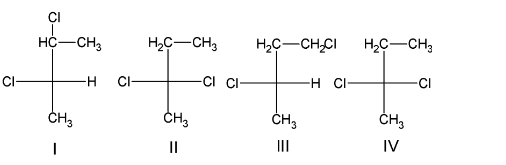
Of the given structural isomers, the structure I additionally shows stereoisomerism. It can exist in two configuration, either as the R- configuration or as the S- configuration. The stereoisomers formed can be drawn as
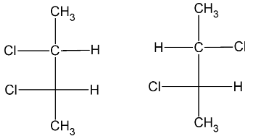
Thus, the total number of isomers of the dichloro- substituted product formed including stereoisomers are 5.
The correct answer is D.
Note: Stereoisomerism can be further divided into configurational isomerism, conformational isomerism and geometrical isomerism. Conformational isomers are interconvertible forms of the same molecule derived from the rotation about the carbon- carbon $\sigma $ bond. Configurational isomers are those stereoisomers which cannot be converted to each other by rotation about carbon- carbon $\sigma $ bond. Geometrical isomers are non- interconvertible stereoisomers due to the restricted rotation about carbon- carbon $\pi $ bond.
Complete step-by-step answer:Structural isomers are those isomers which have the same molecular formula but different linkage of atoms inside the molecule, i.e., they differ in their structures. Stereoisomers are those isomers which possess the same molecular and structural formula but differ due to the variation in arrangement in space of their atoms in a molecule.
The given compound (S)-2- chlorobutane has four carbon atoms with a replaceable hydrogen atom. So on chlorination, the chlorine atom can replace hydrogen atom from any of the four carbon atoms and thus four structural isomers of the dichlorinated product will be formed. They can be drawn as:
Of the given structural isomers, the structure I additionally shows stereoisomerism. It can exist in two configuration, either as the R- configuration or as the S- configuration. The stereoisomers formed can be drawn as
Thus, the total number of isomers of the dichloro- substituted product formed including stereoisomers are 5.
The correct answer is D.
Note: Stereoisomerism can be further divided into configurational isomerism, conformational isomerism and geometrical isomerism. Conformational isomers are interconvertible forms of the same molecule derived from the rotation about the carbon- carbon $\sigma $ bond. Configurational isomers are those stereoisomers which cannot be converted to each other by rotation about carbon- carbon $\sigma $ bond. Geometrical isomers are non- interconvertible stereoisomers due to the restricted rotation about carbon- carbon $\pi $ bond.
Recently Updated Pages
Which will be the least stable resonating structure class 11 chemistry CBSE

How many 5 digit telephone numbers can be construc-class-11-maths-CBSE
How do you find the angle of the resultant vector class 11 physics CBSE
Draw labelled diagram of the following i Gram seed class 11 biology CBSE
1 Quintal is equal to a 110 kg b 10 kg c 100kg d 1000 class 11 physics CBSE
What is the need and importance of classification class 11 biology CBSE
Trending doubts
One Metric ton is equal to kg A 10000 B 1000 C 100 class 11 physics CBSE
Find the value of the expression given below sin 30circ class 11 maths CBSE
Draw a diagram of nephron and explain its structur class 11 biology CBSE
10 examples of friction in our daily life
Proton was discovered by A Thomson B Rutherford C Chadwick class 11 chemistry CBSE
The teeth used for biting and cutting food are called class 11 biology CBSE