




Diamond rings occur in which type of solar eclipse?
(a) total solar eclipse
(b) partial solar eclipse
(c) None of these
Answer
 Verified
557.1k+ views
Hint: In the given question, to know the type of solar eclipse in which diamond rings occur, we should go through the whole concept of Baily’s beads, in which we will come to know the type of solar eclipse.
Complete answer:
The Baily’s beads effect, or Diamond ring effect, is a feature of total and annular solar eclipses. There are four types of solar eclipses: total, partial, annual and hybrid. Total solar eclipses happen when the sun is completely blocked by the moon. During a total solar eclipse, at the beginning and end of the totality the diamond ring effect occurs.
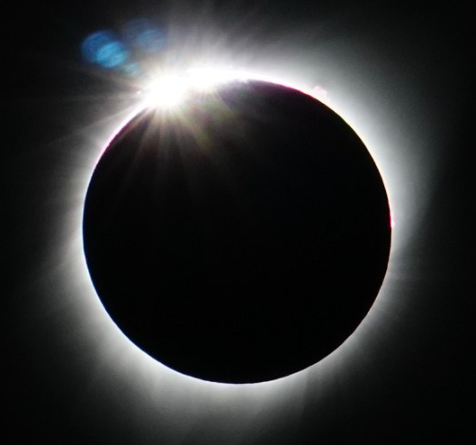
The Baily's beads effect or diamond ring effect is a feature of total and annular solar eclipses. As the Moon covers the Sun during a sun powered obscuration, the rough geography of the lunar appendage permits dabs of daylight to radiate through in certain spots while not in others. The impact is named after Francis Baily, who clarified the wonder in 1836. The precious stone ring impact is seen when just one globule is left, showing up as a sparkling "jewel" set in a brilliant ring around the lunar outline.
Image showing the diamond rings formed during a solar eclipse:
Hence, the correct option is (A).
Note:
It is a component of aggregate and annular sun oriented shrouds. As the Moon covers the Sun during a sun powered obscuration, the rough geology of the lunar appendage permits globules of daylight to radiate through in certain spots while not in others.
Complete answer:
The Baily’s beads effect, or Diamond ring effect, is a feature of total and annular solar eclipses. There are four types of solar eclipses: total, partial, annual and hybrid. Total solar eclipses happen when the sun is completely blocked by the moon. During a total solar eclipse, at the beginning and end of the totality the diamond ring effect occurs.
The Baily's beads effect or diamond ring effect is a feature of total and annular solar eclipses. As the Moon covers the Sun during a sun powered obscuration, the rough geography of the lunar appendage permits dabs of daylight to radiate through in certain spots while not in others. The impact is named after Francis Baily, who clarified the wonder in 1836. The precious stone ring impact is seen when just one globule is left, showing up as a sparkling "jewel" set in a brilliant ring around the lunar outline.
Image showing the diamond rings formed during a solar eclipse:
Hence, the correct option is (A).
Note:
It is a component of aggregate and annular sun oriented shrouds. As the Moon covers the Sun during a sun powered obscuration, the rough geology of the lunar appendage permits globules of daylight to radiate through in certain spots while not in others.

Recently Updated Pages
Master Class 7 Science: Engaging Questions & Answers for Success

Master Class 7 English: Engaging Questions & Answers for Success
Master Class 7 Maths: Engaging Questions & Answers for Success
Class 7 Question and Answer - Your Ultimate Solutions Guide
Master Class 12 Economics: Engaging Questions & Answers for Success
Master Class 12 English: Engaging Questions & Answers for Success
Trending doubts
How many crores make 10 million class 7 maths CBSE
The HCF of 24721284 and a third number N is 12 If their class 7 maths CBSE
Full Form of IASDMIPSIFSIRSPOLICE class 7 social science CBSE
List of coprime numbers from 1 to 100 class 7 maths CBSE
Write a short note on the great bath of MohenjoDar class 7 social science CBSE
The plural of Chief is Chieves A True B False class 7 english CBSE