




Diagrammatically indicates the location of the various endocrine glands in our body.
Answer
 Verified
615k+ views
Hint: The endocrine glands directly secrete hormones and are called ductless glands in the human body. These glands secrete their chemical substances into the bloodstream directly and act as the body’s control system. They are known to be the ‘Glands of internal secretions’.
Complete step by step answer:
The various endocrine glands in our body are as follows:
- Hypothalamus: The hypothalamus is found at the bottom of the brain. It makes hormones that control hormones released within the pituitary. The hypothalamus helps in controlling water balance, sleep, temperature, appetite, mood and reproductive behaviors, and blood pressure.
- Pineal gland: This gland is found within the middle of the brain. It makes the hormone melatonin. This hormone helps your body know when it is time to sleep. This hormone also regulates the timing of other functions throughout the body, like when puberty starts.
- Pituitary gland: This gland is found below the brain. it's often as small as a pea. But it controls many functions of the opposite endocrine glands.
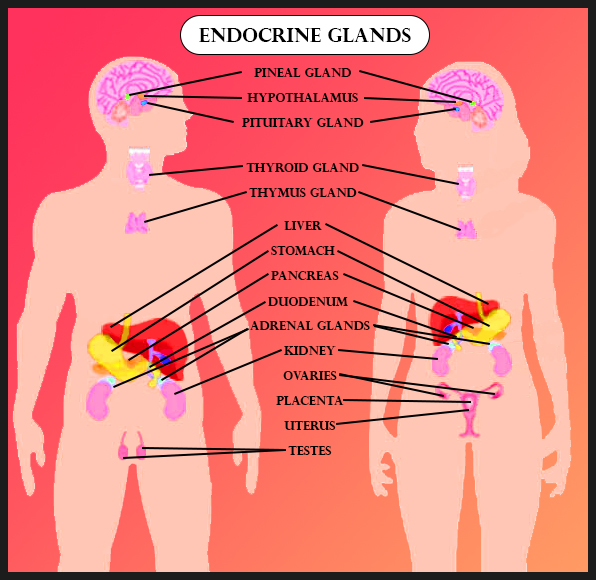
- Thyroid and parathyroid: These glands are located ahead of the neck, below the larynx (larynx). The thyroid plays a key role within the body's metabolism. The parathyroid helps in the regulation of the body's calcium balance and bone strength.
- Adrenal gland: An adrenal is found on top of every kidney. Like many glands, these work alongside the hypothalamus and pituitary. The adrenal glands make and release a hormone known as corticosteroid hormones and adrenaline (epinephrine). These maintain vital signs and regulate metabolism.
- Pancreas: This organ is found across the rear of the belly (abdomen), behind the stomach. It plays a role in digestion and hormone production. Hormones that are made by the pancreas include insulin and glucagon. These regulate blood glucose levels.
- Ovaries: A woman's ovaries are located on each side of the uterus, below the opening of the fallopian tubes. The ovaries contain the egg cells needed for a copy. They also make estrogen and progesterone.
- Testes: A man's testes are located in a pouch that hangs suspended outside the human body. The testes make testosterone and sperm.
Note: The word endocrine was derived from the New Latin which is taken from the Greek words endon, meaning inside or within and crime from the word Krino, meaning separate or distinguished. Endocrinology is the study of the endocrine system and its disorders. The second type of gland is known as the exocrine gland which has ducts and does not secrete directly into the blood.
Complete step by step answer:
- Hypothalamus: The hypothalamus is found at the bottom of the brain. It makes hormones that control hormones released within the pituitary. The hypothalamus helps in controlling water balance, sleep, temperature, appetite, mood and reproductive behaviors, and blood pressure.
- Pineal gland: This gland is found within the middle of the brain. It makes the hormone melatonin. This hormone helps your body know when it is time to sleep. This hormone also regulates the timing of other functions throughout the body, like when puberty starts.
- Pituitary gland: This gland is found below the brain. it's often as small as a pea. But it controls many functions of the opposite endocrine glands.
- Thyroid and parathyroid: These glands are located ahead of the neck, below the larynx (larynx). The thyroid plays a key role within the body's metabolism. The parathyroid helps in the regulation of the body's calcium balance and bone strength.
- Adrenal gland: An adrenal is found on top of every kidney. Like many glands, these work alongside the hypothalamus and pituitary. The adrenal glands make and release a hormone known as corticosteroid hormones and adrenaline (epinephrine). These maintain vital signs and regulate metabolism.
- Pancreas: This organ is found across the rear of the belly (abdomen), behind the stomach. It plays a role in digestion and hormone production. Hormones that are made by the pancreas include insulin and glucagon. These regulate blood glucose levels.
- Ovaries: A woman's ovaries are located on each side of the uterus, below the opening of the fallopian tubes. The ovaries contain the egg cells needed for a copy. They also make estrogen and progesterone.
- Testes: A man's testes are located in a pouch that hangs suspended outside the human body. The testes make testosterone and sperm.
Note: The word endocrine was derived from the New Latin which is taken from the Greek words endon, meaning inside or within and crime from the word Krino, meaning separate or distinguished. Endocrinology is the study of the endocrine system and its disorders. The second type of gland is known as the exocrine gland which has ducts and does not secrete directly into the blood.
Recently Updated Pages
Master Class 12 Economics: Engaging Questions & Answers for Success

Master Class 12 English: Engaging Questions & Answers for Success
Master Class 12 Social Science: Engaging Questions & Answers for Success
Master Class 12 Maths: Engaging Questions & Answers for Success
Master Class 12 Physics: Engaging Questions & Answers for Success
Master Class 11 Social Science: Engaging Questions & Answers for Success
Trending doubts
One Metric ton is equal to kg A 10000 B 1000 C 100 class 11 physics CBSE
Difference Between Prokaryotic Cells and Eukaryotic Cells
Two of the body parts which do not appear in MRI are class 11 biology CBSE
1 ton equals to A 100 kg B 1000 kg C 10 kg D 10000 class 11 physics CBSE
Draw a diagram of nephron and explain its structur class 11 biology CBSE
10 examples of friction in our daily life