



Diagonals of a rhombus are 12cm and 16cm respectively, then find the side of the rhombus and its perimeter.
Answer
 Verified
691.5k+ views
Hint: Rhombus is a two dimensional shape with four equal sides and four angles which can or cannot be $90{}^\circ $, but opposite angles are always same, and both diagonals of a rhombus are perpendicular and bisect each other.
Complete step by step answer:
According to given data,
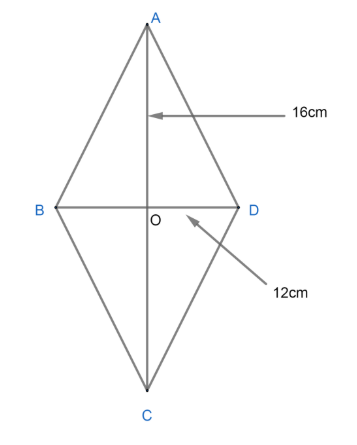
Shape ABCD is a rhombus and O is the intersecting point of both diagonals which is bisecting both diagonals, and both diagonals are perpendicular to each other according to definition.
$\begin{align}
& \Rightarrow AO=\dfrac{16}{2}cm=8cm \\
& \Rightarrow BO=\dfrac{12}{2}cm=6cm \\
\end{align}$
So, $\Delta AOB$ is a right triangle, and using Pythagoras Theorem we can find the length of AB which is a side of rhombus.
According to Pythagoras Theorem,
\[\begin{align}
& A{{B}^{2}}=B{{O}^{2}}+A{{O}^{2}} \\
& AB=\sqrt{{{6}^{2}}+{{8}^{2}}}cm \\
& AB=\sqrt{36+64}=\sqrt{100}=10cm \\
\end{align}\]
And we know the perimeter of the rhombus is equal to 4a where ‘a’ is the length of a side.
So, Perimeter of rhombus $=4a$
$\begin{align}
& =4\times 10cm \\
& =40cm \\
\end{align}$
Hence, the side is 10cm and the perimeter is 40cm.
Note: Here we should have appropriate knowledge of general shapes, some time lack of knowledge can confuse us in easy problems. By the way here we can use direct formula to find out the length of side which is $4A{{B}^{2}}=A{{C}^{2}}+B{{D}^{2}}$.
Complete step by step answer:
According to given data,
Shape ABCD is a rhombus and O is the intersecting point of both diagonals which is bisecting both diagonals, and both diagonals are perpendicular to each other according to definition.
$\begin{align}
& \Rightarrow AO=\dfrac{16}{2}cm=8cm \\
& \Rightarrow BO=\dfrac{12}{2}cm=6cm \\
\end{align}$
So, $\Delta AOB$ is a right triangle, and using Pythagoras Theorem we can find the length of AB which is a side of rhombus.
According to Pythagoras Theorem,
\[\begin{align}
& A{{B}^{2}}=B{{O}^{2}}+A{{O}^{2}} \\
& AB=\sqrt{{{6}^{2}}+{{8}^{2}}}cm \\
& AB=\sqrt{36+64}=\sqrt{100}=10cm \\
\end{align}\]
And we know the perimeter of the rhombus is equal to 4a where ‘a’ is the length of a side.
So, Perimeter of rhombus $=4a$
$\begin{align}
& =4\times 10cm \\
& =40cm \\
\end{align}$
Hence, the side is 10cm and the perimeter is 40cm.
Note: Here we should have appropriate knowledge of general shapes, some time lack of knowledge can confuse us in easy problems. By the way here we can use direct formula to find out the length of side which is $4A{{B}^{2}}=A{{C}^{2}}+B{{D}^{2}}$.
Recently Updated Pages
Master Class 10 Computer Science: Engaging Questions & Answers for Success

Differentiate between voluntary action and reflex class 10 biology CBSE
The uses of bleaching powder are A It is used bleaching class 10 chemistry CBSE
Fill in the blanks with abstract nouns of the words class 10 english CBSE
How many threedigit numbers are there class 10 maths CBSE
What is a reflex arc class 10 biology CBSE
Trending doubts
Explain the Treaty of Vienna of 1815 class 10 social science CBSE
10 examples of evaporation in daily life with explanations
What is the full form of POSCO class 10 social science CBSE
Make a sketch of the human nerve cell What function class 10 biology CBSE
GST is a direct or indirect tax?
The sum of all even numbers between 21 and 51 is a class 10 maths CBSE