




Determine whether the points are collinear. $P =( - 2,3)$,$B = (1,2)$, $C = \left( {4,1} \right)$
Answer
 Verified
602.7k+ views
Hint: To prove that the points are collinear we have to prove that they are on the same line. Three cases are possible in such a situation
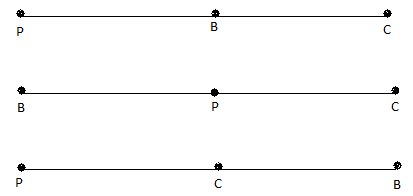
Case1: $PB + BC = PC$
Case 2: $BP + PC = BC$
Case 3: $PC + CB = PB$
If the given points satisfied any one of the above cases then they are collinear otherwise it is not a collinear.
Formula used: Distance between the two points formula, that is $\sqrt {({x_2} - {x_1})_{}^2 + ({y_2} - {y_1})_{}^2} $
Complete step-by-step answer:
It is given that the points are, $P = ( - 2,3)$,$B = (1,2)$and $C = \left( {4,1} \right)$
Here we find out the case 1: $PB + BC = PC$

We have to find out the length of $PB$ by applying the distance formula that is $\sqrt {({x_2} - {x_1})_{}^2 + ({y_2} - {y_1})_{}^2} $
Here, \[\left( {{x_1},{y_1}} \right) = \left( { - 2,3} \right)\]
\[\left( {{x_2},{y_2}} \right) = \left( {1,2} \right)\]
Therefore $PB = \sqrt {(1 + 2)_{}^2 + (2 - 3)_{}^2} = \sqrt {9 + 1} = \sqrt {10} $
Now we have to find out the value of $BC$
Here, \[\left( {{x_1},{y_1}} \right) = \left( {1,2} \right)\]
\[\left( {{x_2},{y_2}} \right) = \left( {4,1} \right)\]
Therefore, the given point are taken by using the distance formula for we get,
$BC$$ = \sqrt {(4 - 1)_{}^2 + (1 - 2)_{}^2} = \sqrt {9 + 1} = \sqrt {10} $
Now we have to find out the value of $PC$
Here, \[\left( {{x_1},{y_1}} \right) = \left( { - 2,3} \right)\]
\[\left( {{x_2},{y_2}} \right) = \left( {4,1} \right)\]
Therefore, the given points are taken by using the distance formula we get, $PC = \sqrt {\{ 4 - ( - 2)\} _{}^2 + (1 - 3)_{}^2} = \sqrt {36 + 4} = \sqrt {40} = 2\sqrt {10} $
Now we have to check the condition when we apply $PB + BC = PC$ we get
$\sqrt {10} + \sqrt {10} = 2\sqrt {10} $
Hence it satisfies the case 1 condition.
Therefore, the given points are collinear.
Note: Two or more points can be regarded as collinear when the points lie on the same line.
If they are present on different lines they are known as non-collinear points. For being collinear they need to satisfy any of the above conditions.
Beside the above method which is by applying distance formula we can also solve the question by applying other methods like by applying area of triangle formula of vertices and if the area of the triangle becomes zero then the points are collinear.
We can also solve the problem by applying the concept of equation of line.
Case1: $PB + BC = PC$
Case 2: $BP + PC = BC$
Case 3: $PC + CB = PB$
If the given points satisfied any one of the above cases then they are collinear otherwise it is not a collinear.
Formula used: Distance between the two points formula, that is $\sqrt {({x_2} - {x_1})_{}^2 + ({y_2} - {y_1})_{}^2} $
Complete step-by-step answer:
It is given that the points are, $P = ( - 2,3)$,$B = (1,2)$and $C = \left( {4,1} \right)$
Here we find out the case 1: $PB + BC = PC$
We have to find out the length of $PB$ by applying the distance formula that is $\sqrt {({x_2} - {x_1})_{}^2 + ({y_2} - {y_1})_{}^2} $
Here, \[\left( {{x_1},{y_1}} \right) = \left( { - 2,3} \right)\]
\[\left( {{x_2},{y_2}} \right) = \left( {1,2} \right)\]
Therefore $PB = \sqrt {(1 + 2)_{}^2 + (2 - 3)_{}^2} = \sqrt {9 + 1} = \sqrt {10} $
Now we have to find out the value of $BC$
Here, \[\left( {{x_1},{y_1}} \right) = \left( {1,2} \right)\]
\[\left( {{x_2},{y_2}} \right) = \left( {4,1} \right)\]
Therefore, the given point are taken by using the distance formula for we get,
$BC$$ = \sqrt {(4 - 1)_{}^2 + (1 - 2)_{}^2} = \sqrt {9 + 1} = \sqrt {10} $
Now we have to find out the value of $PC$
Here, \[\left( {{x_1},{y_1}} \right) = \left( { - 2,3} \right)\]
\[\left( {{x_2},{y_2}} \right) = \left( {4,1} \right)\]
Therefore, the given points are taken by using the distance formula we get, $PC = \sqrt {\{ 4 - ( - 2)\} _{}^2 + (1 - 3)_{}^2} = \sqrt {36 + 4} = \sqrt {40} = 2\sqrt {10} $
Now we have to check the condition when we apply $PB + BC = PC$ we get
$\sqrt {10} + \sqrt {10} = 2\sqrt {10} $
Hence it satisfies the case 1 condition.
Therefore, the given points are collinear.
Note: Two or more points can be regarded as collinear when the points lie on the same line.
If they are present on different lines they are known as non-collinear points. For being collinear they need to satisfy any of the above conditions.
Beside the above method which is by applying distance formula we can also solve the question by applying other methods like by applying area of triangle formula of vertices and if the area of the triangle becomes zero then the points are collinear.
We can also solve the problem by applying the concept of equation of line.
Recently Updated Pages
Master Class 10 Social Science: Engaging Questions & Answers for Success

Master Class 10 Science: Engaging Questions & Answers for Success
Master Class 10 Maths: Engaging Questions & Answers for Success
Master Class 10 General Knowledge: Engaging Questions & Answers for Success
Master Class 10 Computer Science: Engaging Questions & Answers for Success
Class 10 Question and Answer - Your Ultimate Solutions Guide
Trending doubts
What is the full form of PNG A Petrol Natural Gas B class 10 chemistry CBSE
Explain the Treaty of Vienna of 1815 class 10 social science CBSE
In cricket, how many legal balls are there in a standard over?
Why is there a time difference of about 5 hours between class 10 social science CBSE
Who Won 36 Oscar Awards? Record Holder Revealed
What is the median of the first 10 natural numbers class 10 maths CBSE