




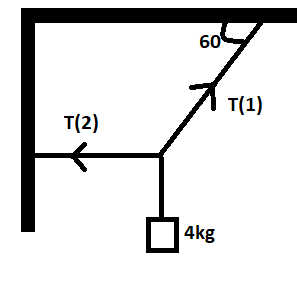
Determine the tensions $ {T_2} $ and $ {T_1} $ in the strings as shown in figure.
(A) $ 22.6N,45.31N $
(B) $ 39.2N,78.4N $
(C) $ 39.2N,67.8N $
(D) $ 39.2N,45.31N $
Answer
 Verified
610.2k+ views
Hint
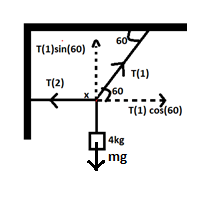
We resolve the tension force in string one into horizontal and vertical components. Since the system is at equilibrium or rest, the force acting upwards is equal to the force acting downwards. Also, the force acting towards the left is equal to the force acting towards the right. The force acting downwards is nothing but the weight of the body, this force is equal to the vertical component of the tension force in string one. We find tension force in string one from this. The tension force acting on string two is equal to the horizontal component of the tension force in string one. The free-body diagram in the complete solution can be referred to for a better understanding.
Complete step by step answer
We resolve the tension force into its horizontal and vertical component as follows,
From alternate exterior angles, we know the angle between the force and the horizontal component of the force.
Since the body is in equilibrium
Equating forces in the y-direction
$\Rightarrow [{T_1}sin60^\circ = 4 \times 9.8\] $
Equating forces in the x-direction
$\Rightarrow [{T_1}cos60^\circ = {T_2}\] $
Tension force on string one is
$\Rightarrow {T_1} = \dfrac{{4 \times 9.8}}{{\sin 60^\circ }} = \dfrac{{4 \times 9.8 \times 2}}{{\sqrt 3 }} $
$\Rightarrow {T_1} = 45.26N $
Tension on string two is
$\Rightarrow {T_2} = {T_1}cos60^\circ $
$\Rightarrow {T_2} = 45.26 \times \dfrac{1}{2} $
$\Rightarrow {T_2} = 22.63N $
Tension forces on string one and string two are $ 45.26N,22.63N $ respectively.
Hence option (A) $ 22.6N,45.31N $ is the correct answer.
Note
We can also solve this problem using Lami's theorem. Lami's theorem states that when three forces acting at a point are in equilibrium, then each force is proportional to the sine of the angle between the other two forces. Referring to the above diagram, consider three forces A, B, C acting on a particle or rigid body making angles α, β, and γ with each other. The mathematical statement of Lami’s theorem is $ \dfrac{A}{{\sin \propto }} = \dfrac{B}{{\sin \beta }} = \dfrac{C}{{\sin \gamma }} $ .
We resolve the tension force in string one into horizontal and vertical components. Since the system is at equilibrium or rest, the force acting upwards is equal to the force acting downwards. Also, the force acting towards the left is equal to the force acting towards the right. The force acting downwards is nothing but the weight of the body, this force is equal to the vertical component of the tension force in string one. We find tension force in string one from this. The tension force acting on string two is equal to the horizontal component of the tension force in string one. The free-body diagram in the complete solution can be referred to for a better understanding.
Complete step by step answer
We resolve the tension force into its horizontal and vertical component as follows,
From alternate exterior angles, we know the angle between the force and the horizontal component of the force.
Since the body is in equilibrium
Equating forces in the y-direction
$\Rightarrow [{T_1}sin60^\circ = 4 \times 9.8\] $
Equating forces in the x-direction
$\Rightarrow [{T_1}cos60^\circ = {T_2}\] $
Tension force on string one is
$\Rightarrow {T_1} = \dfrac{{4 \times 9.8}}{{\sin 60^\circ }} = \dfrac{{4 \times 9.8 \times 2}}{{\sqrt 3 }} $
$\Rightarrow {T_1} = 45.26N $
Tension on string two is
$\Rightarrow {T_2} = {T_1}cos60^\circ $
$\Rightarrow {T_2} = 45.26 \times \dfrac{1}{2} $
$\Rightarrow {T_2} = 22.63N $
Tension forces on string one and string two are $ 45.26N,22.63N $ respectively.
Hence option (A) $ 22.6N,45.31N $ is the correct answer.
Note
We can also solve this problem using Lami's theorem. Lami's theorem states that when three forces acting at a point are in equilibrium, then each force is proportional to the sine of the angle between the other two forces. Referring to the above diagram, consider three forces A, B, C acting on a particle or rigid body making angles α, β, and γ with each other. The mathematical statement of Lami’s theorem is $ \dfrac{A}{{\sin \propto }} = \dfrac{B}{{\sin \beta }} = \dfrac{C}{{\sin \gamma }} $ .
Recently Updated Pages
Master Class 12 Economics: Engaging Questions & Answers for Success

Master Class 12 English: Engaging Questions & Answers for Success
Master Class 12 Social Science: Engaging Questions & Answers for Success
Master Class 12 Maths: Engaging Questions & Answers for Success
Master Class 12 Physics: Engaging Questions & Answers for Success
Master Class 9 General Knowledge: Engaging Questions & Answers for Success
Trending doubts
One Metric ton is equal to kg A 10000 B 1000 C 100 class 11 physics CBSE
Difference Between Prokaryotic Cells and Eukaryotic Cells
Two of the body parts which do not appear in MRI are class 11 biology CBSE
1 ton equals to A 100 kg B 1000 kg C 10 kg D 10000 class 11 physics CBSE
Draw a diagram of nephron and explain its structur class 11 biology CBSE
10 examples of friction in our daily life